There is the court of law, an arm of the judicial branch of government that hears cases and administers justice based on statutes of common law, and then there is the court-of-public-opinion usually driven—right or wrong—by emotion without the kind of evidence that might lead to a conviction in a court with a judge and a possible jury.
After I received the paperback copy that the author’s editor mailed to me for my honest review, I lost sleep for the first few nights that I was reading the book because of a sense of helplessness that there was little I could do so stop the horrible crimes being perpetrated on millions of teachers and more than 50 million children in the United States.
About a third of the way through the book, I asked myself what happens if the judicial branch of government doesn’t do its job when there is a tsunami of evidence so powerful that it reveals, without a doubt (at last for me), who the perpetrators are behind a conspiracy so huge and malignant that it might well turn out to be the crime of the 21st century causing the end of a people’s republic and their democracy.
That conspiracy and crime is what Schneider’s book reveals step-by-methodical-step unraveling a Gordian knot of evidence that even if it were only 25-percent true should be enough to send a small host of alleged criminals to maximum security prisons to serve long sentences after being stripped of their wealth and power—there should be no white-collar prisons for these frauds, manipulators and liars.
For instance, the fraud committed by Bernie Madoff is tiny compared to this crime, and Madoff ended up with 150 years to serve in prison and forfeiture of $17.179 billion. The crime that Schneider reveals in her book is going to add up to a lot more than Madoff’s Securities fraud. In fact, if not stopped, the crime against our public schools will end up stealing trillions of dollars and wrecking tens-of-millions of lives.
If you decide to pay the high price for the Kindle, hardcover or paperback—common for books published by academic presses—be ready for the evidence trail that you will discover. Schneider’s book is not a fast-paced mystery of what’s going on in the corporate education reform war taking place in the United States.
Instead, Schneider’s book reads like a trail of evidence collected meticulously by a team of FBI agents with a goal to make a strong case for a state or federal attorney to file in court and punish the alleged ring leaders. The paperback has a five-page Glossary of the Key Individuals, Organizations, and Terms in addition to 29 pages of Notes broken down by chapter that supports the evidence revealed, followed by a 13 page Index.
I think that any attempt on my part to present in a review the complicated web of evidence this book logically presents would not do justice for the book. I urge anyone who thinks justice should be served to read this book and then write a review and/or protest to your local elected state and federal representative by letter, on-line and/or in person.
I don’t remember ever reading the word “conspiracy’ in this book, but the more documented evidence that I learned, the louder that word shouted in my mind until it became a roar of outrage against the corporate reformers!
_______________________
Lloyd Lofthouse is a former U.S. Marine and Vietnam Veteran,
who taught in the public schools for thirty years (1975 – 2005).
Lofthouse’s first novel was the award winning historical fiction My Splendid Concubine [3rd edition]. His second novel was the award winning thriller Running with the Enemy. His short story A Night at the “Well of Purity” was named a finalist of the 2007 Chicago Literary Awards. His wife is Anchee Min, the international, best-selling, award winning author of Red Azalea, a New York Times Notable Book of the Year (1992).
To follow this Blog via E-mail see upper right-hand column and click on “Sign me up!”
“The suicide rate among 10-to 14-year-olds doubled between 2007 and 2014 – the same period in which states have increasingly adopted Common Core standards and new, more rigorous high stakes tests.”
Laela Gray, an eight-year-old Florida girl, became a poster child for high-stakes testing trauma after she was told she could not advance to fourth grade because she scored 181 instead of 182 on the third grade state reading test
Many teachers say pressure to prepare students for more rigorous Common Core tests means the youngest children are now required to do work that is wildly age-inappropriate.:
Common Core tests are meant to be harder to pass. In New York State, scores from the first administration of Common Core-based exams dropped dramatically from the previous year’s test results. Drops were particularly enormous in districts serving large numbers of English language learners and students with special needs.
Even kindergarten is no longer a refuge from the test preparation craze. New York kindergartners are bubbling in standardized exams based on Common Core math standards so there is test data to use for their teachers’ evaluations. Their teachers report that many of these young children don’t even know how to hold pencils yet and don’t understand how to fill in bubbles on test answer sheets.
And from rethinking schools.org we discover, “Under threat of losing federal funds, all 50 states adopted or revised their standards and began testing every student, every year in every grade from 3 – 8 and again in high school.”
Then there is this from The Washington Post: For the last year a revolt against high-stakes standardized testing has been growing around the country, with teachers, principals, superintendents, parents and students speaking out about the negative impact on education of this obsession.
Now, let’s look closer at child suicide rates:
The American Foundation for Suicide Prevention says, Younger groups have had consistently lower suicide rates than middle-aged and older adults. In 2013, adolescents and young adults aged 15 to 24 had a suicide rate of 10.9 per every 100,000 in that age bracket.
But if you click on the previous link and scroll down to Suicide Rates by Age from 2000 to 2013, you will discover that the suicide rate of children aged 15 to 24 were not always 10.9. In fact, in 2000, the suicide rate for ages 15 to 24 was 10.2 and for the next three years, the suicide rate declined to 9.9; then 9.8 for 2002, and a low of 9.5 for 2003 before it leaped to 10.3 for 2004 and started to climb right along with the corporate education reform agenda and the high stakes tests linked to the No Child Left Behind (2001) and then the Common Core Standards (2010).
After the Common Core appeared in 2010 followed by its high stakes tests, the childhood suicide rate climbed to 10.5 and then to 10.9 where it held steady for three years in a row: 2011, 2012, and 2013.
The suicide rates for children that were less than age 14 has also climbed since 2000 when the rate was 0.5—a rate that held steady or dropped until 2013 when the rate shot up to 0.7 per 100,000 children for the first time.
In this post, I want to demonstrate the dramatic increase in child suicide rates to discover how many children are committing suicide due to the alleged stress caused by No Child Left Behind (NCLB – 2001) and Race To The Top (RTTP -2009) in addition to the Common Core State Standards (CCSS – 2010) and the PARCC tests that followed.
In 2000, the U.S. Census reported there were about 41 million children ages 5 to 14, and 39.1 million children ages 15 to 24. In 2000, 205 children ages 5 to 14, and 3,988 young adults ages 14 to 24 committed suicide.
Thirteen years later, in 2013, the U.S. Census reported that there were 40.9 million children ages 5 to 14 and 43.5 million young adults ages 15 to 24. In 2013, 286 children ages 5 to 14—a dramatic increase of 39.5 percent since 2000—and 4,741.5 young adults ages 15 to 24—another dramatic increase of 18.9 percent since 2000—committed suicide.
If we look at the numbers starting with 2011 when the child suicide rate hit 0.7 and/or 10.9 per 100,000, an additional 243 children ages 5 – 14 and 2,260.5 young adults ages 15 to 24 committed suicide possibly because of the added stress caused by NCLB, CCSS and PARCC.
What else can possible explain the DRAMATIC increase in child suicide rates? Could it be the divorce rate that leads to broken families? Let’s find out. In 1980, the annual divorce rate was 5.2 per 1,000, but in 2000 it was 4.2, and by 2009, the annual divorce rate was down to 3.5. With these dramatic drops in the divorce rate, how can we blame the increase in childhood suicides on divorce, and in 2012, the CDC reported that the divorce rate was down to 3.4 per 1,000 total population? Infoplease.com and CDC.gov
Darn, if we can’t blame it on the divorce rate, what do we blame it on—the increased CO2 levels in the atmosphere?
The answer is simple: Children, starting in kindergarten—where these high stakes testing are also appearing in some states—to 12th grade, spend most of their time second to the time spent at home where they sleep about a third of the day in addition to spending several hours of their free time daily outside of school having fun texting their friends, social networking, playing video games and watching TV—while they are stressing about those tests that might cause their favorite teachers to be fired and their local public schools closed.
Let’s look closely at what was happening to the public schools starting in the 1980s to 2013 to learn how this happened.
First—there was the fraud behind A Nation at Risk, a report released in 1983 during the Reagan years in the White House (Have you ever read The Enduring Lies of Ronald Reagan?). This was the beginning of the alleged claims that the public schools were failing our children and the nation was at risk. But in 1990, the often ignored Sandia Report offered proof that A Nation at Risk was misleading and that the public schools were actually improving.
Second—on May 19, 1999, President Bill Clinton said the government has to do a “far, far better job” with the $15 billion it sends to schools every year, and Clinton announced he was sending Congress his blueprint for how to spend those funds. “We know fundamentally that if we are going to change the way our schools work, we must change the way we invest federal aid in our schools,” Clinton said, and the pressure on children, teachers and the public schools increased even though NAEP Reading and Math tests that first started in 1969 revealed steady annual improvements in the test scores. Diane Ravitch says, “The point here is that NAEP scores show steady and very impressive improvement over the past twenty years.” – For the details, read Reign of Error: The Hoax of the Privatization Movement and the Danger to America’s Public Schoolsby Diane Ravitch
Third—the No Child Left Behind Act of 2001 (NCLB) mandated the impossible: All children must be college and career ready on time by high school graduation even though no country on the earth had ever achieved this goal and has never tried. In fact, the United States is one of the top-five countries in the world for the ratio of college graduates, and there are almost three qualified applicants who are college graduates for every job that requires a college degree. Why do 100% of 17/18 year olds have to be ready for college?
Fourth—President Obama’s Race to the Top made the demands on the public schools worse.
Fifth—adopting standards and assessments that prepare students to succeed in college and the workplace and to compete in the global economy;
Sixth—building data systems that measure student growth and success, and inform teachers and principals about how they can improve instruction;
The Alliance for Childhood revealed that parents, teachers, school nurses, psychologists, and child psychiatrists reported that the stress of high-stakes testing was literally making children sick. – EdWeek.org
TeacherBiz.com says, High-stakes tests: bad for students, teachers, and education in general.
The Alliance for Childhood reports that “There is growing evidence that the pressure and anxiety associated with high-stakes testing is unhealthy for children–especially young children–and may undermine the development of positive social relationships and attitudes towards school and learning. … Parents, teachers, school nurses and psychologists, and child psychiatrists report that the stress of high-stakes testing is literally making children sick.”
Who do we hold responsible for the deaths of thousands of children pressured to take their own lives? If you want to discover who these monsters are, I suggest you read Common Core Dilemma and A Chronicle of Echoes by Mercedes K. Schneider.
PBS says, “Even without the impetus of the No Child Left Behind Act, testing is a burgeoning industry. The National Board on Educational Testing and Public Policy at Boston College compiled data from The Bowker Annual, a compendium of the dollar-volume in test sales each year, and reported that while test sales in 1955 were $7 million (adjusted to 1998 dollars), that figure was $263 million in 1997, an increase of more than 3,000 percent. Today, press reports put the value of the testing market anywhere from $400 million to $700 million.”
Are high stakes tests that rank and punish public school teachers and close public schools really about improving education or are they about increasing profits for big corporations in this age of legalized avarice and greed?
“It’s probably safe to say that statewide assessment will not produce any startling revelations about what can be done by teachers with pupils to help children learn more effectively.” – Beers and Campbell (1973)
What was true in 1973 is still true today!
To learn more about the problems of using student test scores to evaluate teachers, click on this link that will take you to an Economic Policy Institute report on this issue.
“Because education is both a cumulative and a complex process, it is impossible fully to distinguish the influences of students’ other teachers as well as school conditions on their apparent learning, let alone their out-of-school learning experiences at home, with peers, at museums and libraries, in summer programs, on-line, and in the community.
“No single teacher accounts for all of a student’s achievement.”
_______________________
Lloyd Lofthouse is a former U.S. Marine and Vietnam Veteran,
who taught in the public schools for thirty years (1975 – 2005).
Lofthouse’s first novel was the award winning historical fiction My Splendid Concubine [3rd edition]. His second novel was the award winning thriller Running with the Enemy. His short story A Night at the “Well of Purity” was named a finalist of the 2007 Chicago Literary Awards. His wife is Anchee Min, the international, best-selling, award winning author of Red Azalea, a New York Times Notable Book of the Year (1992).
On Friday they told us that we were going to be having Common Core tests next week (SBAC or Smarter balanced tests in CA) .
“Make sure to check your room number by the counseling office.”
“Review the practice exam.”
“Get enough sleep.”
But, for what?
What even is this test?
Why is it so important?
Where is all this information going?
Why was I not told by any member of the staff that I could opt out?
There was a letter posted outside the office. It said that anyone could opt out of these tests with parent permission. It said that we as students have a voice. We have rights. That got me curious. I started asking questions. I asked members of my neighborhood their opinions. I asked family, friends, teachers, and searched the internet about these tests. I wanted to share what I learned. I wanted to have a voice, not just be a number from a test.
I heard stories of kids not wanting to go to school because they were so deflated, so stressed and confused. I read about how much time test prep takes. I talked with my friend Suzy who is a 7th grade English and history teacher about how useless some of this data mining seems. “ We have to do 3 [in class essays] every year. I have to grade all of these, put them in the gradebook, give feedback, then input them into a district website to collect data. One extra step for teachers is awful. Why do we do this? What is done with this data? The district has no answer. I calculated that every year, in addition to all other curriculum requirements, we have to score 450 essays per teacher.”
Schools are having precious learning time taken away to administer standardized tests. The Huffington Post states: “Teachers now devote 30 percent of their work time on testing-related tasks, including preparing students, proctoring, and reviewing the results of standardized tests, the National Education Association says.” Not only is time drained, but money is being used to buy computers to administer these tests.
In Suzy’s case, she has to prep students for this one test but won’t necessarily know where the data is going or how it will be used. Last year we took practice tests and some questions were so hard I clicked random answers. I even wrote a poem about how I felt like a robot. I never got my score back. I wonder what would have happened if I wrote “ WHAT IS THE POINT” for an essay question.
Since I don’t see my results, or the specific questions I got wrong, I don’t understand what I could do better or worse on. In addition, we haven’t been provided specific test information, or easy access to reasons why we are taking this test. For example my math teacher told me that our test will be a practice for a later SBAC test. We aren’t even taking the real thing. She told me that the teachers will grade them and it will be good finals prep. I would be taking a practice exam for the test I would take that is actually a test prep for finals? That is a lot of prep.
It’s relatively easy to administer a test then judge students based on their scores. I think part of the problem is that when people fail these tests, their self esteem drops, they think they aren’t good enough, and then they cry when they get home from school. On many occasions I have come from school frustrated and broken out into tears, and I am an honor student in a really privileged area. Imagine what it’s like for our neighbors who don’t have free tutoring and get Ds and think it is all their fault. A test score is such a small part of a person’s intelligence. When these test are being taken, the institutions are saying that the test is what measures how smart a person is, or how good a school is. That is a whole lot of unnecessary pressure.
In addition if these tests are being given to school with low performance ratings and the tests are really difficult, some of these schools may not have the resources to provide test prep or extra help to their students and because they are underfunded, the students, teachers, and schools suffer the consequences.
To an extent, I agree that tests are necessary. People are certified to become nurses and plumbers and teachers by taking a test. But to test on how well a school or student is doing with one test is ridiculous. If you wanted the whole picture then someone could collect my GPA which has my average test scores. You could look at my extra curricular activities, and then asses the school based on multiple variables. But that would probably take too long.
I agree that the new common core method of teaching is pretty rad. I like having explorations in math. It makes me question and have opinions. I like that. I do not like the immense data collection and loads of testing. There is a limit to all of this stress, confusion, and frustration, and that is what we as a community have to figure out and act upon so that education can be fun, and full of wonder like it should be.
Lloyd Lofthouse, the host of this blog, is a former U.S. Marine and Vietnam Veteran,
who taught in the public schools for thirty years (1975 – 2005).
Lofthouse’s first novel was the award winning historical fiction My Splendid Concubine [3rd edition]. His second novel was the award winning thriller Running with the Enemy. His short story A Night at the “Well of Purity” was named a finalist of the 2007 Chicago Literary Awards. His wife is Anchee Min, the international, best-selling, award winning author of Red Azalea, a New York Times Notable Book of the Year (1992).
To follow this Blog via E-mail see upper right-hand column and click on “Sign me up!”
American students face a ridiculous amount of testing. In the video, John Oliver explains how standardized tests impact school funding, the achievement gap, and how often kids are expected to vomit from the stress caused by these high stakes tests that can destroy a child’s life, get teachers fired and public schools closed.
Ask yourself this, who profits?
In addition, Assessment Around the World (to read the complete article, click the link. The rest of this post is a summary of a piece published by Educational Leadership) reveals how NCLB and its high stakes testing fit in an international context. Here’s what’s happening in the rest of the world.
“Standardized testing is controversial everywhere, regardless of its purpose. Most countries use testing for tracking and for selecting students for admission into academic secondary schools or universities, but generally not for holding educators accountable. Many countries don’t even administer standardized tests until the later grades. In fact, most Canadian universities don’t require the Scholastic Aptitude Test (SAT) or other standardized admissions tests—except for students applying with a U.S. high school diploma!” (Ghosh, 2004)
Testing Practices in Other Countries (from Educational Leadership)
The following examples from England, Turkey, Germany, Singapore, Japan, China, and Finland illustrate how these countries manage these issues.
England
Like the United States, England holds educators accountable for students’ scores on standardized tests, although major differences exist between the two countries’ accountability systems.
Only England—home to the mighty testing giant, Pearson (a profit based, private-sector corporation) that started investing heavily in the U.S. market the year before NCLB mandated the impossible—holds teachers accountable for students’ scores on standardized tests. The test-based accountability policy remains highly controversial and raises issues similar to those currently discussed in the United States. A major question is the validity of using test scores, which are strongly influenced by students’ socioeconomic status, to evaluate the quality of education. This problem is endemic in national and international test score comparisons.
In fact, “Because in every country, students at the bottom of the social class distribution perform worse than students higher in that distribution, U.S. average performance appears to be relatively low partly because we have so many more test takers from the bottom of the social class distribution.” – Economic Policy Institute (Conclusion: Teachers in the US and UK—thanks to lobbyists from Pearson influencing elected representatives—are being punished for children who live in poverty. The more high stakes tests, the more profits Pearson robs from taxpayers who support the public schools in these two English speaking countries.)
Turkey
Turkey’s heavily bureaucratic and centralized education system is modeled after the French system.
Examinations in Turkey are first administered at the end of basic education, although they influence what schools teach long before that. These exams determine admission into the prestigious Anatolian and science high schools, which accept approximately one-quarter of the students who take the exam. Students who wish to enter a university must take another nationwide exam at the end of high school; but because demand outweighs available spaces, acceptance rates are low (around 20 percent). Because of these conditions, Turkish students experience “some of the world’s worst exam anxiety” (Simsek & Yildirim, 2004, p. 165).
Germany
Germany has a highly stratified education system that tracks students, generally beginning in grade 5, into three types of schools: … Teachers and parents—not an examination—determine a child’s placement.
Singapore
In Singapore, educators are only held accountable for their students’ test scores in the sense that secondary schools and junior colleges are ranked in publicly reported “league tables”; the 40 highest-ranked secondary schools receive cash awards. But this “accountability” system bears little resemblance to NCLB in the United States.
The main purpose of testing in Singapore is to determine student placement in the education system and access to elite academic programs—not to evaluate teachers.
Japan
Japan has a highly competitive examination system, but it doesn’t hold educators accountable for students’ scores on standardized tests.
China
For many centuries, the Chinese have viewed their country’s examination system, which dates back to the Shui dynasty in 603 CE, as the main route out of poverty for a child from a low income family. However, like Singapore and Japan, China is attempting to reduce its reliance on rote learning. Realizing that examinations inevitably drive classroom practice, China has revised its highly competitive university entrance exams by requiring students to integrate knowledge from a wide range of fields.
Chinese students face a highly competitive and stressful examination system that doesn’t hold teachers accountable for student test scores.
Finland
In high-ranking Finland, the national ministry of education plays no role in teacher evaluation. Instead, broad policies are defined in the contract with the teachers’ union. Teachers are then typically appraised against the national core curriculum and the school development plan. Finland, of course, is known for having no standardized testing, obviously then making it impossible for it to be used as a tool for teacher evaluation. – NEA Today.org
Note: None of the nations surveyed by OECD use standardized tests to measure teacher effectiveness as bluntly as the United States does. Wariness over the misuse of test scores runs throughout the school systems in most nations – an acknowledgment that they cannot provide a complete picture of teaching quality and that multiple sources of evidence are required (many countries include parent and student surveys as well as classroom observations, and peer and principal assessment).
_______________________
Lloyd Lofthouse is a former U.S. Marine and Vietnam Veteran,
who taught in the public schools for thirty years (1975 – 2005).
Lofthouse’s first novel was the award winning historical fiction My Splendid Concubine [3rd edition]. His second novel was the award winning thriller Running with the Enemy. His short story A Night at the “Well of Purity” was named a finalist of the 2007 Chicago Literary Awards. His wife is Anchee Min, the international, best-selling, award winning author of Red Azalea, a New York Times Notable Book of the Year (1992).
To follow this Blog via E-mail see upper right-hand column and click on “Sign me up!”
Do not let Corporate Education Reformers like Michelle Rhee, David Coleman, Bill Gates, the Walton family and Arne Duncan eat our children for a profit. The resistance to save the transparent, nonprofit, democratic public schools in the United States survives, thrives and grows daily. And regardless of what you might hear in the media, the teachers’ unions did not start this movement or fund it.
1: The movement started in earnest with Diane Ravitch (find her blog here). She was appointed to public office by Presidents George H. W. Bush and Bill Clinton. She served as Assistant Secretary of Education under Secretary of Education Lamar Alexander from 1991 to 1993 and his successor Richard Riley appointed her to serve as a member of the National Assessment Governing Board, which supervises the National Assessment of Educational Progress; she was a member of NAGB from 1997 to 2004. From 1995 to 2005 she held the Brown Chair in Education Studies at the Brookings Institute.
2: The National Center for Fair & Open Testing (FairTest) works to end the misuses and flaws of standardized testing and to ensure that evaluation of students, teachers and schools is fair, open, valid and educationally beneficial.
3: United Opt Out: The Movement to End Corporate Education Reform—The central mission of United Opt Out is to eliminate the threat of high-stakes testing in public K-12 education. We believe that high-stakes testing is destructive to children, educators, communities, the quality of instruction in classrooms, equity in schooling, and the fundamental democratic principles on which this country is based.
4. Badass Teachers Association: We are a community of teachers, professors, and educators running from Kindergarten all the way to University. We are also parents, your neighbors, and your friends. We are members of your community, and we care deeply about that community. We have come together to push back against so-called corporate education reform, or the Educational-Industrial Complex and the damage it has done to students, schools, teachers, and communities.
5: The first national conference of the Network for Public Education (NPE) was held at The University of Texas at Austin on March 1 and 2 in 2014, and about 400 people attended. About 600 people attended the second annual conference of the NPE held in Chicago on April 25 and 26, 2015.
6: Momma Bears: Someone jokingly called one of us a “Momma Bear” for having the courage to stand up against politicians to defend our children’s public schools. We realized that’s what we were! Since then, we’ve met many other people who didn’t realize they were Momma Bears, but they are.
Momma Bears defend and support children and public schools. Momma Bears realize that quality public education is a right for every child. There are greedy corporations and politicians eager to destroy and profit from our American public school system and vulnerable children. Momma Bears are united in defending and protecting our young and their future from these threats.
7. USAS:Public education is under attack.Corporate-backed behemoths like the Walton (Walmart) and Fisher (Gap Inc) foundations are pouring millions into manufacturing a new pro-corporate education reform consensus on our campuses, propping up groups like Teach for America, Students for Education Reform, and countless sponsored academic research programs. Their goal? To privatize our public education system, turning over a major public good into private hands, in the process smashing the only organized force that has dared to stand up to them: teachers’ unions.
United Students Against Sweatshops (USAS) is a grassroots organization run entirely by youth and students. We develop youth leadership and run strategic student-labor solidarity campaigns with the goal of building sustainable power for working people. We define “sweatshop” broadly and consider all struggles against the daily abuses of the global economic system to be a struggle against sweatshops.
8: EduBloggers: The Education Bloggers Network is an informal confederation of more than 200 education reporters, advocacy journalists, investigative bloggers, and commentators. Members of the Education Bloggers Network are dedicated to providing parents, teachers, public education advocates and the public with the truth about public education in the United States and the efforts of the corporate education reform industry.
9: Students Against Testing: Students Against Testing was created to be a strong force against the score-obsessed education machine known as standardized testing. At the same time, SAT also exists as an advocate for bringing positive, creative and real-life learning activities into the schools. SAT believes that for the reasons stated below urgent action from the student body itself is the most direct way to counteract the boredom and petty competition that currently plagues the schools.
10. Parents Across America (PAA): Parents Across America is committed to bringing the voice of public school parents – and common sense – to local, state and national debates.
PAA was founded by a group of parents active in their communities who recognized the need to collaborate for positive change rather than remain isolated in local battles. Since the top-down forces that are imposing their will on our schools have become national in scope, we need to be as well.
_______________________
Lloyd Lofthouse is a former U.S. Marine and Vietnam Veteran,
who taught in the public schools for thirty years (1975 – 2005).
Lofthouse’s first novel was the award winning historical fiction My Splendid Concubine [3rd edition]. His second novel was the award winning thriller Running with the Enemy. His short story A Night at the “Well of Purity” was named a finalist of the 2007 Chicago Literary Awards. His wife is Anchee Min, the international, best-selling, award winning author of Red Azalea, a New York Times Notable Book of the Year (1992).
To follow this Blog via E-mail see upper right-hand column and click on “Sign me up!”
The foundation of the U.S. corporate education reform movement is built on a house of cards that alleges there are too many incompetent teachers in America’s public schools, and that using standardized high stakes test to rank teachers based on student test scores will reveal who those teachers are.
But today the corporate education reformers have unwittingly provided evidence that they are totally wrong with the same data they want to use to root out these alleged incompetent teachers and then also close public schools with the worst scores.
Stanford.edu reports, “There is an achievement gap between more and less disadvantaged students in every country; surprisingly, that gap is smaller in the United States than in similar post-industrial countries, and not much larger than in the very highest scoring countries.”
If the alleged claims of the corporate education reformers were correct, that means—according to the results of the international PISA tests—teachers who work with disadvantaged students in every country are also incompetent and should lose their jobs.
But … here’s the twist: “Achievement of U.S. disadvantaged students has been rising rapidly over time, while achievement of disadvantaged students in countries to which the United States is frequently unfavorably compared – Canada, Finland and Korea, for example – has been falling rapidly.” – Stanford.edu
This tells us that the alleged incompetent teachers in the U.S.—who work with the most disadvantaged students—are the most competent (incompetent teachers) in the world.
How can America’s public school teachers be incompetent when the disadvantaged students they work with are outperforming the disadvantaged students in every country PISA tests—even Canada, Finland and Korea? An oxymoron if I’ve ever heard one.
The corporate education reformers have hung themselves with the same noose they intended to put around the necks of public school teachers in the United States.
_______________________
Lloyd Lofthouse is a former U.S. Marine and Vietnam Veteran,
who taught in the public schools for thirty years (1975 – 2005).
Lofthouse’s first novel was the award winning historical fiction My Splendid Concubine [3rd edition]. His second novel was the award winning thriller Running with the Enemy. His short story A Night at the “Well of Purity” was named a finalist of the 2007 Chicago Literary Awards. His wife is Anchee Min, the international, best-selling, award winning author of Red Azalea, a New York Times Notable Book of the Year (1992).
To follow this Blog via E-mail see upper right-hand column and click on “Sign me up!”
To discover the answer, I turned to the top eight ranked countries on the 2012 International PISA Test. To come up with the top eight, I dropped China from the list because Shanghai, Hong Kong and Macao do not represent all of China’s 15 or 16 year old children. I’ve also dropped Liechtenstein and Estonia, because it’s ridiculous to compare the United States—with more than 316 million people and almost 50 million children in its public schools—to Liechtenstein with a total population that’s less than 37 thousand and Estonia with about 1.3 million.
To repeat, the United States has almost 50 million children attending K–12, 4 million teachers, and 1 in 4 children live in poverty—the United States is much more diverse and has challenges the top ranked countries don’t have to deal with. Liechtenstein, for instance, has one of the highest standards of living in the world with one of Europe’s most affluent communities. Estonia has 589 schools and compulsory education only goes to 9th grade.
Fair Test.org reports “The U.S. is the only economically advanced nation to rely heavily on multiple-choice tests (But Pearson is working hard to change that and add more countries. To learn more, I suggest you read No profit left behind). Other nations use performance-based assessment to evaluate students on the basis of real work such as essays, projects and activities. Ironically, because these nations do not focus on teaching to multiple-choice and short-answer tests, they score higher on international exams.”
Truth Out.org reports, “Among the most prominent members of the testocracy are some of the wealthiest people the world has ever known. Its tsars include billionaires Bill Gates, Eli Broad, and members of the Walton family (the owners of Walmart), who have used their wealth to circumvent democratic processes and impose test-and-punish policies in public education. They fund a myriad of organizations—such as Michelle Rhee’s StudentsFirst, Teach for America, and Stand for Children—that serve as shock troops to enforce the implantation of high-stakes testing and corporate education reform in states and cities across the nation.”
I also think it’s important to compare the racial diversity and total population of the United States with the eight top ranked PISA countries. It is also worth noting that children represent more than one-third of the 46.5 million Americans who live in poverty. In addition, blacks and Hispanics are more likely than whites to be poor and to be in poverty and deep poverty (For instance, only 10% of Whites live in poverty compared to 27% of Blacks and 24% of Hispanic/Latino –The Henry J. Kaiser Family Foundation). The poverty rate (the percentage of all people in the United States who were poor) also remained at high levels: 15.1% for all Americans and 21.8% for children under age 18.
77.7% of Americans are White – 248 million
17.1% Hispanic or Latino – 54.5 million
13.2% or Black – 42 million
5.3% are Asian – 16.8 million
1.2% are American Indian and Alaska Native – 3.8 million
Singapore – 5.4 million and 26% or 1.4 million live below poverty line compared to 46.5 million in the United States or 861% of the total population of Singapore. BBC.com reports, that in Singapore everyone is provided an education, health care and public housing if they can’t afford their own. What they pay for housing is based on what they earn. If one compares the poor in Singapore to those in countries such as India and China, or even the homeless in the US, it is indeed true that the situation here is not as dire. ”Singapore has an extensive social safety net,” said a ministry spokesman. ”Singaporeans enjoy subsidized housing, healthcare and education.”
77% Chinese
14.8% Malays
7% Indians
1.2% Other
Taiwan – 23.34 million and 1.16% or 27 thousand live below the poverty line compared to 46.5 million in the United States or 199.2% of the total population of Taiwan.
84% Taiwanese (including Hakka)
14% mainland Chinese
2% indigenous
South Korea – 50.22 million and 15% or 7.53 million live below the poverty line compared to 46.5 million in the United States or 92% of the population of South Korea.
Koreans except for 20,000 Chinese
Japan – 127.3 million and 16% or 20.3 million live below the poverty line compared to 46.5 million in the United State or 36.5% of the total population of Japan.
95% Japanese
5% foreign citizens
Switzerland – 8 million, but only 1.93 million are permanent residents (23.8% of the total population), and 6.9% (not sure if this is based on permanent or total) live below the poverty line compared to 46.5 million in the United States or 581.25% of the total population of Switzerland.
Netherlands – 16.8 million and 10.5% or 1.764 million live below the poverty line compared to 46.5 million in the United States or 277.78% of the total population of the Netherlands.
78.5% Dutch
5% EU
2.2% Indonesian
2.3% Turkish
2% Surinamese
2% Moroccan
6% other
Finland – 5.4 million. Finland has one of the lowest poverty rates in the world compared to 46.5 million in the United States or 861% the total population of Finland.
89.33% Finish
5.34% Swedish
5.33% 35 Other Ethnic groups
Canada – 35.1 million and 9.4% or 3.3 million live below the poverty line compared to 46.5 million in the United States or 132.5% the total population of Canada.
Lloyd Lofthouse is a former U.S. Marine and Vietnam Veteran,
who taught in the public schools for thirty years (1975 – 2005).
Lofthouse’s first novel was the award winning historical fiction My Splendid Concubine [3rd edition]. His second novel was the award winning thriller Running with the Enemy. His short story A Night at the “Well of Purity” was named a finalist of the 2007 Chicago Literary Awards. His wife is Anchee Min, the international, best-selling, award winning author of Red Azalea, a New York Times Notable Book of the Year (1992).
To follow this Blog via E-mail see upper right-hand column and click on “Sign me up!”
Watch the video and read the Op-Ed in The Washington Post.
Here’s the lead paragraph of The Washington Post piece by Valerie Strauss:
“Imagine that you are a doctor and your evaluation is based on patients you didn’t have. Or a car dealer, and you are assessed by how many cars your colleagues — not you — sell. It sounds preposterous, right? Well, that’s just what is happening to public school teachers.”
How students with top test scores hurt a teacher’s evaluation http://wpo.st/PJGB0
#WashingtonPost
#EDBlogNet
My father was a fan of thoroughbred horse racing. He went as often as possible, and he stayed up late every night handicapping to discover the horses he thought might win. He won more races than he lost, but what would happen in that sport if the VAM being used to rank and then fire teachers or close public schools were used on those horses, and all horses that did not win every race were to be euthanized, their jockeys fired for life, their owners driven into bankruptcy—all because every horse in a horse race didn’t win.
That is what the corporate driven education reform movement is doing to public schools, public school teachers and children—treating them like horses and demanding that they all win every race—or else they must suffer brutal consequences.
In 2001, when President G. W. Bush signed into law the No Child Left Behind Act, that legislation mandated that by 2014 every (100%) 17/18 year old in the nation had to graduate from high school on time and be college and career ready. President Obama made this situation worse with his Race to the Top. But Bill Gates and the Walton family, for instance, upped the anti with there massive financial support for the Common Core State Standards linked to high stakes testing in addition to promoting corporate Charter schools and vouchers/tax credits that legally steal money from the public schools. A bad law is still a bad law.
This is legalized crime!
This is child abuse!
This is teacher abuse!
This is stripping parents of their responsibility as parents!
This is stealing from tax payers!
This is WRONG on so many levels!
Education is not a horse race!
_______________________
Lloyd Lofthouse is a former U.S. Marine and Vietnam Veteran,
who taught in the public schools for thirty years (1975 – 2005).
Lofthouse’s first novel was the award winning historical fiction My Splendid Concubine [3rd edition]. His second novel was the award winning thriller Running with the Enemy. His short story A Night at the “Well of Purity” was named a finalist of the 2007 Chicago Literary Awards. His wife is Anchee Min, the international, best-selling, award winning author of Red Azalea, a New York Times Notable Book of the Year (1992).
To follow this Blog via E-mail see upper right-hand column and click on “Sign me up!”
While the United States and a few other countries have allowed UK’s Pearson—the largest private-sector, for profit education publisher and test generator in the world—greater influence in their countries, Finland is going in the opposite direction.
“Finland making drastic changes to an already successful education system. Why now? And will this model change the way other countries go about educating their children?” The Christian Science Monitor asks.
Despite having an education system that doesn’t rely on standardized test scores, Finnish students perform extremely well on exams that are given to students all over the developed world.
But now Finland is looking to overhaul its education system and will now focus more on “topics” and less on subjects, according to Alexander LaCasse for The Christian Science Monitor.
The Finns are calling this “phenomena” teaching while in the United States, teaching is called “TESTING”.
I ran into trouble embedding this vimeo video in the post so here’s the link or click Watch on Vimeo above: https://vimeo.com/122720631
Alexander LaCasse, who wrote the piece for The Christian Science Monitor said, “Finland’s deviation on educational standards may come as a surprise to some – because Finland trails only Singapore and China in performance on the Program for International Student Assessment (PISA), a standardized test given to 15 year olds in 65 of the world’s most developed countries.”
What the corporate reformers don’t want anyone to know is that poverty is the problem—a challenge totally ignored by the rank and punish Common Core Standardized Testing culture promoted heavily by the Bill and Melinda Gates and Walton Family Foundations (in addition to a few other billionaires)—and not teachers or public schools.
If you watch the video that comes with this post, starting at 30:00, you will discover that when we compare U.S. Schools internationally, U.S. schools with less than 10% student poverty are ranked #1 in the world on the PISA test.
For instance, Finland has less than 4% childhood poverty compared to the U.S. that has at least 24% of its children living in poverty. In fact, high achieving countries that score high on international tests all have less than 10% of their children living in poverty.
Even U.S. schools with 25% childhood poverty rates rank #3 in the world on international tests and even schools that have 50% student poverty levels rank above international averages in reading. In addition, 1 in 5 schools in the United States have 75% of children, or more, living in poverty.
The schools I taught in for 27 years of the 30 I spent in classrooms as a teacher had 70% – 80% childhood poverty rates.
Pearson is expanding its brand into the United Kingdom, Australia, Italy, South Africa, Brazil, India and Saudi Arabia. Pearson earns over $8 billion in annual global sales, with much more to come if countries continue to use standardized tests to rate students, teachers and schools.
Among the likely benefactors of the extra funds were the four companies that dominate the testing market — three test publishers and one scoring firm.
Those four companies are Harcourt Educational Measurement, CTB McGraw-Hill, Riverside Publishing (a Houghton Mifflin company), and NCS Pearson. According to an October 2001 report in the industry newsletter Educational Marketer, Harcourt, CTB McGraw-Hill, and Riverside Publishing write 96 percent of the exams administered at the state level. NCS Pearson, meanwhile, is the leading scorer of standardized tests.
Even without the impetus of the No Child Left Behind Act, testing is a burgeoning industry. The National Board on Educational Testing and Public Policy at Boston College compiled data from The Bowker Annual, a compendium of the dollar-volume in test sales each year, and reported that while test sales in 1955 were $7 million (adjusted to 1998 dollars), that figure was $263 million in 1997, an increase of more than 3,000 percent. Today, press reports put the value of the testing market anywhere from $400 million to $700 million.
The British publishing giant Pearson had made few inroads in the United States — aside from distributing the TV game show “Family Feud” — when it announced plans in the summer of 2000 to spend $2.5 billion on an American testing company.
The controversy over Common Core hasn’t stopped companies from cashing in on the education standards program.
States have already awarded hundreds of millions of dollars in Common Core-related contracts to businesses including Pearson, McGraw-Hill Education CTB, Houghton Mifflin Harcourt and Apple since 2012. And, despite some legal challenges and boycotts, more contracts potentially worth billions of dollars for testing, instructional materials and teacher training are on the way.
The National Center for Fair & Open Testing (FairTest) works to end the misuses and flaws of standardized testing and to ensure that evaluation of students, teachers and schools is fair, open, valid and educationally beneficial.
Lloyd Lofthouse is a former U.S. Marine and Vietnam Veteran,
who taught in the public schools for thirty years (1975 – 2005).
Lofthouse’s first novel was the award winning historical fiction My Splendid Concubine [3rd edition]. His second novel was the award winning thriller Running with the Enemy. His short story A Night at the “Well of Purity” was named a finalist of the 2007 Chicago Literary Awards. His wife is Anchee Min, the international, best-selling, award winning author of Red Azalea, a New York Times Notable Book of the Year (1992).
To follow this Blog via E-mail see upper right-hand column and click on “Sign me up!”
There are several forms of Capitalism in use throughout the world. Economics Help.org defines them and reports that Crony Capitalism is what’s used in the United States. The Age of Crony Capitalism says, “For most of US history, crony capitalism has been in a struggle with free-market capitalism for the heart and soul of the American economy. For the past half century, crony capitalism has been gaining the upper hand.”
In addition, Dr. Gary G. Kohls of Global Resaerch.ca says, “The 12 years of unrestrained crony capitalism during the anti-democracy mis-leadership of Republican presidents Ronald Reagan and George H. W. Bush tricked most of us into naively believing in their fraudulent ‘Trickle-down Economics’.”
Crony Capitalism is a term used to refer to the situation where business success is related to strategic influences with civil servants, politicians and those in authority. It could be used to refer to situations in early twentieth century U.S. where business leaders had to buy off politicians in return for favors (e.g. in popular media: Citizen Kane). Arguably a degree of crony capitalism occurs in countries like China, South Korea and Latin America. The power of the Mafia in Italy is also an example of crony capitalism.
The other forms of capitalism mentioned by Economics Help.org are: Turbo Capitalism (also known as unrestrained capitalism or free market capitalism), Responsible Capitalism, Popular Capitalism, Advanced Capitalism and State Capitalism. Visit the site to learn about the differences. I read them all and I think the two that are highlighted in this paragraph are the best choices for the most people.
In the corporate war against public education—known also as education reform leading to school choice, corporate charter schools and school vouchers—what reports do not support the Crony Capitalist reform movement?
The 1966 Coleman Report—Instead of proving that the quality of schools is the most important factor in a student’s academic success—as its sponsors had expected—the report written by the sociologist James S. Coleman of Johns Hopkins University found that a child’s family background and the school’s socioeconomic makeup are the best predictors. … A better summary of the findings, from Gordon M. Ambach’s perspective, is: Family and socioeconomic backgrounds are so important that it’s difficult for schools to overcome them.
In 1966, the Coleman Report highlighted the impact of poverty on student achievement. In this installment of the Mini-Moments with Big Thinkers series, policy faculty member Jeffrey Henig argues that it’s time to recognize that schools alone cannot ensure that all students succeed equally.
The 1983 report under the Reagan Administration known as A Nation at Risk was characterized by its authors as “an open letter to the American people.” The report called for elected officials, educators, parents, and students to reform a public school system it described as “in urgent need of improvement.” That need for improvement was based on numerous statistics listed in the report that the commission said showed the inadequate quality of American education. The authors ominously cautioned that the data showed the nation was at risk and expressed grave concern that our “once unchallenged pre-eminence in commerce, industry, science, and technological innovation is being overtaken by competitors throughout the world.
The 1990 Sandia Report proves that A Nation at Risk was wrong and reveals what was actually happening:
Between 1975 and 1988, average SAT scores went up or held steady for every student subgroup.
Between 1977 and 1988, math proficiency among seventeen-year-olds improved slightly for whites, notably for minorities.
Between 1971 and 1988, reading skills among all student subgroups held steady or improved.
Between 1977 and 1988, in science, the number of seventeen-year-olds at or above basic competency levels stayed the same or improved slightly.
Between 1970 and 1988, the number of twenty-two-year-old Americans with bachelor degrees increased every year; the United States led all developed nations in 1988.
Then in 2000, Pearson, the British publishing giant, spends $2.5 billion on an American testing company while spending millions aggressively lobbying the states and the U.S. Congress to make testing a vital element of school reform in the United States. –POLITICO Pro: No profit left behind
One year later, The No Child Left Behind Act (NCLB), based on the fraud of A Nation at Risk, and ignoring the results of the Coleman and Sandia Reports, becomes law.
NCLB required states, school districts, and schools to ensure all students (something that no country on the earth has ever achieved to this day) are proficient in grade-level math and reading by 2014. States define grade-level performance. Schools must make “adequate yearly progress” toward this goal, whereby proficiency rates increase in the years leading up to 2014. The rate of increase required is chosen by each state. In order for a school to make adequate yearly progress (AYP), it must meet its targets for student reading and math proficiency each year. A state’s total student proficiency rate and the rate achieved by student subgroups are all considered in the AYP determination.
Schools that fail to make adequate yearly progress for two consecutive years are identified for “school improvement,” and must draft a school improvement plan, devote at least 10 percent of federal funds provided under Title I of NCLB to teacher professional development. Schools that fail to make AYP for a third year are identified for corrective action, and must institute interventions designed to improve school performance from a list specified in the legislation. Schools that fail to make AYP for a fourth year are identified for restructuring, which requires more significant interventions. If schools fail to make AYP for a fifth year, they much implement a restructuring plan that includes reconstituting school staff and/or leadership, changing the school’s governance arrangement, converting the school to a charter, turning it over to a private management company, or some other major change.
School districts in which a high percentage of schools fail to make AYP for multiple years can also be identified for school improvement, corrective action, and restructuring.
The 2009 Race to the Top is a $4.35 billion United States Department of Education competitive grant created to spur and reward innovation and reforms in state and local district K-12 education. … Race to the Top is one contributing factor to 48 states that have adopted common standards for K-12. … Although the vast majority of states have competed to win the grants, Race to the Top has also been criticized by politicians, policy analysts, thought leaders and educators. Teachers’ unions argued that state tests are an inaccurate way to measure teacher impact, despite the fact that learning gains on assessments is only one component of the evaluation systems. Conservatives complained that it imposes federal overreach on state schools, and others argued that charter schools weaken public education.
From A Nation at Risk, No Child Left Behind and Race to the Top—still ignoring the 1966 Coleman Report and the 1990 Sandia Report, and the fact that no country has ever been successful with all children—comes the 2010 Common Core State Standards and the CCSS punishment based standardized testing used to rank teachers by student test scores and then fire teachers and close public schools turning our children over to the for profit, mostly corporate Charter private sector where Crony Capitalists profit off of our children.
Who are the biggest financial supporters of the Common Core State Standards and the agenda to use standardized test results to rank, fire public school teachers and then close public schools while opening the door to Crony Capitalists who own the corporate Charters?
The Washington Post reveals How Bill Gates pulled off the swift Common Core revolution. “The Bill and Melinda Gates Foundation didn’t just bankroll the development of what became known as the Common Core State Standards. With more than $200 million, the foundation also built political support across the country, persuading state governments to make systemic and costly changes.”
Dissent Magazine.org reported that “hundreds of private philanthropies together spend almost $4 billion annually to support or transform K–12 education, most of it directed to schools that serve low-income children (only religious organizations receive more money). But three funders—the Bill and Melinda Gates Foundation, the Eli and Edythe Broad (rhymes with road) Foundation, and the Walton Family Foundation—working in sync, command the field.
One last thought—The Economic Policy Institute (I urge you to click the link and read the rest) reported that “there is broad agreement among statisticians, psychometricians, and economists that student test scores alone are not sufficiently reliable and valid indicators of teacher effectiveness to be used in high-stakes personnel decisions, even when the most sophisticated statistical applications such as value-added modeling are employed.”
Who benefits? Who loses?
_______________________
Lloyd Lofthouse is a former U.S. Marine and Vietnam Veteran,
who taught in the public schools for thirty years (1975 – 2005).
Runner Up in Biography/Autobiogrpahy
2015 Florida Book Festival
Honorable Mention in Biography/Autobiography 2015 Los Angeles Book Festival 2014 Southern California Book Festival 2014 New England Book Festival 2014 London Book Festival
His third book is Crazy is Normal, a classroom exposé, a memoir. “Lofthouse presents us with grungy classrooms, kids who don’t want to be in school, and the consequences of growing up in a hardscrabble world. While some parents support his efforts, many sabotage them—and isolated administrators make the work of Lofthouse and his peers even more difficult.” – Bruce Reeves
Lofthouse’s first novel was the award winning historical fiction My Splendid Concubine [3rd edition]. His second novel was the award winning thriller Running with the Enemy. His short story A Night at the “Well of Purity” was named a finalist of the 2007 Chicago Literary Awards. His wife is Anchee Min, the international, best-selling, award winning author of Red Azalea, a New York Times Notable Book of the Year (1992).
To follow this Blog via E-mail see upper right-hand column and click on “Sign me up!”






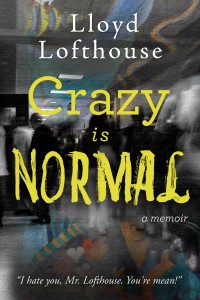
 Crazy Normal - the Classroom Exposé