President Obama visited the University of Chicago in January 2014, and said, “We know that not enough low-income students are taking the steps required to prepare for college.” He said this because No Child Left Behind, his Race To The Top program, and Bill Gates Common Core agenda demands that 100% of all U.S. children grow up to be college and career ready when they leave high school.
Why do I think this is an insane and criminal goal? The first part of my answer is simple. According to the College Board, the average cost of tuition and fees for the 2013–2014 school year was $30,094 at private colleges, $8,893 for state residents at public colleges, and $22,203 for out-of-state residents attending public universities.
Presidents G. W. Bush and Obama are selling parents and children a fantasy that everyone can go to college and end up with a college career job, but that is not going to happen.
Currently, the U.S. has almost three college graduates for every available job that requires a college degree (according to the Bureau of labor Statistics), and I’ll bet not many people know that AT&T stores—for instance, where people go to buy mobile phones, TV’s and Internet access—are mostly staffed with college graduates who sell the services AT&T provides.
When I was working my way through college with some help from the GI Bill, I stocked shelves and sold shoes working at a J.C. Penny. I also bagged groceries in a super market and finished up college with a job at a Gallo winery one summer. None of these jobs required a college degree, and a job selling mobile phones at AT&T shouldn’t require it either.
If we take the lowest college cost at almost $9,000 annually, four years of college would cost $36,000, but 26% of the jobs in the U.S. don’t even require a H.S. degree and another 40% only required a high school degree. If we go with the highest cost, in four years, a college degree would cost more than $120,000 — for a possible job selling mobile phones for AT&T!
Because the U.S. has the 3rd largest population in the world, it is currently the most educated nation in the world when we look at gross numbers and not ratios because ratios can be misleading when a country only has 35.16 million people like Canada does.
Yes, Canada does have a higher ratio of college grads then the U.S. In 2012, Canada was ranked #1 with 55.8% of adults having college degrees, but 35.1% of those graduates are in jobs that are not related to their education. If we subtract the 10.1 million Canadians that are age 0 to 24, that leaves 25 million or 14 million college grads compared to the U.S. that has more than 108 million college grads—almost 8x the number in Canada, and more than 3X the entire population of America’s northern neighbor.
When corporate education reformers want to make America’s public schools look bad, they don’t mention the 108 million college graduates in the U.S. What they do is just mention that Canada has a higher ratio of college grads than the U.S.
But PBS reported that only 27% of the jobs in the United States require a college degree.
Glendon Cameron knows what he is talking about.
In 2013, there were 204.3 million Americans age 25 and over.
88.15%—180 million—had a high school degree.
9.84%—20.1 million—had an Associate degree (two years of college)
31.66%—64.7 million—had a Bachelor’s degree
8.41%—17.1 million—had a Master’s degree
1.48%—3 million—had a professional degree
1.68%—3.4 million—had a Doctorate
Only 11.85%—24.2 million—did not earn a HS degree
The corporate education reform movement that President Obama and Bill Gates support is a war being waged against the public schools because of the 11.85% of Americans who never graduated from high school and most of these citizens grew up in and still live in poverty—something Obama and his most powerful and wealthiest supporter, Bill Gates, are doing nothing to change. But Bill Gates is spending $5 to $7 billion to wreck America’s public schools and turn our children over to autocratic corporations to teach.
Did you know that corporate Charters are suspending and kicking out at-risk and difficult to teach children in much larger ratios than the public school have ever done?
I think the U.S. should focus more on dealing with the damage caused by children living in poverty and stop demanding that the public schools make sure every child is college and career ready. But—thanks to the President, Bill Gates and Arne Duncan, the Secretary of the Department of Education—in 2010, 62.5% of high school grads went directly to college expecting to graduate and find a high-paying secure job. HigherEdInfo.org
A lot of young Americans are being lied to, and a lot of public school teachers are being persecuted and punished for not achieving impossible goals set by criminals and con men — because not one country in the history of the world has ever educated 100% of its children to be college and career ready.
Not even Canada where the functional illiteracy rate is 42% or some 12 million adults aged 16 and over. Reverse that and functional Literacy is 58%. In 2003, the Document U.S. Functional Literacy level was 66% for Intermediate and Proficient. The U.S. scale is based on four levels: Below Basic, Basic, Intermediate and Proficient. In Canada, literacy is divided into five levels with level 3 as the internationally accepted level of literacy considered necessary for meeting the demands of everyday life and work in an information-based society, the same as level 3, the Intermediate level, in the U.S.
_______________________
Lloyd Lofthouse is a former U.S. Marine and Vietnam Veteran, who went to college on the GI Bill, and taught in the public schools for thirty years (1975 – 2005).
THIRD UPDATE
(Scroll down for the Second and First updates followed by the actual post that started a Twitter storm)
This afternoon, I received an e-mail informing me that because of my racist tendencies I was being removed as a member of the TBATS. I can only assume that this is because I think poverty and single parent homes are more of a factor in the behavior of students who are suspended from school than racism.
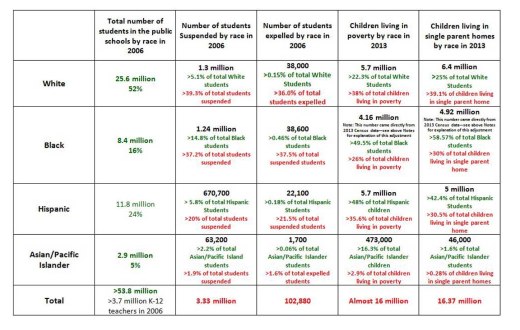
Therefore, this update includes a new chart with more information. Using the information in this chart, we will attempt to compare the ratio of White children living in poverty and single parent homes to see if the suspensions of Blacks, Hispanics and Asian/Pacific Islander students was equal or close to the ratio of White students who were suspended.
Using 22.3% of total white students living in poverty and 5.1% of total white students who were suspended as the base, then 49.5% of Black students living in poverty is 2.2 times the number of White students. This equals 11.22% of 8.4 million. If racism was a factor in the additional 3.58% of Black student who were suspended, then 300,720 Black students might have been suspended due to racist tendencies leaving 74.9% of the total students suspended due to factors that might have been related to growing up in poverty and/or single parent homes.
Using 25% of total White students living in single family homes and 5.1% of students who were suspended as the base, then 58.57% of Black students living in single parent homes is 2.34 times the number of White students or 11.9% instead of 14.8% of black students suspended offering evidence that racism might have been a factor in 2.9% of the suspensions of Black students. If true, then 240,400 Black students might have been suspended due to racist tendencies leaving 83.3% of the total students suspended that might have been related to growing up in poverty and/or single parent homes.
The ratio of Hispanic students who live in poverty is 2.15 times the number of White students and that ratio is equal to 10.97% instead of the 5.8% who were suspended offering no evidence that racism was a factor in the suspension of Hispanic students.
The ratio of Hispanic students who live in single family homes is 1.7 times the number of White students and this ratio is equal to 8.64% instead of the 5.8% of Hispanic students who were suspended offering no evidence that racism was a factor in the suspensions of Hispanic students.
The ratio of Asian/Pacific Islander students who live in poverty is 0.73 times the White students who live in poverty and this ratio is equal to 3.72% instead of the 2.2% of total Asian/Pacific Islander students who were suspended offering no evidence that racism was a factor in the suspensions of Asian/Pacific Islander students.
The ratio of Asian/Pacific Islander students who live in single parent homes was 0.4 times the White students and this ratio was equal to 2.42% instead of the 2.2% who were suspended offering no evidence that racism was a factor in the suspensions of Asian/Pacific Islander students.
In conclusion, poverty and growing up in single family homes is a much larger factor in the number of student suspensions than racism, and a transparent, public school, national, early childhood education program starting as early as age two might have a large impact that will eventually reduce poverty and increase literacy and life-long learning skills in children who grow up in poverty and/or single parent homes. Racism is another issue and other methods will be necessary to deal with this challenge. I don’t think early childhood education will have much of an impact in reducing racism.
SECOND UPDATE
Because I asked this question in my post there was an explosion on Twitter taking me to task for not focusing on racism and not admitting that it was a problem.
In the original post I wrote, “When 6.1% of the total students are suspended from public schools—or less as you will see—is that cause for a national crises and is it evidence of alleged racism?” … Later in the post, I also said, “Some critics have even alleged that the ratio of Black children being suspended is a sign of racism. I disagree, but you will have to make up your own mind after you look at all the numbers and in this post there are a lot of numbers to wrap your critical thinking around.”
Here is my response to one of the reactions that arrived as an e-mail. Too bad they couldn’t have left a comment here so we could have talked it over and explored the issue here where others could follow along.
My reply, I can see that racism is a topic you are passionate about. I think you even prove my point with your examples. We can’t stop racism, but we can help children who live in poverty and/or who grow up in single parent homes by implementing a public school managed national early childhood education program so those children grow up with the tools that will help them escape poverty and combat racism without anger and a sense of helplessness.
That’s why I refuse to allow the focus of my post to be hijacked by people obsessed with racism. …
What do you propose we do to stop racism—-send out mobs of vigilantes to hang anyone we suspect of racist tendencies?
I think the strongest weapon we can give victims of racism is literacy and an education and a good start, our best chance, would be a transparent publicly managed national early childhood education program that is not managed by corporations, because the evidence is strong that corporate Charters are racist because they encourage segregation and mostly refuse to work with the children who suffer the most from racism—at-risk children who grow up in poverty and/or single parent homes.
We can stay angry at racists, or we can eventually defeat racism by doing something about childhood poverty by intervening in the development of children as young as age two. They did it in France more than thirty years ago and poverty has dropped more than 50% since.
FIRST UPDATE
It came to my attention this morning (1-7-2015) that this post was severely criticized and attacked by some of the members of a site (TBATS) that recommended the post to their members—TBATS has deleted the recommendation and apologized to those who complained. The reason for this is because one paragraph in this post quoted information for one post at the conservative Heritage Foundation.
I want to make it clear that the numbers used in the chart did not come from the Heritage Foundation. They came from other sources, and I made the mistake of listing those sources further down in the post—and for that confusion, I apologize but for nothing else. I think this post was unfairly criticized. I have now moved those links, and they may be found right below the chart.
The only information quoted from the Heritage Foundation was the quote in that one paragraph about “children raised in single-parent homes are more likely to have emotional and behavioral problems; be physically abused; smoke, drink, and use drugs; be aggressive; engage in violent, delinquent, and criminal behavior; have poor school performance; and drop out of high school.” Nowhere in that quote was race mentioned.
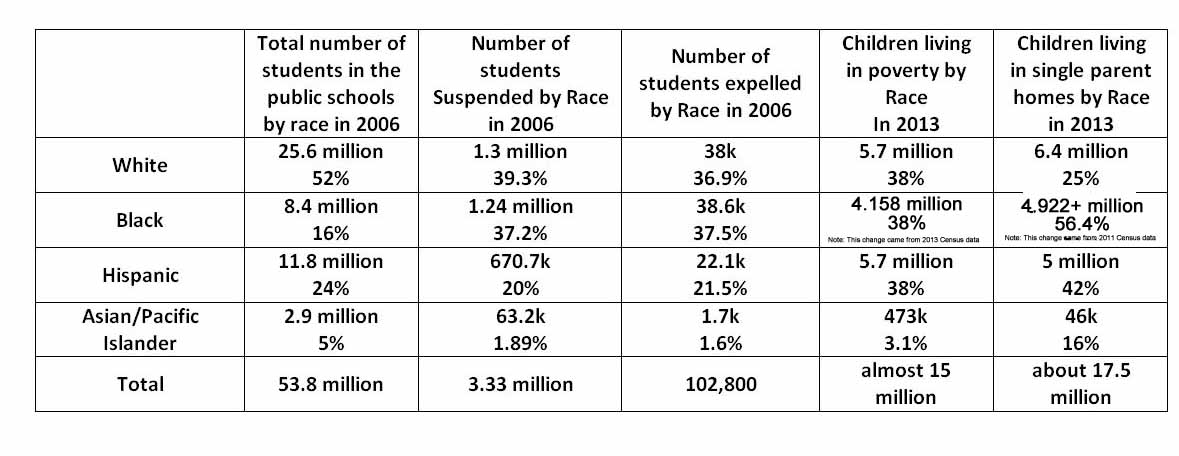
However, because of the criticism of my post based on that one quote in one paragraph from the Heritage Foundation—a foundation that has been linked to ALEX and support from the Koch brothers and Bill Gates—that had nothing to do with the data in the chart, I decided to go directly to the U.S. Census.gov to verify some of the data that I used in the chart and made two revisions where—if you visit the actual Census data—you will discover that the total number of Black or African American family households was (in Table 1) 8,726,419, and that 836,460 single family households were are led by a male, while 4,085,938 were led by female householders for a total of 4,922,398 or 56.4% of the total number of Black and African American households in 2011. I have corrected the chart to show 56.4% instead of the 67% quoted from a 2013 source—that was not the Heritage Foundation. In addition, about 43.6% of Black or African American family households were led by married couples.
I then turned directly to the U.S. Census for info about poverty by race and found this data from 2013. In 2013, 38% (4.158 million) of Black or African-American children under 18 years lived in families below poverty. I used the data for Black Alone on page 53, Table B-2. The previous number that was quoted in my chart from another 2013 source was much lower.
Here is the actual pull quote from the conclusion of the study that the Heritage Foundation quoted in their piece:
“A large body of research has documented the disadvantages of children raised in single-parent homes relative to children raised in two-parent homes. Lower high school graduation rates, lower GPAs, and greater risk for drug abuse are only some of the negative outcomes associated with growing up in a single-parent home. … This paper has been a review and critique of research from the past few decades regarding single parenthood. While the economic and social costs of single parenthood have been well documented, the strengths of single parents and their children have been largely overlooked.”
I think we might be able to learn something from this—that just because information comes from a conservative source doesn’t mean that information is wrong. Just like we sometimes have to follow the money, we also have to go to the original source.
THE ORIGINAL POST STARTS NEXT
In 2006, the U.S. public schools suspended students 3.3 million times. Note that I did not say 3.3 million students, because that might be misleading as you will see if you keep reading.
There is currently a group in the United States demanding that teachers and schools be restricted when it comes to suspending children from classrooms and schools. It would be interesting to know who is funding this issue and pushing it. Is it Arne Duncan who is the Secretary of the federal Department of Education or is it Bill Gates who is funding the push for Common Core standardized testing with $5 – $7 billion—test results that will be used to rank and fire teachers in addition to close public schools and turn our children over to corporations to teach even if parents don’t want that?
Corporate education reformers love throwing around numbers like 3.3 million, because that will make the public schools look really bad, and big numbers tossed out like that look so impressive to people who are easy to fool.
I decided to dig deeper to understand what that number really means.
In this post, we will explore what is behind the suspension and expulsion rates in the United States, because the public schools have been criticized for suspending too many students. Some critics have even alleged that the ratio of Black children being suspended is a sign of racism. I disagree, but you will have to make up your own mind after you look at all the numbers and in this post there are a lot of numbers to wrap your critical thinking around. The followinSome critics have even alleged that the ratio of Black children being suspended is a sign of racism.g chart provides a powerful and revealing comparison and I’m interested in your conclusions from this data.
Table 169, at this National Center for Educational Statistics.gov link lists the “Number of students suspended and expelled from public elementary and secondary schools, by sex, race/ethnicity, and state: 2006”.
The ratio of children living in single family homes by race may be found through this link at Kids Count data center.org
Heritage.org says “Seventy-one percent of poor families with children are headed by single parents, mostly single mothers. Compared to children raised in an intact family, children raised in single-parent homes are more likely to have emotional and behavioral problems; be physically abused; smoke, drink, and use drugs; be aggressive; engage in violent, delinquent, and criminal behavior; have poor school performance; and drop out of high school.” The Heritage Foundation reports that in the United States, marriage drops the probability of child poverty by 82 percent.
In 2006, there were 53.8 million children in the k – 12 public schools, and there were 3.3 million suspensions representing 6.1% of the total number of students. That means almost 94% (or more) of the children did not earn a suspension. Census.gov
When 6.1% of the total students are suspended from public schools—or less as you will see—is that cause for a national crises and is it evidence of alleged racism?
If we average that 3.3 million suspensions per school, it means each school suspended an average of about 33.4 students during the 2006 school year, and a school year has about 180 instructional days—I suspect the ratio is higher for schools with higher levels of childhood poverty and there is a reason for that, and it isn’t unique to the United States as you will see if you keep reading.
If we take that per-school average of 33.4 suspensions, it equals one student is suspended on average every 5.4 days for each school—but was it always a different student or were there repeat offenders as I strongly suspect based on my 30 years of experience as a public school teacher.
When I say repeat, I mean the same student being suspended more than once during one school year, and some of those chronic offenders eventually end up with an expulsion hearing.
For instance, at the high school where I taught from 1989 to 2005 there was a 70% childhood poverty rate at the time (it’s higher today) based on free and/or reduced lunch, and 92% of the students were non-white. The teacher—we called him Mr. D—who ran the in-house suspension system—a separate classroom on campus where students were required to do worksheets (the students were not allowed to just sit and visit. If they didn’t do the academic worksheets, they’d end up returning the next day for another period suspension), said that about 5% of the students at the high school earned 95% of the average 20,000 annual referrals that teachers wrote. At the time, Nogales High School had a student population of about 2,600. Five percent equals 130 students who earned 95% of the 20,000 referrals written by teachers each year. That works out to 146 referrals for each one of those 130 students, and yes, we had students who earned referrals from more than one of their teachers on a daily basis. Some students would earn six referrals a day—one for each class—day after day and if the teacher didn’t write the referral and send the student to Mr. D in the in-house suspension center for a class suspension, that student would often disrupt the learning environment for the rest of the students in the class—stealing learning time from every child.
The teacher couldn’t teach and the other students couldn’t learn.
What if the 3.3 million suspensions in 2006 were not from 3.3 million individual children because many might have been repeat offenders. It would be nice to know how many students were suspended more than once but I couldn’t find that information. For instance, what if only 500-thousand students or less earned those 3.3 million suspensions? If correct, that would mean less than 1% of the total public school students were actually suspended from school—some multiple times.
But what if the 3.3 million suspended students were counted as individuals and not multiple offenders. Then there’s another way to look at this large but insignificant number.
There were about 7.2 million teachers in the United States in 2009. Almost 3 million taught at the elementary and middle school level. The remainder included those teaching at the post secondary, secondary, preschool, kindergarten levels, special education and other teachers or instructors.
Taking the total number of teachers into account, if we divided the 3.3 million suspended students up evenly among the 7.2 million teachers, that equals 0.45 or less than half a student for each teacher for an entire school year. And even if we only counted the regular k – 12 teachers it would break about even—one suspended student each school year for each teacher. Source: U.S. Bureau of Labor Statistics as cited in the Statistical Abstract of the United States: 2011, Table 615 <https://www.census.gov/compendia/statab/>
And if all we do is count just the 3.7 million full-time-equivalent (FTE) elementary and secondary school teachers engaged in classroom instruction in fall 2012, then for every teacher there was 0.89% of a student suspended from a school for breaking rules and/or disrupting the educational environment so other students couldn’t learn. nces.ed.govDo you know of any child who is only 0.89% of a child? Where did the missing 0.11% go—did that part of the suspended student stay in the classroom to cooperate and learn?
What about the 112k who were expelled from all of the public schools in 2006?
If we average that 112k, it becomes about 1.1 students for each school in the United States. Is that excessive requiring an act of Congress to control, and what happens to the Common Core standardized test scores that are being used to rank and fire teachers in only the public schools when teachers are forced to keep disruptive students in the classroom who literally rob learning time from all of our children—the 94% that don’t earn suspensions?
What about suspensions and expulsions in the other OECD nations, or is this something that Arne Duncan, Bill Gates and the other corporate education reformers don’t want America to know—because some OECD countries have higher rates of suspension and expulsion than the United States does?
The corporate reformers can avoid this information in their allegations of the US public schools, but they can’t hide it. The Stanford Graduate School of Education reported in January 2013 that Poor ranking on international tests misleading about U.S. performance and said, “There is an achievement gap between more and less disadvantaged students in every country; surprisingly, that gap is smaller in the United States than in similar post-industrial countries, and not much larger than in the very highest scoring countries. Achievement of U.S. disadvantaged students has been rising rapidly over time, while achievement of disadvantaged students in countries to which the United States is frequently unfavorably compared – Canada, Finland and Korea, for example – has been falling rapidly.”
In addition, while fewer than 3 percent of students in 13 countries—including Japan, Norway, and the United Kingdom—reported ever repeating a grade, more than 25 percent of students repeated at least once in France, Spain, Brazil, and a dozen others studied. The United States reported more than one in 10 students (10 percent) repeating a grade, higher than the OECD average, while the top-performing countries, Finland and Korea, do not allow grade retention. … The OECD found that both high rates of grade retention and transfer happened in countries in which a child’s socioeconomic status was more likely to predict that child’s academic performance. Education Week.org
What happens to teachers if the Department of Education and/or the U.S. Congress caves in to pressure from special interest groups—possibly funded by Bill Gates or the Walton family—and drafts legislation that takes away a teacher or school’s power to suspend or remove a student through expulsion—especially when teachers are being ranked and then fired based on the Common Core standardized test results of a teacher’s students?
If being ranked and fired by those test scores becomes a reality for every public school teacher, then every instructional and/or learning minute will become vitally important and forcing teachers to keep children who cause problems and disrupt the learning environment will cripple a teacher’s ability to teach.
Maybe that’s what President Obama, Arne Duncan, Bill Gates and the Walton family want to happen so they can turn our children over the corporations to brainwash.
In conclusion, if you are one of the critics of public education who thinks 3.3 million (6.1%) children suspended from the public schools in one school year is too many, then instead of passing laws restricting the public schools’ ability—because these laws will not impact the corporate Charter schools that also are not required to teach to the Common Core—to decide who gets suspended, consider looking at what causes those children to disrupt the classroom—for instance, poverty and single parents families, and do something about that instead of making a teacher’s job to teach more difficult by forcing them to keep those at-risk and difficult to teach children in the classroom. And if you think the corporate reform movement has the answer, think again.
Joseph Williams, a veteran journalist and former White House correspondent for Politico, reported, “Charter schools also lead their traditional counterparts in a more disturbing trend: the number of students who are suspended or expelled each year … charter schools are far more likely to suspend students for infractions such as dress code violations and insubordination toward teachers.”
In fact, if there are suspension restrictions imposed on the public schools, those same restrictions will not be imposed on the corporate Charters just like the Common Core agenda to rank and fire teachers is not found in private-sector Charters—proving that this latest manufactured crisis in public education is another ploy by the corporate reformers to destroy the public schools.
_____________________________________
Lloyd Lofthouse is a former U.S. Marine and Vietnam Veteran,
who taught in the public schools for thirty years (1975 – 2005).
Runner Up in Biography/Autobiography
2014 Florida Book Festival
Honorable Mentions in Biography/Autobiography
2014 Southern California Book Festival
2014 London Book Festival
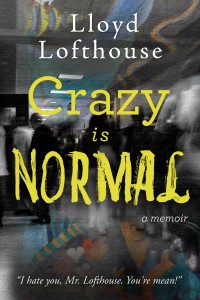
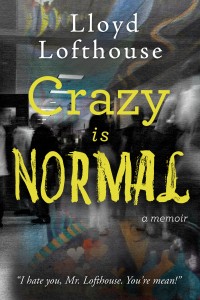
His third book is Crazy is Normal, a classroom exposé, a memoir. “Lofthouse presents us with grungy classrooms, kids who don’t want to be in school, and the consequences of growing up in a hardscrabble world. While some parents support his efforts, many sabotage them—and isolated administrators make the work of Lofthouse and his peers even more difficult.” – Bruce Reeves
Lofthouse’s first novel was the award winning historical fiction My Splendid Concubine [3rd edition]. His second novel was the award winning thriller Running with the Enemy. His short story A Night at the “Well of Purity” was named a finalist of the 2007 Chicago Literary Awards. His wife is Anchee Min, the international, best-selling, award winning author of Red Azalea, a New York Times Notable Book of the Year (1992).
To follow this Blog via E-mail see upper right-hand column and click on “Sign me up!”
For the second time in world history, the public schools of a country are under attack by powerful men. The first time a country waged war on its public schools was when Mao launched China’s Cultural Revolution (1966 – 1976).
How successful was Mao in destroying more than 2,000 years of public school tradition in
China? The answer may shock you. By the time Mao died in 1976, the literacy rate in China had plunged to 20%, and the poverty rate was 85%.
In the United States the biggest crime of the corporate education reformers is chasing profits and not dealing with the challenges of poverty. In fact, corporate education reform supported by billionaire oligarchs—for instance, Bill Gates, the Walton family, Eli Broad, and the Koch brothers—are doing nothing to deal with poverty. Instead they claim that if they get wealthier that will somehow magically solve poverty. When, at any time in history, has the wealthy solved poverty by getting richer?
In a Chicago Sun Times Op-Ed piece, Laura Washington writes about Ted Manuel, an African American who lives in Hyde Park: Manuel said, ‘Although we have one or more churches on every other block, what effect are the preachers having? Why is there no partnering of schools with corporations, where glimpses of future possibilities can inspire the kids? I know of no such connections, if they exist.’”
To answer Ted Manual’s questions, the reason that corporate education reformers are doing nothing about poverty is because dealing with the causes of poverty is not profitable.
And how can the public schools do anything? Funds for public schools have been cut drastically while other funds have been diverted to the Common Core test taking culture supported and driven by Bill Gates—the wealthiest man in the world. Mao had his Little Red Book, and Bill Gates has his Common Core.
Who will profit the most from Bill Gates war on the public schools? UK’s Pearson—a company that will make money every time an American child takes one of their tests, and they want to test children from pre-school to high school graduation—hours of tests annually.
What about China? Starting in the late 1970’s under Deng Xiaoping’s leadership, who do you think China learned from as they started to rebuild their public schools after Mao’s Cultural Revolution?
If you answered the United States and Europe, you would have been right. China sent teams to the United States to learn from America’s public schools—and this all happened before A Nation at Risk, NCLB, Race to the Top and Common Core—and according to the last two international PISA tests, China’s 15-year-olds in Shanghai are ranked #1 in the world thanks to what China learned in the United States before the corporate war on public education.
In fact, China is moving away from a test-based public education system and toward what the United States is abandoning thanks to Bill Gates and the $5 – $7 billion he is spending in his crusade to destroy what works and replace it with a market-based education system that several Stanford studies have already proved is a failure.
Education Week.com reported in 2010 that Schools in China and U.S. Move in Opposite Directions. Schools in China are slowly trying to break away from their emphasis on memorization (and testing) toward adopting strategies that stress creativity. Until now, schools believed that the former was the best way to score high on the gao kao (the college entrance exam taken the last year of high school). But recognizing that the approach is counterproductive in the new global economy, China is attempting to change.
Meanwhile, Education Week.com says, “In the U.S., a different trend is underway. Convinced that high-stakes tests are the best way to measure educational quality and assure our economic hegemony, (corporate) reformers are running roughshod over those who believe otherwise.”
France dealt with poverty more than thirty years ago when they introduced a national early childhood education program starting as young as age two, a program that is transparent and part of the French public education system. France, unlike the United States, puts its education dollars in one pot and then shares that money equally among all of its public schools. But in the U.S. funding is not equitable. School districts in wealthy communities spend heavily on their public schools while schools in communities infected with poverty spend much less.
Thirty years after France implemented its national early childhood education program in the public schools—not run by the private sector—poverty has been cut drastically. In 1970, 15% of France’s population lived in poverty. By 2001, only 6.1% lived in poverty. In 1970, about 86% of the population of France was literate, but by 2003, the literacy rate improved to 99%. – Our World in Data.org
China had to wait for Mao to die before its war on public education ended. Will the United States have to wait for the oligarchs to all die before the corporate war on public education ends?
Don’t forget, Mao had his Little Red Book, and Bill Gates has his Common Core.
_______________________
Lloyd Lofthouse is a former U.S. Marine and Vietnam Veteran,
who taught in the public schools for thirty years (1975 – 2005).
Runner Up in Memoir 2014 Florida Book Festival
Honorable Mention in Biography/Autobiography
2014 Southern California Book Festival and at the 2014 London Book Festival
His third book is Crazy is Normal, a classroom exposé, a memoir. “Lofthouse presents us with grungy classrooms, kids who don’t want to be in school, and the consequences of growing up in a hardscrabble world. While some parents support his efforts, many sabotage them—and isolated administrators make the work of Lofthouse and his peers even more difficult.” – Bruce Reeves
Lofthouse’s first novel was the award winning historical fiction My Splendid Concubine [3rd edition]. His second novel was the award winning thriller Running with the Enemy. His short story A Night at the “Well of Purity” was named a finalist of the 2007 Chicago Literary Awards. His wife is Anchee Min, the international, best-selling, award winning author of Red Azalea, a New York Times Notable Book of the Year (1992).
To follow this Blog via E-mail see upper right-hand column and click on “Sign me up!”
The reason education reform in the United States is a fraud is because of G. W. Bush’s No Child Left Behind Act that demanded public school teachers achieve the impossible and educate 100% of America’s children to be college and career ready by age 17 or 18. Never mind that about half of today’s college graduates are underpaid and/or can’t find a job that requires a college degree.
This crime was made worse with President Obama’s Race To The Top, in addition to Bill Gates’s funding the Common Core agenda to use student test scores to rank and then fire teachers soon followed by closing public schools when that 100% mandate isn’t met.
The rank and yank testing mentality has become so Orwellian that some cities and states are now testing kindergarteners to see if they are college and career ready at age 5/6, with talk of doing the same with preschool children.
To insure that this national crime against children and teachers continues, Bill Gates has dedicated $5 – $7 billion dollars in grants—a fancy name for bribes—to influence state and federal leaders.
Why is it impossible to educate 100% of U.S. children to be college and career ready by age 17/18?
Because it is a proven fact that both poverty and lack of proper sleep play a major role in how a child performs in school—two major factors that teachers have no power over.
Late last night it all came together after I read a piece in the January 2015 National Geographic Magazine (NGM) that provided the evidence that the school reform movement leads to prejudice, inequality, workplace discrimination and child neglect. I also think that if Bill Gates and the other fake reformers had known that NGM was going to publish this piece, they would have done all they could to stop it from being printed.
The title was A baby’s brain needs love to develop. What happens in THE FIRST YEAR is profound. The link should take you to this heavily research-based story that proves without-doubt that poverty damages children’s brains (and more than 16-million children in America live in poverty—22% of all children). The story also points out how this damage can be avoided—something that teachers have known for decades, but the fake education reformers ignore, while they rake in profits from taxes meant to support education.
The researchers used magnetoencephalography (EEG) to scan the brains of children as the brain developed and discovered that for a child’s brain to develop to its potential, the child needs to be nurtured in a stable home environment with supportive parents.
“The amount of brain activity in the earliest years affects how much (brain activity) there is later in life. EEG scans of eight-year-olds show that institutionalized children who were not moved to a nurturing foster care environment before they were two-years old have less (brain) activity than those who were.”
In addition, “Children in well-off families—where the parents were typically college-educated professionals—heard an average of 2,153 words an hour spoken to them, whereas children in families on welfare heard an average of 616 words. By the age of four this difference translated to a cumulative gap of some 30 million words.”
This scientific evidence is the reason why teachers who are fired based on the results of student test scores are victims of workplace discrimination, because teachers are being punished for children who don’t have the same nurturing and supportive home environment as children from well-off families.
Another important factor in the development and health of a child’s brain is sleep. The same day that I read the piece in NGM, I also read a short piece in the December 2014 issue of AARP Magazine: Why Sleep Is Precious for Staying Sharp. “New research indicates chronic sleep deprivation can lead to irreversible brain damage … extended wakefulness can injure neurons essential for alertness and cognition—and that the damage might be permanent.”
Children in the United States aren’t getting enough sleep, and many parents do not identify their children’s sleep problems as an issue that should be addressed. Add to the mix that doctors often aren’t asking enough questions about their young patients’ sleep. These are some of the major findings in the 2004 Sleep in America poll, the first nationwide survey on the sleep habits of children and their parents.
In addition, adolescents are notorious for not getting enough sleep. The average amount of sleep that teenagers get is between 7 and 7 ¼ hours. However, studies show that most teenagers need exactly 9 ¼ hours of sleep. – Nationwide Childrens.org
But when 100% of the children are not college and career ready according to the results of Common Core standardized tests, teachers are losing their jobs, and public schools are being closed and replaced with corporate Charters that—according to several Stanford studies—are often worse or no better than the public school that they replaced. Dr. Margaret Raymond, Stanford’s CREDO Director, says that after decades of looking at the nation’s charter school sector, she has come to the conclusion that the “market mechanism just doesn’t work” in education.
In the last decade—thanks to the fake education reformers—thousands of public schools have been closed, tens of thousands of teachers have been heartlessly fired and hundreds of thousands of children have been forced—in some cases—to attend corporate Charter schools that often kick out the students who are the most difficult to teach, the same children that caused those standardized test scores to suffer—-children who don’t get enough sleep and/or live in poverty.
Tell President Obama, Arne Duncan and Bill Gates we are going to hold them accountable for their crimes against children and teachers.
_______________________
Lloyd Lofthouse is a former U.S. Marine and Vietnam Veteran,
who taught in the public schools for thirty years (1975 – 2005).
Honorable Mention in Biography/Autobiography at 2014 Southern California Book Festival
His third book is Crazy is Normal, a classroom exposé, a memoir. “Lofthouse presents us with grungy classrooms, kids who don’t want to be in school, and the consequences of growing up in a hardscrabble world. While some parents support his efforts, many sabotage them—and isolated administrators make the work of Lofthouse and his peers even more difficult.” – Bruce Reeves
Lofthouse’s first novel was the award winning historical fiction My Splendid Concubine [3rd edition]. His second novel was the award winning thriller Running with the Enemy. His short story A Night at the “Well of Purity” was named a finalist of the 2007 Chicago Literary Awards. His wife is Anchee Min, the international, best-selling, award winning author of Red Azalea, a New York Times Notable Book of the Year (1992).
To follow this Blog via E-mail see upper right-hand column and click on “Sign me up!”
The Merriam Webster Dictionary defines CORRUPTION as “dishonest or illegal behavior especially by powerful people”, and by the time I finished reading the last page of The Educator and the Oligarch: A Teacher Challenges the Gates Foundation, I was convinced that Bill Gates was a charlatan, is corrupt, and three famous quotes were spinning inside my head.
The first quote was from Lord John Acton (1834-1902) who said, “Power tends to corrupt and absolute power corrupts absolutely. Great men are almost always bad men, even when they exercise influence and not authority.”
I think Bill Gates is one of those bad men who is using his wealth to exercise influence over government to achieve his own goals for public education in the United States—no matter how many millions of children, parents and teachers he will hurt.
There are 27 chapters in the book and—in many—Cody offers examples of Bill Gates saying one thing for public consumption to obviously fool as many people as possible while Cody offers the evidence that the Gates Foundation does the exact opposite.
For instance—not mentioned in the book—is the fact that recently the Gates Foundation promoted in the media an offer of one million dollars in grants to help teachers buy classroom supplies, but—in the book—Cody reveals that the Gates Foundation has dedicated $5 to $7 billion to influence federal and state governments to develop the Common Core State Standards and use student test results to rank and yank teachers in addition to supporting the spread of corporate Charter schools while getting rid of elected school boards and closing public schools—for good.
THINK—Bill Gates spends one million dollars to boost his public image as a humanitarian, but at the same time, his foundation is quietly spending $5 to $7 billion to spread his influence like a malignant cancer—did you know that almost 4-million public school teachers spend about two billion dollars annually to buy materials for their classrooms so children can learn? But Bill Gates offered 0.0005% of what teachers spend annually to buy supplies for their classrooms, and 0.00014% of what he is spending to destroy the public schools.
The second quote comes from Carl Sagan (1934 – 1996): “One of the saddest lessons of history is this: If we’ve been bamboozled long enough, we tend to reject any evidence of the bamboozle. We’re no longer interested in finding out the truth. The bamboozle has captured us. It’s simply too painful to acknowledge, even to ourselves, that we’ve been taken. Once you give a charlatan power over you, you almost never get it back.”
It is arguable that Bill Gates was bamboozled by Gene Wilhoit and David Coleman who went to see Bill Gates in 2008 to ask him to underwrite the Common Core State Standards, and now Bill Gates is not interested in finding out the truth and is bamboozling as many people as possible when he says one thing in the media to make himself look good, but then spends billions to crush the teachers’ unions, take away due process job protection from all teachers with a goal to fire almost one million teachers annually, increase class sizes and turn children into brainwashed, bamboozled drones who are forced to learn from computers while the few teachers that remain become classroom monitors (baby sitters) with one goal: to force those children to raise test scores—no questions asked. It doesn’t matter if the children learn anything useful as long as the test scores improve, and billionaires like Bill Gates get to brag that they made it all happen—even if they have to falsify the facts to look like they succeeded when they didn’t, which is already happening—the falsifying of facts!
The third quote comes from Abraham Lincoln who said, “You (Bill Gates) can fool all the people some of the time, and some of the people all the time, but you (Bill Gates) cannot fool all the people all the time.”
I think that once many of the people who have already been fooled by Bill Gates discover the facts—then the house of cards that Bill Gates has spent billions to build is going to crumble along with his false reputation as a humanitarian that he has worked so hard to create.
This is where Cody’s book works best, because when you finish reading it, if you still think Bill Gates is a humanitarian—instead of the corrupt billionaire that he clearly is—then you have been bamboozled proving that Carl Sagan was right.
Lloyd Lofthouse is a former U.S. Marine and Vietnam Veteran,
who taught in the public schools for thirty years (1975 – 2005).
Honorable Mention in Biography/Autobiography at 2014 Southern California Book Festival
His third book is Crazy is Normal, a classroom exposé, a memoir. “Lofthouse presents us with grungy classrooms, kids who don’t want to be in school, and the consequences of growing up in a hardscrabble world. While some parents support his efforts, many sabotage them—and isolated administrators make the work of Lofthouse and his peers even more difficult.” – Bruce Reeves
Lofthouse’s first novel was the award winning historical fiction My Splendid Concubine [3rd edition]. His second novel was the award winning thriller Running with the Enemy. His short story A Night at the “Well of Purity” was named a finalist of the 2007 Chicago Literary Awards. His wife is Anchee Min, the international, best-selling, award winning author of Red Azalea, a New York Times Notable Book of the Year (1992).
To follow this Blog via E-mail see upper right-hand column and click on “Sign me up!”
The Oligarch is Bill Gates. The Educator is Anthony Cody, who has gone toe-to-toe with the Gates Foundation in private conversations and publicly for several years. Cody’s book, The Educator and the Oligarch, covers what he has learned while in the trenches battling a billionaire and his vast, entrenched organization, and the book is worth reading.
Do I NEED to repeat that?
At 2:30, Saturday (12-6) afternoon, I left home to walk the two miles to the nearest BART station.
At 4:05, I walked into the Laurel Book Store in Oakland, California to hear Anthony Cody, who started talking soon after I sat down, and by then it was standing room only.
Cody has been in the fight to save democratic public education much longer than I have, and his knowledge of the issue is deeper. Back in the mid 1980’s, I started suspecting that there might be a plot to destroy the public schools—it was just a feeling I had due to the crazy and insane things that teachers were being forced to do that made no sense.
Thinking I was cooking up a conspiracy theory, I went into denial mode and continued teaching and dodging bullets from those imagined ghosts until I retired in 2005 after thirty years in the classroom. Then in November 2013, my wife came home and told me she’d heard Diane Ravtich on NPR talking about her book “Reign of Error,” and I read the book and discovered my suspicions had been true all along—but like cancer this plot has branched out and taken on a malignant life of its own and it’s spreading into every element of public education in the United States in addition to corrupting our democratic government—thanks in large part to Bill Gates.
Listening to Cody late this afternoon, I learned how Bill Gates always gets what he wants—he buys everyone and everything he can, and he has dedicated between $5 to $7 billion dollars to destroy America’s democratic public education system and rebuild it into what HE thinks it should be.
I didn’t raise my hand until the end of Cody’s talk, and after several others had asked questions and shared their thinking. It was obvious that there was a lot of passion in the room among parents and teachers.
Then I had my say—not knowing that I was going to be attacked, not by Cody, but by another person in the audience. I said that we had to stop measuring children and focus on the children who needed the most help: children from dysfunctional homes and who lived in poverty. I mentioned that France had launched a national early childhood education program managed by its own public schools in the 1970’s, and thirty years later, the French poverty rate had dropped more than 50%.
When I finished talking—one loud person—grabbed the crowd’s attention and attacked me for blaming dysfunctional parents for at risk children who were difficult to teach. She said that it wasn’t the parent’s fault their children were not succeeding. I didn’t respond to her attack maybe because I’m severely dyslexic and it takes me time to think before I open my mouth. It’s so much easier to write, revise, edit and wait a few days and then revise some more. I had no desire to get into a heated shouting match with this stranger.
When the event ended and the crowd moved from the event area into the bookstore, several people came up to me and offered support. They all agreed that I had never blamed dysfunctional parents for the problems in classrooms caused by at-risk and difficult to teach children.
I replied that dysfunctional parents can’t be blamed when their children are not learning in school, because my parents were dysfunctional—who both dropped out of high school when they were fourteen—because I was born to poverty; because when I was six or seven, my mother was told I would never learn to read, but she taught me anyway after failing to teach my older brother 12 years earlier. My brother died at age 64 illiterate and he left behind several of his own adult children who are still illiterate. My father was a gambler and an alcoholic. If he wasn’t drinking, he was a wonderful, gentle man. My brother spent about 15 years of his life in prison. He was also an alcoholic, a sometime drug user, and a heavy smoker. Like our parents, he also never had the tools to raise children who easily learned in school.
If my family wasn’t dysfunctional, I don’t know what is.
If you ask someone to fix your car who doesn’t know how to use the tools, do we blame that person for not fixing the car? Dysfunctional parents—like my parents—did not have the parenting tools to raise children that were ready to learn, and I wasn’t ready to learn until I was in my early twenties after serving several years in the U.S. Marines and fighting in Vietnam.
It was dark out when I left the bookstore and started the long ride home on BART, and it was a long ride. The BART train was delayed several times sitting at stations because of some problem down the line. What should have been a 25-minute ride stretched to about one-and-a-half hours, and this turned out to be a good thing, because the wait provided time for me to read to Chapter 4 in Cody’s book, and discover just how involved Bill Gates is in HIS own goal to destroy our democratic public schools, and replace those schools with what HE wants. For instance, if Gates was cutting open our bodies and reaching inside to do surgery to save our lives HIS way, he’d have our blood all the way to his shoulders, smeared on his face and drenching his clothing down to his shoes as he pulled out one organ after another and threw them over his shoulder to the filthy floor.
Bill Gates has bought—bribed would be more appropriate—the media, nonprofits, and institutions for education, state governments, the Department of Education, and the White House. At the moment, Bill Gates is the unelected emperor of the United States, and if he achieves HIS goals with our schools, our democracy and our freedom will be gone too.
It’s getting late. If this needs editing, I’ll fix it tomorrow. Right now, I want to publish this post, brush my teeth and relax by watching the last of the 3rd season of The Tudors . I think I see a lot of similarities between Emperor Bill Gates and England’s King Henry 8, but Bill Gates isn’t beheading wives. He is beheading teachers, children—and our democracy.
_______________________
Lloyd Lofthouse is a former U.S. Marine and Vietnam Veteran,
who taught in the public schools for thirty years (1975 – 2005).
His third book is Crazy is Normal, a classroom exposé, a memoir. “Lofthouse presents us with grungy classrooms, kids who don’t want to be in school, and the consequences of growing up in a hardscrabble world. While some parents support his efforts, many sabotage them—and isolated administrators make the work of Lofthouse and his peers even more difficult.” – Bruce Reeves
Lofthouse’s first novel was the award winning historical fiction My Splendid Concubine [3rd edition]. His second novel was the award winning thriller Running with the Enemy. His short story A Night at the “Well of Purity” was named a finalist of the 2007 Chicago Literary Awards. His wife is Anchee Min, the international, best-selling, award winning author of Red Azalea, a New York Times Notable Book of the Year (1992).
To follow this Blog via E-mail see upper right-hand column and click on “Sign me up!”
There are NO bad schools unless we are talking about schools that are falling apart, because they are starving for funds to repair and update the infrastructure
Americans believe a lack of financial support is the biggest problem currently facing public schools, according to the 44th annual Phil Delta Kappa International/Gallup poll of public attitudes toward public schools released Wednesday, but they also say that balancing the federal budget is more important than improving the quality of education. – Governing.com
There are NO FAILING schools except when VAM is used to measure them and VAM has been proven to be misleading and does NOT work.
As is the case in every profession that requires complex practice and judgments, precision and perfection in the evaluation of teachers will never be possible. Evaluators may find it useful to take student test score information into account in their evaluations of teachers, provided such information is embedded in a more comprehensive approach. What is now necessary is a comprehensive system that gives teachers the guidance and feedback, supportive leadership, and working conditions to improve their performance, and that permits schools to remove persistently ineffective teachers without distorting the entire instructional program by imposing a flawed system of standardized quantification of teacher quality. – Problems with the use of student test scores to evaluate teachers from theEconomic Policy Institute
There is poverty and very little is being done to deal with it
The negative effects of poverty on all levels of school success have been widely demonstrated and accepted; the critical question for us as a caring society is, can these effects be prevented or reversed? A variety of data are relevant to this question, and recent research gives us reason to be both positive and proactive. The impact of poverty on educational outcomes for children, U.S. National Library of Medicine
Most public school teachers work 60+ hours a week teaching, correcting, planning, prepping and calling parents
Annual teaching hours by education level, 2010 among OECD nations. The U.S. ranked 3rd place for most hours worked by teachers behind Argentina in 1st place and Chile for 2nd place. – Figure 4.7
The average number of teaching hours in public primary schools is 782 hours per year in OECD countries but ranges from fewer than 600 hours in Greece and Poland to over 1,000 hours in Chile and the United States. … Teaching time is defined as the number of hours per year that a full-time teacher teaches a group or class of students. … Working time refers to the normal working hours of a full-time teacher and includes time directly associated with teaching as well as the hours devoted to teaching-related activities, such as preparing lessons, counselling students, correcting assignments and tests, and meeting with parents and other staff. Data are from the 2011 OECD-INES Survey on Teachers and the Curriculum and refer to the 2009-10. How much time do teachers spend teaching? OECD
There are children who learn and children who don’t learn—for whatever reason—that has little or nothing to do with the quality of teaching, and the children who don’t learn are causing the low VAM scores Child Neglect: A Guide for Prevention, Assessment and Intervention
Just because a teacher teaches, that doesn’t mean a child will make the effort to learn and the parent or parents will support the learning process so learning takes place
Researchers have evidence for the positive effects of parent involvement on children, families, and school when schools and parents continuously support and encourage the children’s learning and development.The Benefits of Parent Involvement: What Research Has to Say
There is an overwhelming avalanche of evidence that there are MANY crooks and liars in the corporate supported public education reform movement using VAM scores to drive their goals toward more wealth and profit that has nothing to do with the learning of the most at risk and difficult to teach children, the children who cause the low VAM scores in the first place.
There’s been a flood of local news stories in recent months about FBI raids on charter schools all over the country. FBI Tracks Charter Schools
A compilation of news articles about charter schools which have been charged with, or are highly suspected of, tampering with admissions, grades, attendance and testing; misuse of funds and embezzlement; engaging in nepotism and conflicts of interest; engaging in complicated and shady real estate deals; and/or have been engaging in other questionable, unethical, borderline-legal, or illegal activities. This is also a record of charter school instability and other unsavory tidbits. Charter School Scandals
In conclusion, the case for public school success in the United States:
The average high school graduation rate, ages 24 – 65, for all OECD countries—including the United States—is 75%.
The high school graduation rate for the United States, by itself, ages 24 – 65, is 90%
The 4-year+ average graduation rate among all OECD countries—including the United States—is 37.7%.
The 4-year+ college graduation rate in the United States is 42%—the 4th highest in the world, but the U.S. has about 3 college graduates for every job that requires a college degree.
Among major English speaking countries, the United States is ranked 2nd for functional literacy.
In the United Kingdom, the child poverty rate is 17% and the adult functional literacy rate is 80%
In the United States, the child poverty rate is 22%, and the adult functional literacy rate is 65%
In New Zealand, the child poverty rate is 22%, and the adult functional literacy rate is 55%
In Australia, the child poverty rate is 10.9%, and the adult functional literacy rate is 53.6%
In Canada, the child poverty rate is 14.3%, and the adult functional literacy rate is 51.5%
_______________________
Lloyd Lofthouse is a former U.S. Marine and Vietnam Veteran,
who taught in the public schools for thirty years (1975 – 2005).
His third book is Crazy is Normal, a classroom exposé, a memoir. “Lofthouse presents us with grungy classrooms, kids who don’t want to be in school, and the consequences of growing up in a hardscrabble world. While some parents support his efforts, many sabotage them—and isolated administrators make the work of Lofthouse and his peers even more difficult.” – Bruce Reeves
Lofthouse’s first novel was the award winning historical fiction My Splendid Concubine [3rd edition]. His second novel was the award winning thriller Running with the Enemy. His short story A Night at the “Well of Purity” was named a finalist of the 2007 Chicago Literary Awards. His wife is Anchee Min, the international, best-selling, award winning author of Red Azalea, a New York Times Notable Book of the Year (1992).
To follow this Blog via E-mail see upper right-hand column and click on “Sign me up!”
Its Black Friday and time to look closer at the corporate war against public education that’s supported by the neo-liberal Common Core agenda out of the Obama White House.
The Common Core agenda mandates that all high school graduates must be college and career ready by 17/18 years old. This means every high school graduate must read at an intermediate or advanced literacy level by high school graduation.
Any school that doesn’t achieve 100% success with every child—no matter what—is considered a failure according to President Bush’s No Child Left Behind and President Obama’s Race to the Top, Common Core agenda.
When public schools don’t meet this impossible goal that no other country on the earth has ever achieved with children, teachers must be ranked and yanked (fired) by using CCSS standardized tests, and public schools labeled failures must be closed and replaced with corporate Charters that must turn a profit—no matter what—or go out of business.
But, what does it take to become an economist or an electrician? Let’s find out.
According to bls.gov, in 2013, 26-percent of the 143.9 million jobs [37.4 million] did not require a high school diploma or its equivalent; 40-percent [57.56 million] only required a high school degree; 6% [8.6 million] required a post-secondary non-degree award (I think that is some form of specific job training that may lead to a certificate – for instance, a plumber, mechanic, etc.); 4% required an Associate degree—about 2 years of college [5.7 million]; 18% required a BA degree [25.9 million], 2% a Master’s degree [2.87 million], and 3% [4.3 million] a doctoral or professional degree.
In addition, according to The National Assessment of Adult Literacy, in 2003, 123-million adults in the United States read at a level that indicates they were college ready—but less than 39-million jobs required that level of literacy compared to almost 104-million jobs that didn’t.
Common Core is mentioned at 7:17 – 8:24
I know someone who earned a PhD in economics, and then he became an electrician just like his HS graduate father—he was perfectly happy doing electrical work for a living instead of economics. The only reason he earned that PhD in economics was because that’s what his father wanted for his son. The father thought it would lead to a better paying, more secure job—he was wrong!
How many jobs are there for people who have a PhD in economics compared to an electrician?
According to BLS.gov, there are almost 600,000 electricians in the United States earning the median of about $50k annually with almost 115,000 job openings between 2012-22 (that’s 11,500 new jobs annually).
Although most electricians learn through an apprenticeship, some start out by attending a technical school. Most states require electricians to be licensed. What does it cost to become an electrician? A certificate or associate’s degree costs about $1,000 to $11,000.
Now, let’s look at the job market for an economist—entry level is a Master’s degree in economics, and there are less than 17,000 jobs in this field in the United States with only 2,300 openings predicted to be available between 2012-22 (that’s 230 annually). The median pay for these jobs is more than $92k annually—great if you can get one of these jobs.
What does it take? Most economists need a master’s degree or Ph.D. However, some entry-level jobs—primarily in the federal government—are available for workers with a bachelor’s degree.
What does it cost to earn a PhD? According to the U.S. Department of Education’s National Center for Education Statistics (NCES), a typical doctoral program takes five full-time years to complete, bringing the total cost to roughly $123,500-$181,500, depending on whether attendance is at a public or private school (nces.ed.gov).
NOW, what do you think about President Obama’s Common Core agenda that mandates every 17/18 year old must be college and career ready right out of high school, and that public school teachers and the public schools MUST be punished by termination if every child doesn’t achieve that impossible CCSS goal?
_______________________
Lloyd Lofthouse is a former U.S. Marine and Vietnam Veteran,
who taught in the public schools for thirty years (1975 – 2005).
His third book is Crazy is Normal, a classroom exposé, a memoir. “Lofthouse presents us with grungy classrooms, kids who don’t want to be in school, and the consequences of growing up in a hardscrabble world. While some parents support his efforts, many sabotage them—and isolated administrators make the work of Lofthouse and his peers even more difficult.” – Bruce Reeves
Lofthouse’s first novel was the award winning historical fiction My Splendid Concubine [3rd edition]. His second novel was the award winning thriller Running with the Enemy. His short story A Night at the “Well of Purity” was named a finalist of the 2007 Chicago Literary Awards. His wife is Anchee Min, the international, best-selling, award winning author of Red Azalea, a New York Times Notable Book of the Year (1992).
To follow this Blog via E-mail see upper right-hand column and click on “Sign me up!”
If the damage to public education in the United States caused by the profit-driven, corporate supported war on the public schools were added up in dollars and damaged lives, how much would that equal?
And if we were to compare that amount to the cost of the wars in the Middle East in the West’s fight against Islamic fundamentalist extremist terrorism with Al Qaeda and ISIS, how would that compare?
Once we have those numbers boiled down to solid figures with dollar signs, we then have the evidence that provides proof that the corporate war on public education is an act of terror close to or equal to the world war on Islamic terrorism.
Both wars—the one against the public schools and the one against Islamic terrorists—destroy lives and damage the economy, but corporations always win and profit. It doesn’t matter if the corporation supplies the tests for the Common Core agenda that ranks and yanks teachers and closes public schools or makes bombs and drones, because someone loses or profits.
When those passenger jets hit the World Trade Center in September 2001, The New York Times reported that the losses caused by 9/11 were about $3.3 Trillion, but someone profited from that attack—the corporations that rebuilt the World Trade Center and the corporations that make the weapons and bombs used in the ongoing war on terror. The money spent to fight the war against terror doesn’t vanish down a rabbit hole.
If you want to know some of the faces behind the corporate economic war of terror on public education, it’s easy—follow the money.
“Hundreds of private philanthropies together spend almost $4 billion annually to support or transform K–12 education, most of it directed to schools that serve low-income children (only religious organizations receive more money). But three funders—the Bill and Melinda Gates Foundation, the Eli and Edythe Broad (rhymes with road) Foundation, and the Walton Family Foundation—working in sync, command the field.” Dissent Magazine.org
Billions are being spent annually to fund the war on the U.S. public schools. Does this mean the billionaires in expensive suits who are funding this war against our children and public school teachers think of these innocents as terrorists to be targeted and destroyed?
The equation is simple—terrorists often target innocent people. it doesn’t matter if the terrorist comes dressed in a suit or they are dressed in black with a mask hiding their face while wearing a keffiyeh on their head before they behead an innocent victim.
_______________________
Lloyd Lofthouse is a former U.S. Marine and Vietnam Veteran,
who taught in the public schools for thirty years (1975 – 2005).
His third book is Crazy is Normal, a classroom exposé, a memoir. “Lofthouse presents us with grungy classrooms, kids who don’t want to be in school, and the consequences of growing up in a hardscrabble world. While some parents support his efforts, many sabotage them—and isolated administrators make the work of Lofthouse and his peers even more difficult.” – Bruce Reeves
Lofthouse’s first novel was the award winning historical fiction My Splendid Concubine [3rd edition]. His second novel was the award winning thriller Running with the Enemy. His short story A Night at the “Well of Purity” was named a finalist of the 2007 Chicago Literary Awards. His wife is Anchee Min, the international, best-selling, award winning author of Red Azalea, a New York Times Notable Book of the Year (1992).
To follow this Blog via E-mail see upper right-hand column and click on “Sign me up!”
The term social promotion has been misused by the corporate supported, fake, public-education reform movement to fool as many people as possible—the same as they have misused the meaning of teacher tenure.
There is no such thing as social promotion in most if not all of the U.S. public schools that leads to an automatic high school (HS) graduation by age 17/18. To think that social promotion in the public schools moves children along as if they were parts on an assembly line is as foolish as thinking that public school teachers have total job protection through tenure and cannot lose their jobs for any reason—of course teachers can be fired. All a school district has to do is prove that the claims of incompetence are true through due process, and due process cases in court against teachers take place annually across America in every state and some are successful.
Social promotion does not mean the student will earn a HS degree, and the system that appears to move children along as if they were on an assembly line was not created by teachers—it was created by legislation and/or public pressure through political correctness such as the parent self-esteem movement that swept the nation for several decades and is still a formidable force. Parents who don’t want their child’s self-esteem to suffer will fight to keep the child moving along with their peers.
But, social promotion doesn’t always mean the child, who falls behind in reading and/or math, is neglected and ignored as they move along from grade to grade.
Most if not all public schools have interventions as long as they have the funding to support those interventions.
The law makes education mandatory from age 5/6 to 17/18, but it doesn’t—until Bill Gates and Obama’s Common Core State Standards interfered with the process—control what the schools can do to re-mediate a child who is falling behind.
For instance, in the district where I taught for thirty years, children who fell behind in reading were assigned to reading labs in lieu of electives. If the child continued to fall behind, they might be assigned to two sections of a reading lab. The reading labs usually had 20-25 students with a teacher and an adult assistant. Children who were reading close to, on, or above grade level would not be scheduled into a reading lab. Reading specialists and reading labs may be found in most elementary, middle and high schools as long as the money is there to fund these resources.
The district where I taught also offered after school tutoring—for the children who needed it most—and parents and students were counseled and advised to attend, but after mandatory school hours, attending the tutoring, night classes or summer school classes was voluntary and many of these children, who needed this remedial help the most, didn’t take advantage of what was offered, and that was usually due to lack of parent support.
For children with special needs, there was also special education classes with teachers who were trained specialists certificated in that area, and individualized instruction was offered for each of these students. The special education teachers worked with the mainstream classroom teachers in other subjects to create individualized plans that would focus on improving the areas where these children needed the most help.
For most of the years I taught, I also taught summer school to children who needed to make up classes they had failed or to improve their reading skills. Summer school was not mandatory, and for that reason, on the first day of summer school, my class loads would start out with 50 – 60 students, but by the end of the first week, that number would be cut in half as students decided to leave and not return. By the end of summer school, it was common to have less than twenty students and closer to ten in a class.
Social promotion does not equal an automatic HS graduation. Students must still pass the required classes, earn the required number of credits/units and, in about half of the states including California where I taught, pass a competency exam that indicates the student has the minimum skills in English, math and maybe science to qualify for HS graduation. In California, students who failed all or a portion of the competency exam as early as tenth grade would be encouraged to enroll in summer school classes designed to help the student to catch up and pass the competency exam before on-time graduation at age 17/18.
If students, for instance, failed 9th grade English, they would still move on to 10th grade English the next year, but counselors would advise the students to catch up in the summer by taking the 9th grade English class a second or third time, or to take night classes at the local community college to make up any failed classes that were required for HS graduation.
Every year at the high school where I taught for the last 16 years of my 30 year teaching career, there were always seniors who reached the 12th grade deficient in units, and it was up to them to retake the classes they had failed before graduation in June. Those who did not were told they could finish high school late by taking classes at the local community college.
This explains why the on-time HS graduation rate is about 80%, but by age twenty-five, 90% of Americans have earned a HS degree or its equivalent. And the 10% (about 24 million) of adult Americans that never earned a HS degree or its equivalent, well, it was their choice not to take advantage of every effort that was offered to them every step of the way.
In the United States, it is mandatory that a child stay in school to age 18 (it’s possible to drop out at 16 with permission), but, for a number of reasons, it would be wrong to keep a child in grade school until they turned 18 just because they were reading below grade level and made little or no effort to catch up. I’m sure most parents wouldn’t want their six-year old in the same classroom sitting next to a hormonal raging sixteen year old, who, for whatever reason, just didn’t qualify to move on according to some test.
_______________________
Lloyd Lofthouse is a former U.S. Marine and Vietnam Veteran,
who taught in the public schools for thirty years (1975 – 2005).
His third book is Crazy is Normal, a classroom exposé, a memoir. “Lofthouse presents us with grungy classrooms, kids who don’t want to be in school, and the consequences of growing up in a hardscrabble world. While some parents support his efforts, many sabotage them—and isolated administrators make the work of Lofthouse and his peers even more difficult.” – Bruce Reeves
Lofthouse’s first novel was the award winning historical fiction My Splendid Concubine [3rd edition]. His second novel was the award winning thriller Running with the Enemy. His short story A Night at the “Well of Purity” was named a finalist of the 2007 Chicago Literary Awards. His wife is Anchee Min, the international, best-selling, award winning author of Red Azalea, a New York Times Notable Book of the Year (1992).
To follow this Blog via E-mail see upper right-hand column and click on “Sign me up!”

 Crazy Normal - the Classroom Exposé