It is no coincidence that high achieving countries, like Singapore, South Korea, and Finland are quite selective as to who teaches their youth, how they prepare those who are to teach their youth, and how they maintain ongoing development while teaching their youth. Why is the U.S. under G.W. Bush and then Obama going in the opposite direction?
While there has been much talk about the needs of teacher education, the “fixes” now center on Arne Duncan’s misguided belief that teacher colleges should be evaluated by the scores of the students taught by their graduates. This is a long stretch of causality and is sure to encourage these institutions to advise their graduates to apply to teach where the challenges are lowest. Here is another point of view, written by James D. Kirylo. He is an education professor and a former state teacher of the year. His most recent book is titled A Critical Pedagogy of Resistance. He can be reached at jkirylo@yahoo.com
Teacher Education: The Path Toward Educational Transformation in Louisiana
It is said that education is the great equalizer. Yet, we know when it comes to resources, opportunity, and the quality of a teacher, not all educational experiences are equal. Then we react with a…
President Obama visited the University of Chicago in January 2014, and said, “We know that not enough low-income students are taking the steps required to prepare for college.” He said this because No Child Left Behind, his Race To The Top program, and Bill Gates Common Core agenda demands that 100% of all U.S. children grow up to be college and career ready when they leave high school.
Why do I think this is an insane and criminal goal? The first part of my answer is simple. According to the College Board, the average cost of tuition and fees for the 2013–2014 school year was $30,094 at private colleges, $8,893 for state residents at public colleges, and $22,203 for out-of-state residents attending public universities.
Presidents G. W. Bush and Obama are selling parents and children a fantasy that everyone can go to college and end up with a college career job, but that is not going to happen.
Currently, the U.S. has almost three college graduates for every available job that requires a college degree (according to the Bureau of labor Statistics), and I’ll bet not many people know that AT&T stores—for instance, where people go to buy mobile phones, TV’s and Internet access—are mostly staffed with college graduates who sell the services AT&T provides.
When I was working my way through college with some help from the GI Bill, I stocked shelves and sold shoes working at a J.C. Penny. I also bagged groceries in a super market and finished up college with a job at a Gallo winery one summer. None of these jobs required a college degree, and a job selling mobile phones at AT&T shouldn’t require it either.
If we take the lowest college cost at almost $9,000 annually, four years of college would cost $36,000, but 26% of the jobs in the U.S. don’t even require a H.S. degree and another 40% only required a high school degree. If we go with the highest cost, in four years, a college degree would cost more than $120,000 — for a possible job selling mobile phones for AT&T!
Because the U.S. has the 3rd largest population in the world, it is currently the most educated nation in the world when we look at gross numbers and not ratios because ratios can be misleading when a country only has 35.16 million people like Canada does.
Yes, Canada does have a higher ratio of college grads then the U.S. In 2012, Canada was ranked #1 with 55.8% of adults having college degrees, but 35.1% of those graduates are in jobs that are not related to their education. If we subtract the 10.1 million Canadians that are age 0 to 24, that leaves 25 million or 14 million college grads compared to the U.S. that has more than 108 million college grads—almost 8x the number in Canada, and more than 3X the entire population of America’s northern neighbor.
When corporate education reformers want to make America’s public schools look bad, they don’t mention the 108 million college graduates in the U.S. What they do is just mention that Canada has a higher ratio of college grads than the U.S.
But PBS reported that only 27% of the jobs in the United States require a college degree.
Glendon Cameron knows what he is talking about.
In 2013, there were 204.3 million Americans age 25 and over.
88.15%—180 million—had a high school degree.
9.84%—20.1 million—had an Associate degree (two years of college)
31.66%—64.7 million—had a Bachelor’s degree
8.41%—17.1 million—had a Master’s degree
1.48%—3 million—had a professional degree
1.68%—3.4 million—had a Doctorate
Only 11.85%—24.2 million—did not earn a HS degree
The corporate education reform movement that President Obama and Bill Gates support is a war being waged against the public schools because of the 11.85% of Americans who never graduated from high school and most of these citizens grew up in and still live in poverty—something Obama and his most powerful and wealthiest supporter, Bill Gates, are doing nothing to change. But Bill Gates is spending $5 to $7 billion to wreck America’s public schools and turn our children over to autocratic corporations to teach.
Did you know that corporate Charters are suspending and kicking out at-risk and difficult to teach children in much larger ratios than the public school have ever done?
I think the U.S. should focus more on dealing with the damage caused by children living in poverty and stop demanding that the public schools make sure every child is college and career ready. But—thanks to the President, Bill Gates and Arne Duncan, the Secretary of the Department of Education—in 2010, 62.5% of high school grads went directly to college expecting to graduate and find a high-paying secure job. HigherEdInfo.org
A lot of young Americans are being lied to, and a lot of public school teachers are being persecuted and punished for not achieving impossible goals set by criminals and con men — because not one country in the history of the world has ever educated 100% of its children to be college and career ready.
Not even Canada where the functional illiteracy rate is 42% or some 12 million adults aged 16 and over. Reverse that and functional Literacy is 58%. In 2003, the Document U.S. Functional Literacy level was 66% for Intermediate and Proficient. The U.S. scale is based on four levels: Below Basic, Basic, Intermediate and Proficient. In Canada, literacy is divided into five levels with level 3 as the internationally accepted level of literacy considered necessary for meeting the demands of everyday life and work in an information-based society, the same as level 3, the Intermediate level, in the U.S.
_______________________
Lloyd Lofthouse is a former U.S. Marine and Vietnam Veteran, who went to college on the GI Bill, and taught in the public schools for thirty years (1975 – 2005).
There is a new documentary out that every teacher, parent, student and concerned citizen needs to watch. It is called Dying to Teach: The Killing of Mary Eve Thorson. Mary Thorson has been mentioned here before. She was the Illinois middle school teacher who committed suicide by standing in the path of an oncoming semi on Thanksgiving Day, 2011. She was only 32 years old.
The filmmaker, Myra Richardson, is herself a former Illinois school teacher whose career fell victim to the machinations of education reform. The film for Ms. Richardson has been a labor of love; love for Mary Thorson, a teacher she did not know personally but with whom she has a kinship nonetheless. Upon hearing the story of Mary Thorson, I too felt a kinship with her. I sense that most of us who teach for a living cannot help but identify with her tragic story.
This commentary was written by a veteran education advocate who must remain anonymous because of a career situation. All sources are cited.
The billionaire-funded education “reform” operation Parent Revolution recently announced that its longtime director, Ben Austin, is leaving. I’ve followed Parent Revolution (PRev) since the beginning, so to mark the occasion and the new year, I’m presenting some informal history and observations – including predicting the likely fizzle of yet another once-hailed fad.
PRev has fallen drastically short of its own projected impact. PRev created the “parent trigger,” whereby a 50%+1 majority of parents at a school can sign a petition forcing “transformation” of the school, or forcing it to close. The parent trigger was originally projected to turn many “failing” public schools into charter schools. In reality, since its founding in 2009, it has turned just one public school into a charter, inflicting ugly divisiveness on the community…
Another review of Anthony Cody’s book, “The Educator and the Oligarch” I think that every voting citizen in the United States should read this book and learn about the REAL Bill Gates. If you are old enough to vote and you have never voted, then why bother because you can’t change a thing if you don’t get involved and vote. The thing is, Bill Gates is not a politician. He is a billionaire oligarch who buys politicians any way he can and then those elected officials do what Bill Gates wants them to do.
Anthony Cody’ book The Educator And The Oligarch meticulously documents the efforts of Bill and Melinda Gates and the Gates Foundation’s efforts to “reform” public education. But more than a well-researched book, Cody documents how his criticism of the Gates Foundation led to a public dialogue (through online posts) with the foundation about the efficacy of the Foundation’s intent to change public education.
If you’re looking for evidence about the Gates’ plan to reform schools, this is an excellent resource with 350 references to articles, books, public speeches, YouTube videos, online documents, and personal communications. Cody does an excellent job of weaving in these references with classroom-based insights about what might happen to public education if Gates is successful.
In 2012 Cody “received an email from a highly placed individual in the Gates Foundation” (p. 55). This opened a dialogue with officials in the Gates Foundation and led to a series…
Children: Ask your parents and teachers to rescue you from being victims of the corporate education coup now occurring across America.
As school resumes in January, resumption of the despicable form of teacher/parent/children abuses must not resume. High stakes testing from K-12 is unlike anything experienced by any adult in America. The “new normal” is over ten years old and abnormal.
How can you and all of us overcome this billionaire boys club profit machine called education reform?
Stop the tests which stops the data which stops the highly profitable flow of money away from public education taxes into the pockets of wealthy multinational investors in the club.
What must we do to stop this abuse.
Attend and/or support the January 16-18 the United Opt Out National Conference: Standing Up for Action in Fort Lauderdale, FL. Panelists will…
THIRD UPDATE
(Scroll down for the Second and First updates followed by the actual post that started a Twitter storm)
This afternoon, I received an e-mail informing me that because of my racist tendencies I was being removed as a member of the TBATS. I can only assume that this is because I think poverty and single parent homes are more of a factor in the behavior of students who are suspended from school than racism.
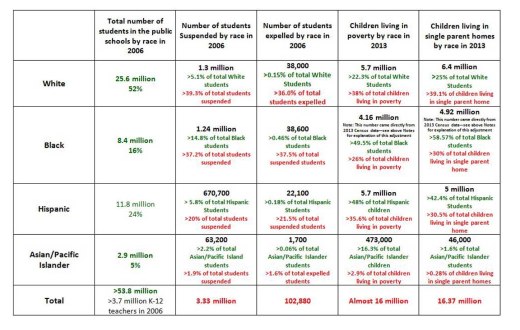
Therefore, this update includes a new chart with more information. Using the information in this chart, we will attempt to compare the ratio of White children living in poverty and single parent homes to see if the suspensions of Blacks, Hispanics and Asian/Pacific Islander students was equal or close to the ratio of White students who were suspended.
Using 22.3% of total white students living in poverty and 5.1% of total white students who were suspended as the base, then 49.5% of Black students living in poverty is 2.2 times the number of White students. This equals 11.22% of 8.4 million. If racism was a factor in the additional 3.58% of Black student who were suspended, then 300,720 Black students might have been suspended due to racist tendencies leaving 74.9% of the total students suspended due to factors that might have been related to growing up in poverty and/or single parent homes.
Using 25% of total White students living in single family homes and 5.1% of students who were suspended as the base, then 58.57% of Black students living in single parent homes is 2.34 times the number of White students or 11.9% instead of 14.8% of black students suspended offering evidence that racism might have been a factor in 2.9% of the suspensions of Black students. If true, then 240,400 Black students might have been suspended due to racist tendencies leaving 83.3% of the total students suspended that might have been related to growing up in poverty and/or single parent homes.
The ratio of Hispanic students who live in poverty is 2.15 times the number of White students and that ratio is equal to 10.97% instead of the 5.8% who were suspended offering no evidence that racism was a factor in the suspension of Hispanic students.
The ratio of Hispanic students who live in single family homes is 1.7 times the number of White students and this ratio is equal to 8.64% instead of the 5.8% of Hispanic students who were suspended offering no evidence that racism was a factor in the suspensions of Hispanic students.
The ratio of Asian/Pacific Islander students who live in poverty is 0.73 times the White students who live in poverty and this ratio is equal to 3.72% instead of the 2.2% of total Asian/Pacific Islander students who were suspended offering no evidence that racism was a factor in the suspensions of Asian/Pacific Islander students.
The ratio of Asian/Pacific Islander students who live in single parent homes was 0.4 times the White students and this ratio was equal to 2.42% instead of the 2.2% who were suspended offering no evidence that racism was a factor in the suspensions of Asian/Pacific Islander students.
In conclusion, poverty and growing up in single family homes is a much larger factor in the number of student suspensions than racism, and a transparent, public school, national, early childhood education program starting as early as age two might have a large impact that will eventually reduce poverty and increase literacy and life-long learning skills in children who grow up in poverty and/or single parent homes. Racism is another issue and other methods will be necessary to deal with this challenge. I don’t think early childhood education will have much of an impact in reducing racism.
SECOND UPDATE
Because I asked this question in my post there was an explosion on Twitter taking me to task for not focusing on racism and not admitting that it was a problem.
In the original post I wrote, “When 6.1% of the total students are suspended from public schools—or less as you will see—is that cause for a national crises and is it evidence of alleged racism?” … Later in the post, I also said, “Some critics have even alleged that the ratio of Black children being suspended is a sign of racism. I disagree, but you will have to make up your own mind after you look at all the numbers and in this post there are a lot of numbers to wrap your critical thinking around.”
Here is my response to one of the reactions that arrived as an e-mail. Too bad they couldn’t have left a comment here so we could have talked it over and explored the issue here where others could follow along.
My reply, I can see that racism is a topic you are passionate about. I think you even prove my point with your examples. We can’t stop racism, but we can help children who live in poverty and/or who grow up in single parent homes by implementing a public school managed national early childhood education program so those children grow up with the tools that will help them escape poverty and combat racism without anger and a sense of helplessness.
That’s why I refuse to allow the focus of my post to be hijacked by people obsessed with racism. …
What do you propose we do to stop racism—-send out mobs of vigilantes to hang anyone we suspect of racist tendencies?
I think the strongest weapon we can give victims of racism is literacy and an education and a good start, our best chance, would be a transparent publicly managed national early childhood education program that is not managed by corporations, because the evidence is strong that corporate Charters are racist because they encourage segregation and mostly refuse to work with the children who suffer the most from racism—at-risk children who grow up in poverty and/or single parent homes.
We can stay angry at racists, or we can eventually defeat racism by doing something about childhood poverty by intervening in the development of children as young as age two. They did it in France more than thirty years ago and poverty has dropped more than 50% since.
FIRST UPDATE
It came to my attention this morning (1-7-2015) that this post was severely criticized and attacked by some of the members of a site (TBATS) that recommended the post to their members—TBATS has deleted the recommendation and apologized to those who complained. The reason for this is because one paragraph in this post quoted information for one post at the conservative Heritage Foundation.
I want to make it clear that the numbers used in the chart did not come from the Heritage Foundation. They came from other sources, and I made the mistake of listing those sources further down in the post—and for that confusion, I apologize but for nothing else. I think this post was unfairly criticized. I have now moved those links, and they may be found right below the chart.
The only information quoted from the Heritage Foundation was the quote in that one paragraph about “children raised in single-parent homes are more likely to have emotional and behavioral problems; be physically abused; smoke, drink, and use drugs; be aggressive; engage in violent, delinquent, and criminal behavior; have poor school performance; and drop out of high school.” Nowhere in that quote was race mentioned.
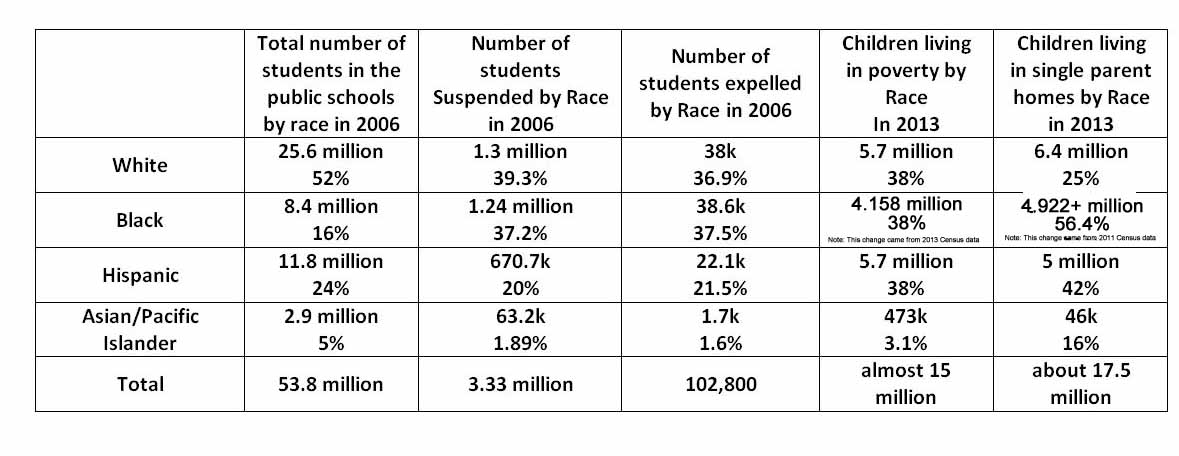
However, because of the criticism of my post based on that one quote in one paragraph from the Heritage Foundation—a foundation that has been linked to ALEX and support from the Koch brothers and Bill Gates—that had nothing to do with the data in the chart, I decided to go directly to the U.S. Census.gov to verify some of the data that I used in the chart and made two revisions where—if you visit the actual Census data—you will discover that the total number of Black or African American family households was (in Table 1) 8,726,419, and that 836,460 single family households were are led by a male, while 4,085,938 were led by female householders for a total of 4,922,398 or 56.4% of the total number of Black and African American households in 2011. I have corrected the chart to show 56.4% instead of the 67% quoted from a 2013 source—that was not the Heritage Foundation. In addition, about 43.6% of Black or African American family households were led by married couples.
I then turned directly to the U.S. Census for info about poverty by race and found this data from 2013. In 2013, 38% (4.158 million) of Black or African-American children under 18 years lived in families below poverty. I used the data for Black Alone on page 53, Table B-2. The previous number that was quoted in my chart from another 2013 source was much lower.
Here is the actual pull quote from the conclusion of the study that the Heritage Foundation quoted in their piece:
“A large body of research has documented the disadvantages of children raised in single-parent homes relative to children raised in two-parent homes. Lower high school graduation rates, lower GPAs, and greater risk for drug abuse are only some of the negative outcomes associated with growing up in a single-parent home. … This paper has been a review and critique of research from the past few decades regarding single parenthood. While the economic and social costs of single parenthood have been well documented, the strengths of single parents and their children have been largely overlooked.”
I think we might be able to learn something from this—that just because information comes from a conservative source doesn’t mean that information is wrong. Just like we sometimes have to follow the money, we also have to go to the original source.
THE ORIGINAL POST STARTS NEXT
In 2006, the U.S. public schools suspended students 3.3 million times. Note that I did not say 3.3 million students, because that might be misleading as you will see if you keep reading.
There is currently a group in the United States demanding that teachers and schools be restricted when it comes to suspending children from classrooms and schools. It would be interesting to know who is funding this issue and pushing it. Is it Arne Duncan who is the Secretary of the federal Department of Education or is it Bill Gates who is funding the push for Common Core standardized testing with $5 – $7 billion—test results that will be used to rank and fire teachers in addition to close public schools and turn our children over to corporations to teach even if parents don’t want that?
Corporate education reformers love throwing around numbers like 3.3 million, because that will make the public schools look really bad, and big numbers tossed out like that look so impressive to people who are easy to fool.
I decided to dig deeper to understand what that number really means.
In this post, we will explore what is behind the suspension and expulsion rates in the United States, because the public schools have been criticized for suspending too many students. Some critics have even alleged that the ratio of Black children being suspended is a sign of racism. I disagree, but you will have to make up your own mind after you look at all the numbers and in this post there are a lot of numbers to wrap your critical thinking around. The followinSome critics have even alleged that the ratio of Black children being suspended is a sign of racism.g chart provides a powerful and revealing comparison and I’m interested in your conclusions from this data.
Table 169, at this National Center for Educational Statistics.gov link lists the “Number of students suspended and expelled from public elementary and secondary schools, by sex, race/ethnicity, and state: 2006”.
The ratio of children living in single family homes by race may be found through this link at Kids Count data center.org
Heritage.org says “Seventy-one percent of poor families with children are headed by single parents, mostly single mothers. Compared to children raised in an intact family, children raised in single-parent homes are more likely to have emotional and behavioral problems; be physically abused; smoke, drink, and use drugs; be aggressive; engage in violent, delinquent, and criminal behavior; have poor school performance; and drop out of high school.” The Heritage Foundation reports that in the United States, marriage drops the probability of child poverty by 82 percent.
In 2006, there were 53.8 million children in the k – 12 public schools, and there were 3.3 million suspensions representing 6.1% of the total number of students. That means almost 94% (or more) of the children did not earn a suspension. Census.gov
When 6.1% of the total students are suspended from public schools—or less as you will see—is that cause for a national crises and is it evidence of alleged racism?
If we average that 3.3 million suspensions per school, it means each school suspended an average of about 33.4 students during the 2006 school year, and a school year has about 180 instructional days—I suspect the ratio is higher for schools with higher levels of childhood poverty and there is a reason for that, and it isn’t unique to the United States as you will see if you keep reading.
If we take that per-school average of 33.4 suspensions, it equals one student is suspended on average every 5.4 days for each school—but was it always a different student or were there repeat offenders as I strongly suspect based on my 30 years of experience as a public school teacher.
When I say repeat, I mean the same student being suspended more than once during one school year, and some of those chronic offenders eventually end up with an expulsion hearing.
For instance, at the high school where I taught from 1989 to 2005 there was a 70% childhood poverty rate at the time (it’s higher today) based on free and/or reduced lunch, and 92% of the students were non-white. The teacher—we called him Mr. D—who ran the in-house suspension system—a separate classroom on campus where students were required to do worksheets (the students were not allowed to just sit and visit. If they didn’t do the academic worksheets, they’d end up returning the next day for another period suspension), said that about 5% of the students at the high school earned 95% of the average 20,000 annual referrals that teachers wrote. At the time, Nogales High School had a student population of about 2,600. Five percent equals 130 students who earned 95% of the 20,000 referrals written by teachers each year. That works out to 146 referrals for each one of those 130 students, and yes, we had students who earned referrals from more than one of their teachers on a daily basis. Some students would earn six referrals a day—one for each class—day after day and if the teacher didn’t write the referral and send the student to Mr. D in the in-house suspension center for a class suspension, that student would often disrupt the learning environment for the rest of the students in the class—stealing learning time from every child.
The teacher couldn’t teach and the other students couldn’t learn.
What if the 3.3 million suspensions in 2006 were not from 3.3 million individual children because many might have been repeat offenders. It would be nice to know how many students were suspended more than once but I couldn’t find that information. For instance, what if only 500-thousand students or less earned those 3.3 million suspensions? If correct, that would mean less than 1% of the total public school students were actually suspended from school—some multiple times.
But what if the 3.3 million suspended students were counted as individuals and not multiple offenders. Then there’s another way to look at this large but insignificant number.
There were about 7.2 million teachers in the United States in 2009. Almost 3 million taught at the elementary and middle school level. The remainder included those teaching at the post secondary, secondary, preschool, kindergarten levels, special education and other teachers or instructors.
Taking the total number of teachers into account, if we divided the 3.3 million suspended students up evenly among the 7.2 million teachers, that equals 0.45 or less than half a student for each teacher for an entire school year. And even if we only counted the regular k – 12 teachers it would break about even—one suspended student each school year for each teacher. Source: U.S. Bureau of Labor Statistics as cited in the Statistical Abstract of the United States: 2011, Table 615 <https://www.census.gov/compendia/statab/>
And if all we do is count just the 3.7 million full-time-equivalent (FTE) elementary and secondary school teachers engaged in classroom instruction in fall 2012, then for every teacher there was 0.89% of a student suspended from a school for breaking rules and/or disrupting the educational environment so other students couldn’t learn. nces.ed.govDo you know of any child who is only 0.89% of a child? Where did the missing 0.11% go—did that part of the suspended student stay in the classroom to cooperate and learn?
What about the 112k who were expelled from all of the public schools in 2006?
If we average that 112k, it becomes about 1.1 students for each school in the United States. Is that excessive requiring an act of Congress to control, and what happens to the Common Core standardized test scores that are being used to rank and fire teachers in only the public schools when teachers are forced to keep disruptive students in the classroom who literally rob learning time from all of our children—the 94% that don’t earn suspensions?
What about suspensions and expulsions in the other OECD nations, or is this something that Arne Duncan, Bill Gates and the other corporate education reformers don’t want America to know—because some OECD countries have higher rates of suspension and expulsion than the United States does?
The corporate reformers can avoid this information in their allegations of the US public schools, but they can’t hide it. The Stanford Graduate School of Education reported in January 2013 that Poor ranking on international tests misleading about U.S. performance and said, “There is an achievement gap between more and less disadvantaged students in every country; surprisingly, that gap is smaller in the United States than in similar post-industrial countries, and not much larger than in the very highest scoring countries. Achievement of U.S. disadvantaged students has been rising rapidly over time, while achievement of disadvantaged students in countries to which the United States is frequently unfavorably compared – Canada, Finland and Korea, for example – has been falling rapidly.”
In addition, while fewer than 3 percent of students in 13 countries—including Japan, Norway, and the United Kingdom—reported ever repeating a grade, more than 25 percent of students repeated at least once in France, Spain, Brazil, and a dozen others studied. The United States reported more than one in 10 students (10 percent) repeating a grade, higher than the OECD average, while the top-performing countries, Finland and Korea, do not allow grade retention. … The OECD found that both high rates of grade retention and transfer happened in countries in which a child’s socioeconomic status was more likely to predict that child’s academic performance. Education Week.org
What happens to teachers if the Department of Education and/or the U.S. Congress caves in to pressure from special interest groups—possibly funded by Bill Gates or the Walton family—and drafts legislation that takes away a teacher or school’s power to suspend or remove a student through expulsion—especially when teachers are being ranked and then fired based on the Common Core standardized test results of a teacher’s students?
If being ranked and fired by those test scores becomes a reality for every public school teacher, then every instructional and/or learning minute will become vitally important and forcing teachers to keep children who cause problems and disrupt the learning environment will cripple a teacher’s ability to teach.
Maybe that’s what President Obama, Arne Duncan, Bill Gates and the Walton family want to happen so they can turn our children over the corporations to brainwash.
In conclusion, if you are one of the critics of public education who thinks 3.3 million (6.1%) children suspended from the public schools in one school year is too many, then instead of passing laws restricting the public schools’ ability—because these laws will not impact the corporate Charter schools that also are not required to teach to the Common Core—to decide who gets suspended, consider looking at what causes those children to disrupt the classroom—for instance, poverty and single parents families, and do something about that instead of making a teacher’s job to teach more difficult by forcing them to keep those at-risk and difficult to teach children in the classroom. And if you think the corporate reform movement has the answer, think again.
Joseph Williams, a veteran journalist and former White House correspondent for Politico, reported, “Charter schools also lead their traditional counterparts in a more disturbing trend: the number of students who are suspended or expelled each year … charter schools are far more likely to suspend students for infractions such as dress code violations and insubordination toward teachers.”
In fact, if there are suspension restrictions imposed on the public schools, those same restrictions will not be imposed on the corporate Charters just like the Common Core agenda to rank and fire teachers is not found in private-sector Charters—proving that this latest manufactured crisis in public education is another ploy by the corporate reformers to destroy the public schools.
_____________________________________
Lloyd Lofthouse is a former U.S. Marine and Vietnam Veteran,
who taught in the public schools for thirty years (1975 – 2005).
Runner Up in Biography/Autobiography
2014 Florida Book Festival
Honorable Mentions in Biography/Autobiography
2014 Southern California Book Festival
2014 London Book Festival
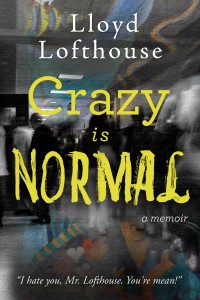
His third book is Crazy is Normal, a classroom exposé, a memoir. “Lofthouse presents us with grungy classrooms, kids who don’t want to be in school, and the consequences of growing up in a hardscrabble world. While some parents support his efforts, many sabotage them—and isolated administrators make the work of Lofthouse and his peers even more difficult.” – Bruce Reeves
Lofthouse’s first novel was the award winning historical fiction My Splendid Concubine [3rd edition]. His second novel was the award winning thriller Running with the Enemy. His short story A Night at the “Well of Purity” was named a finalist of the 2007 Chicago Literary Awards. His wife is Anchee Min, the international, best-selling, award winning author of Red Azalea, a New York Times Notable Book of the Year (1992).
To follow this Blog via E-mail see upper right-hand column and click on “Sign me up!”
True reformers seek to improve public schools and to honor the teaching profession, not to close schools, fire teachers, and turn our children over to entrepreneurs.
I have decided to break precedent today. This is the only post you will see.
I wish you and your family a happy, healthy New Year. I hope that 2015 is a year of dreams fulfilled, mountains climbed, happiness achieved. I hope all of us are able to meet the inevitable challenges and setbacks with heart and fortitude. I hope we learn and practice the virtues of patient struggle, unflagging endurance, the ability to build alliances, and the willingness to seek common ground with others.
2014 was a rough year for me, physically, and I am glad to bid it farewell. I spent most of the year thinking I would never walk again without a walker or a cane. I’m happy to report that I am walking without either, thanks to the intervention of a wise rehabilitation specialist in Cincinnati who built a rigid (temporary) cast for my bum leg…
For the second time in world history, the public schools of a country are under attack by powerful men. The first time a country waged war on its public schools was when Mao launched China’s Cultural Revolution (1966 – 1976).
How successful was Mao in destroying more than 2,000 years of public school tradition in
China? The answer may shock you. By the time Mao died in 1976, the literacy rate in China had plunged to 20%, and the poverty rate was 85%.
In the United States the biggest crime of the corporate education reformers is chasing profits and not dealing with the challenges of poverty. In fact, corporate education reform supported by billionaire oligarchs—for instance, Bill Gates, the Walton family, Eli Broad, and the Koch brothers—are doing nothing to deal with poverty. Instead they claim that if they get wealthier that will somehow magically solve poverty. When, at any time in history, has the wealthy solved poverty by getting richer?
In a Chicago Sun Times Op-Ed piece, Laura Washington writes about Ted Manuel, an African American who lives in Hyde Park: Manuel said, ‘Although we have one or more churches on every other block, what effect are the preachers having? Why is there no partnering of schools with corporations, where glimpses of future possibilities can inspire the kids? I know of no such connections, if they exist.’”
To answer Ted Manual’s questions, the reason that corporate education reformers are doing nothing about poverty is because dealing with the causes of poverty is not profitable.
And how can the public schools do anything? Funds for public schools have been cut drastically while other funds have been diverted to the Common Core test taking culture supported and driven by Bill Gates—the wealthiest man in the world. Mao had his Little Red Book, and Bill Gates has his Common Core.
Who will profit the most from Bill Gates war on the public schools? UK’s Pearson—a company that will make money every time an American child takes one of their tests, and they want to test children from pre-school to high school graduation—hours of tests annually.
What about China? Starting in the late 1970’s under Deng Xiaoping’s leadership, who do you think China learned from as they started to rebuild their public schools after Mao’s Cultural Revolution?
If you answered the United States and Europe, you would have been right. China sent teams to the United States to learn from America’s public schools—and this all happened before A Nation at Risk, NCLB, Race to the Top and Common Core—and according to the last two international PISA tests, China’s 15-year-olds in Shanghai are ranked #1 in the world thanks to what China learned in the United States before the corporate war on public education.
In fact, China is moving away from a test-based public education system and toward what the United States is abandoning thanks to Bill Gates and the $5 – $7 billion he is spending in his crusade to destroy what works and replace it with a market-based education system that several Stanford studies have already proved is a failure.
Education Week.com reported in 2010 that Schools in China and U.S. Move in Opposite Directions. Schools in China are slowly trying to break away from their emphasis on memorization (and testing) toward adopting strategies that stress creativity. Until now, schools believed that the former was the best way to score high on the gao kao (the college entrance exam taken the last year of high school). But recognizing that the approach is counterproductive in the new global economy, China is attempting to change.
Meanwhile, Education Week.com says, “In the U.S., a different trend is underway. Convinced that high-stakes tests are the best way to measure educational quality and assure our economic hegemony, (corporate) reformers are running roughshod over those who believe otherwise.”
France dealt with poverty more than thirty years ago when they introduced a national early childhood education program starting as young as age two, a program that is transparent and part of the French public education system. France, unlike the United States, puts its education dollars in one pot and then shares that money equally among all of its public schools. But in the U.S. funding is not equitable. School districts in wealthy communities spend heavily on their public schools while schools in communities infected with poverty spend much less.
Thirty years after France implemented its national early childhood education program in the public schools—not run by the private sector—poverty has been cut drastically. In 1970, 15% of France’s population lived in poverty. By 2001, only 6.1% lived in poverty. In 1970, about 86% of the population of France was literate, but by 2003, the literacy rate improved to 99%. – Our World in Data.org
China had to wait for Mao to die before its war on public education ended. Will the United States have to wait for the oligarchs to all die before the corporate war on public education ends?
Don’t forget, Mao had his Little Red Book, and Bill Gates has his Common Core.
_______________________
Lloyd Lofthouse is a former U.S. Marine and Vietnam Veteran,
who taught in the public schools for thirty years (1975 – 2005).
Runner Up in Memoir 2014 Florida Book Festival
Honorable Mention in Biography/Autobiography
2014 Southern California Book Festival and at the 2014 London Book Festival
His third book is Crazy is Normal, a classroom exposé, a memoir. “Lofthouse presents us with grungy classrooms, kids who don’t want to be in school, and the consequences of growing up in a hardscrabble world. While some parents support his efforts, many sabotage them—and isolated administrators make the work of Lofthouse and his peers even more difficult.” – Bruce Reeves
Lofthouse’s first novel was the award winning historical fiction My Splendid Concubine [3rd edition]. His second novel was the award winning thriller Running with the Enemy. His short story A Night at the “Well of Purity” was named a finalist of the 2007 Chicago Literary Awards. His wife is Anchee Min, the international, best-selling, award winning author of Red Azalea, a New York Times Notable Book of the Year (1992).
To follow this Blog via E-mail see upper right-hand column and click on “Sign me up!”
I broke a tooth over the weekend and visited the dentist this afternoon spending a few hours in THE chair. I hate those shots that numb your jaw making it feel swollen like a puffy blimp. In a few days I will return for the fitting of the crown.
But when I returned home with that numb jaw, there was a surprise—a double dose of what I think was good news.
“”“Crazy is Normal, a classroom expose” didn’t earn any awards from Writer’s Digest, but the judge’s comments were appreciated. :o)
_______________________
Lloyd Lofthouse is a former U.S. Marine and Vietnam Veteran,
who taught in the public schools for thirty years (1975 – 2005).
His third book is Crazy is Normal, a classroom exposé, a memoir. “Lofthouse presents us with grungy classrooms, kids who don’t want to be in school, and the consequences of growing up in a hardscrabble world. While some parents support his efforts, many sabotage them—and isolated administrators make the work of Lofthouse and his peers even more difficult.” – Bruce Reeves
Lofthouse’s first novel was the award winning historical fiction My Splendid Concubine [3rd edition]. His second novel was the award winning thriller Running with the Enemy. His short story A Night at the “Well of Purity” was named a finalist of the 2007 Chicago Literary Awards. His wife is Anchee Min, the international, best-selling, award winning author of Red Azalea, a New York Times Notable Book of the Year (1992).
To follow this Blog via E-mail see upper right-hand column and click on “Sign me up!”









 Crazy Normal - the Classroom Exposé