On January 20, 2015, education historian Diane Ravitch wrote an open letter to Senator Lamar Alexander regarding the upcoming reauthorization of the Elementary and Secondary Education Act (ESEA), the most recent revision of which is No Child Left Behind (NCLB). In her letter, Ravitch refers to her time as Alexander’s assistant secretary of education (research) from 1991 to 1993.
Alexander is drafting the Senate’s next version of ESEA.
At its heart, Ravitch’s letter is an appeal for Alexander to abandon the federal mandate for standardized testing in grades 3 through 8.
When I initially read Ravitch’s appeal, two thoughts occurred to me. The first was that Ravitch and Alexander have known one another for decades, with Alexander choosing Ravitch as assistant secretary of education despite his being a Republican and her being a Democrat– which means she must have impressed him enough to set aside issues of political party…
Kay McSpadden, a high school teacher and writer in South Carolina, notes a striking irony. In the midst of School Chiice Week, two major reports appeared that showed the success of our public schools.
The federal National Center for Education Statistics “report shows that in schools with less than 25 percent poverty rates, American children scored higher in reading than any other children in the world. In. The. World.
“The takeaway is simple. Our middle-class and wealthy public school children are thriving. Poor children are struggling, not because their schools are failing but because they come to school with all the well-documented handicaps that poverty imposes – poor prenatal care, developmental delays, hunger, illness, homelessness, emotional and mental illnesses, and so on.”
A second report, by the Horace Mann League and National Superintendents Roundtable, says the United States is, “by far, the wealthiest and best-educated of the nine G-7…
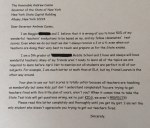
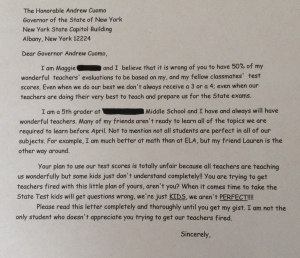
Two days ago, I published a letter from Josh – a fourth grader from NYC. That one letter has gotten over 13,000 views from all over the globe. I truly believe IT IS TIME for STUDENT VOICES to be heard. Today I received this letter from the parent of Maggie – a fifth grader from Central NY State. I am honored to share Maggie’s letter with my readers.
Maggie is the fourth Student Hero presented on this Poetic Justice blog. She, too, is bold and brave and not afraid to put her opinions in writing. I truly hope that Maggie’s letter will be read by many and will encourage other students to voice their opinions in writing to the governors of their states.
As Maggie writes:
“Please read this letter completely and thoroughly until you (Governor Cuomo) get my gist. I am not the only student who doesn’t appreciate you…
This is a balanced and fair assessment of Josh Starr’s tenure as superintendent of the Montgomery County, Maryland, public schools.
Starr seeks collaborative relationships with parents and staff. He is no fan of high-stakes testing. He has directed more funding to schools that enroll more students with high needs than to those with fewer such students.
“Starr says he is focused on making sure all MCPS students receive the same quality education and has begun programs to help them get ready for college, including one with Montgomery College and The Universities at Shady Grove. He is also pushing for the expansion of “project-based learning” programs in high schools that incorporate hands-on learning and real-world projects to teach students to be critical thinkers and problem solvers.
“He has put in place a data-driven, early-alert system to identify students who are at risk of failing, and has told principals and teachers to…
Georgia’s recently elected State Superintendent Richard Woods wrote a terrific letter to Secretary of Education Arne Duncan, explaining patiently why federal testing mandates are defective. The letter was printed in Maureen Downey’s blog at the Atlanta Journal-Constitution.
Superintendent Woods sounds like a veteran educator, which he is. He pulls no punches. This is what he wrote:
Dear Secretary Duncan,
With the reauthorization of the Elementary and Secondary Education Act (ESEA) comes an opportunity to address the valid concerns of students, parents, teachers, and communities regarding the quantity and quality of federally mandated standardized tests.
As Georgia’s School Superintendent, I have a constitutional duty to convey those concerns and provide ideas on how to move my state and our nation forward. Georgia recently entered into a $108 million contract to deliver federally mandated standardized tests to our students. That figure does not include the millions of dollars spent to develop and…
While charter advocates assert that competition will cause public schools to improve, this is not what is happening in Pennsylvania. Charters make alluring promises and drain away students and funding. The public schools, with less resources, goes into a tailspin, soon finding that it must cut programs and services, making it less able to compete with charters.
Meanwhile, more than one Stanford study concludes that corporate Charters are mostly worse or the same as the public schools that they are destroying.
Moody’s Investors Servicrs paints a gloomy picture of the effects of charter schools on public schools in Pennsylvania.
Moody’s writes:
“Some fiscally stressed Pennsylvania public school districts have come up with new approaches for combating a primary pressure point: competition from charter schools, Moody’s Investor Service says in a new report. Some of the plans would be transformative, such as a proposal to send all students to other school districts and pay tuition, or to operate a public school district as all-charter.
“Some financially stressed districts have offered recovery proposals that fundamentally alter the nature of their public school district operations,” says Moody’s Assistant Vice President — Analyst, Dan Seymour. “The bold plans face near-term execution challenges, but are positive in the long run as some of these districts would continue to deteriorate without significant structural changes. The strong measures are more likely to lead to long-term financial and operational…
In a recent Facebook discussion about PARCC and the Common Core State Standards, I commented that the Common Core standards are developmentally inappropriate in the younger grades. Another participant in the discussion challenged that assertion, and pointed to the CCSS kindergarten literacy standards. He asked me to identify what was inappropriate in them.
Here’s an edited and expanded version of my response:
I think pointing to the Reading:Literacy Standards (Kindergarten) for an analysis of developmental inappropriateness misses the mark. My concern with the standards for the youngest grades is not with the Reading: Literacy Standards, which are about comprehension and understanding stories, but rather with the Reading: Foundational Standards (Kindergarten), which are about phonics and decoding words. The Reading: Foundational Standards require ALL kindergartners, for instance, to be reading CVC words (i.e., 3 letter short vowel words) by the end of kindergarten, unless those words end with r…
This list reveals the most dangerous enemies of public education and how they earned their spot in infamy. To discover why they landed on this list, click the links included with each name below the brick wall. This list is subject to change at any time.
#1 #BillGates Spending billions to destroy Public Schools with testing agenda to rank & fire teachers Living in Dialogue
#2
The #Waltons
Why are #Walmart Billionaires Bankrolling Phony School Reform Bill Moyers.com
If you want to suggest someone who deserved to be added to the extended list—beyond the Top Ten—please leave a comment with a name and provide a link to evidence that shows why they deserve a spot on the extended list of public education’s worst enemies.
Lloyd Lofthouse is a former U.S. Marine and Vietnam Veteran,
who taught in the public schools for thirty years (1975 – 2005).
Runner Up in Biography/Autobiogrpahy
2015 Florida Book Festival
Honorable Mention in Biography/Autobiography 2014 Southern California Book Festival
2014 New England Book Festival
2014 London Book Festival
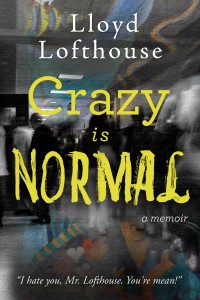
His third book is Crazy is Normal, a classroom exposé, a memoir. “Lofthouse presents us with grungy classrooms, kids who don’t want to be in school, and the consequences of growing up in a hardscrabble world. While some parents support his efforts, many sabotage them—and isolated administrators make the work of Lofthouse and his peers even more difficult.” – Bruce Reeves
Lofthouse’s first novel was the award winning historical fiction My Splendid Concubine [3rd edition]. His second novel was the award winning thriller Running with the Enemy. His short story A Night at the “Well of Purity” was named a finalist of the 2007 Chicago Literary Awards. His wife is Anchee Min, the international, best-selling, award winning author of Red Azalea, a New York Times Notable Book of the Year (1992).
To follow this Blog via E-mail see upper right-hand column and click on “Sign me up!”
Anthony Cody left a comment on the Education Bloggers Network Central about an ETS report on education to serve the economy. “The ETS is basically Pearson Education these days,” said Paul Horton in another comment.
This means ETS is a mouthpiece for Pearson PLC, a British multinational publishing and education company headquartered in London. Pearson is the largest—for profit—education company and the largest book publisher in the world, and Pearson has been funding media propaganda and lobbying elected officials to use the unproven and flawed Common Core State Standards and Pearson’s copyrighted tests in the U.S. for those standards.
Guess who gets paid every time a student takes one of those Pearson copyrighted Common Core tests that the Bill and Melinda Gates Foundation is spending hundreds of millions of dollars to use as a way to rank and fire teachers while closing public schools and then turning our children over to corporate Charters that several Stanford studies report are worse or the same as the public schools they are replacing.
If you guessed Pearson, you were right. Pearson—with help from Bill Gates’s billions—is behind testing our children toward failure. Watch the video to discover what that means for our children.
“I believe in standardizing automobiles. I do not believe in standardizing human beings. Standardization is a great peril which threatens American culture.” > Albert Einstein
ETS made misleading claims in their press release that announced the (economic corporate education reform) meeting to be held in Washington D.C. on February 17, 2015, that left out many important facts about public education in the United States.
For instance:
The Economic Policy Institute reports, U.S. poverty rates higher, safety net weaker than in peer countries—the U.S. is ranked dead last for percentile as a share of median worker earnings in 21 selected OECD countries.
The functional literacy rate when comparing the United States to Canada, Australia, New Zealand and the UK—five English speaking countries that all belong to the OECD. > Literacy Comparison
The college graduation ranking for the United States compared to every country on the planet as reported by World Atlas.com. The United States is ranked #4 on the top 10 most educated nations list—and there are 196 countries in the world today. The United States is in the top two percent for college graduates.
More than 16 million childrenin the United States – 22% of all children – live in families with incomes below the federal poverty level– $23,550 a year for a family of four. Research shows that, on average, families need an income of about twice that level to cover basic expenses. Using this standard, 45%—or more than 33 million—of children live inlow-income families. > nccp.org
How does that number of children living in poverty compare to 34 OECD countries? Answer: OECD.org reports that 13% of all children were poor in 2010. The only OECD countries with childhood poverty rates higher than the United States were: Chile, Mexico, Romania, Turkey and Israel.
In addition,Stanford.edu reported in a study that: “Based on their analysis, the co-authors found that average U.S. scores in reading and math on the PISA are low partly because a disproportionately greater share of U.S. students comes from disadvantaged social class groups, whose performance is relatively low in every country.
“As part of the study, Carnoy and Rothstein calculated how international rankings on the most recent PISA might change if the United States had a social class composition similar to that of top-ranking nations: U.S. rankings would rise to sixth from 14th in reading and to 13th from 25th in math. The gap between U.S. students and those from the highest-achieving countries would be cut in half in reading and by at least a third in math.”
The report also found: There is an achievement gap between more and less disadvantaged students in every country; surprisingly, that gap is smaller in the United States than in similar post-industrial countries, and not much larger than in the very highest scoring countries.
Achievement of U.S. disadvantaged students has been rising rapidly over time, while achievement of disadvantaged students in countries to which the United States is frequently unfavorably compared – Canada, Finland and Korea, for example – has been falling rapidly.
Note: countries that score high on the PISA have low rates of childhood poverty. Childhood poverty in Canada is about 14%, in Finland it’s less than 5%, and in South Korea it’s less than 10%.
The Global Innovation Index rankings, comparing 143 countries, lists the United States as #6 with a score of 60.09—92.7% of first place Switzerland’s index rank of 64.79. That means the U.S. was ranked higher than almost 96% of the world’s countries.
Alternet.org reports that “New Data reveals our public—not private—school system is among the best in the world. In fact, except for the debilitating effects of poverty, our public school system may be the best in the world.” Paul Buchheit writes, “Perhaps most significant in the NCES readingresults is that schools with less than 25% free-lunch eligibility scored higher than the average in ALL OTHER COUNTRIES. “
Maybe I should have titled this post: “The Misleading lies that Pearson and Bill Gates keep telling us” or “For Profit and Wealth, Blame it on the Teacher as Usual”.
_______________________
Lloyd Lofthouse is a former U.S. Marine and Vietnam Veteran,
who taught in the public schools for thirty years (1975 – 2005).
Runner Up in Biography/Autobiogrpahy
2015 Florida Book Festival
Honorable Mention in Biography/Autobiography 2014 Southern California Book Festival
2014 New England Book Festival
2014 London Book Festival
His third book is Crazy is Normal, a classroom exposé, a memoir. “Lofthouse presents us with grungy classrooms, kids who don’t want to be in school, and the consequences of growing up in a hardscrabble world. While some parents support his efforts, many sabotage them—and isolated administrators make the work of Lofthouse and his peers even more difficult.” – Bruce Reeves
Lofthouse’s first novel was the award winning historical fiction My Splendid Concubine [3rd edition]. His second novel was the award winning thriller Running with the Enemy. His short story A Night at the “Well of Purity” was named a finalist of the 2007 Chicago Literary Awards. His wife is Anchee Min, the international, best-selling, award winning author of Red Azalea, a New York Times Notable Book of the Year (1992).
To follow this Blog via E-mail see upper right-hand column and click on “Sign me up!”
Strangely, we are now confronted with a different brand of revolutionaries, education reformers who seek not to expand democracy, but instead to restrict it and not to wage a war to end poverty, but instead to make a path for a lucky few to escape from poverty.
Arthur Camins, director of the Center for Innovation in Engineering and Science Education at the Stevens Institute of Technology in Hoboken, N.J., remembers when the idea of revolution was about social equality and a just, humane society. That was then. This is now.
But something has happened to the revolution.
He writes:
“Strangely, we are now confronted with a different brand of revolutionaries, education reformers who seek not to expand democracy, but instead to restrict it and not to wage a war to end poverty, but instead to make a path for a lucky few to escape from poverty. Lennon lyrics may now have meaning when self-proclaimed “game-changers” advocate improvement through disruptive innovation. Their vision is at once expansive — disrupt the basic structure of democratically governed public education — and pathetically small and selfish — provide competitive opportunities for advancement for the few.
“Today’s education revolutionaries believe that they…





 Crazy Normal - the Classroom Exposé