Jessica Calefati of the San Jose Mercury-News wrote a shocking series about the online charter schools of K12 Inc., which have the lowest graduation rate in the state, and which counts students “present” if they log on for only one minute.
Millions of public dollars fund the California Virtual Academies (CAVA), which operates for profit and is listed on the New York Stock Exchange. The company, founded by Michael and Lowell Milken, delivers a substandard education. It should be closely supervised or shut down.
Unfortunately, as Calefati discovered, the legislature is moving at a snail’s pace to authorize an audit of CAVA. Nothing seems to be happening. Much clucking of tongues, but no action.
CAVA is the lowest performing school in the state. Why hasn’t it been shut down long ago? If you recall, K12’s online charter in Tennessee was the lowest performing school in the state, and not even…
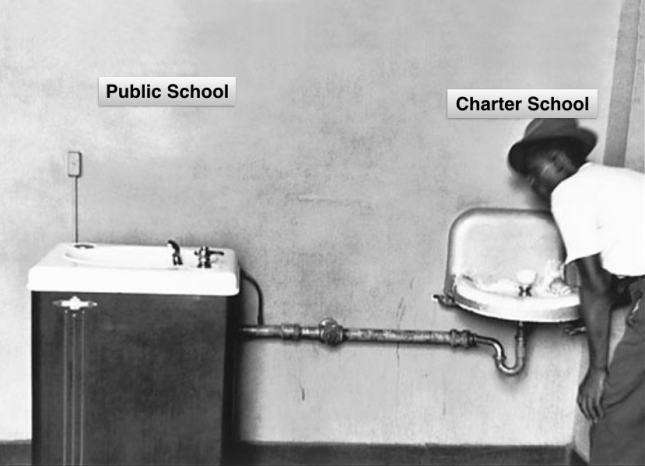
School choice boosters rarely if ever couch their support in these terms, but when touting charter schools over traditional public schools, this is exactly what they’re advocating.
According to the Civil Right Project at UCLA, “The charter school movement has been a major political success, but it has been a civil rights failure.”
This post by Paul Thomas is a perfect example of how the autocratic, for-profit at any price, corporate public education reform (defraud) movement misleads and fools people.
The ‘advertorial’ is, in my opinion, the lowest form of advertising. Perhaps you’ve never heard this word before, but you have surely nearly fallen for this kind of deceit when reading what you think is a newspaper article with a flashy headline before noticing, in small print, the words ‘advertisement.’
An ‘Advertorial’
Education Week used to be the gold standard in education reporting. I can remember how proud I was in October 1995 when, at just 25 years old, I got my first ‘published’ article in a ‘real’ publication, Education Week’s Teacher Magazine, for a piece I wrote called ‘Natural Born Teacher.’ Over the next six years, I was always so proud whenever I’d get a piece accepted into either Teacher Magazine or Education Week.
As the internet grew and Twitter gained popularity, I joined and of course followed Education Week. Though I’ve found Education Week to be generally slanted…
So there will be no discussion of your concerns, no defense of the questions in question. Instead you’ll be threatened to silence.
This is the Catch-22 for teachers, parents and children throughout the nation.
We know the federally mandated high stakes assessments public school children must take are poorly constructed, culturally and racially biased, and ultimately unfair. But if we speak up in public with any kind of specificity, we’re threatened with steep fines. And if we write about it on-line, those articles will be taken down, censored or otherwise disappeared.
Grace Davis is a sophomore at Ponderosa High School in Parker, Colorado. She was upset that so many teachers left every year, and she decided to hold a student protest to call attention to the issue. (I posted about this here on May 8). She got clearance from the school. She read about her First Amendment rights. She thought everything was set.
Two members of the school board asked to meet with her. One is the president of the board. Grace brought a recording device with her and taped the meeting. From her research, she knew it was legal to tape a conversation without the consent of all parties under Colorado law.
The meeting lasted an hour and a half. (Grace missed a class while she was harangued.) The board members warned her that her family would be liable for any damages…
Pearson Education is a British-owned education publishing and assessment service to schools and corporations, as well as directly to students. Pearson owns educational media brands including Addison–Wesley, Peachpit, Prentice Hall, eCollege, Longman, Poptropica, and others. Though Pearson generates approximately 60% of its sales in North America, they operate in more than 70 countries. The company was founded in the UK in 1844 by Samuel Pearson as a building and engineering concern. Pearson didn’t enter the education industry until 1996 when it bought the education division of Harper Collins from News Corp.
Pearson is now organized into three main business groupings: Pearson School, Pearson Higher Education and Pearson Professional (includes Financial Times Group and Pearson English). In 2011 Pearson generated total revenues of £5.9 billion (about 8.5 billion US Dollars), of which £4,390 million were from Pearson Education, £1,045 million from Penguin Group, and £427 million from Financial Times Group. In 2011, 60% of Pearson’s revenues were generated in North America, 23% in Europe, 11% in Asia, and 6% in the rest of the world.
Fortune Magazine published Everybody Hates Pearson. “Legions of parents, teachers, and others (in the United States) see the new Pearson in a very different light. Many of them, particularly in North America, where the company does some 60% of its sales, think of it as the Godzilla of education. In their view, Pearson is bent on controlling every element of the process, from teacher qualifications to curriculums to the tests used to evaluate students to the grading of the tests to, increasingly, owning and operating its own learning institutions.”
“In the U.S., testing is the most searingly divisive issue. The business of assessing students through high school has grown 57% in just the past three years, to $2.5 billion, according to the Software & Information Industry Association. Some believe ‘high-stakes testing’ is the best way to create accountability; others think it measures little and incentivizes the wrong things.”
“Today analysts think Pearson controls some 60% of the North American testing market.”
Recently Pearson used its financial power to censor American activists protesting over testing with poorly designed for-profit tests from autocratic private sector corporations that can be used to close public schools, fire teachers, block students from graduating from high school and teachers from becoming teachers. Imagine spending four to six years in college learning to become a public school teacher, and then a for-profit test from Pearson, that many cannot pass even after several expensive attempts, keeps them from becoming a teacher.
Outrage on the Page said, “There are layers of not-so-subtle issues that need to be aired as a result of national and state testing policies that are dominating children’s lives in America. As any well prepared educator knows, curriculum planning and teaching requires knowing how you will assess your students and planning backwards from that knowledge. If teachers are unable to examine and discuss the summative assessment for their students, how can they plan their instruction?” … “right out of the gate, 4th graders are being asked to read and respond to texts that are two grade levels above the recommended benchmark. After they struggle through difficult texts with advanced vocabulary and nuanced sentence structures, they then have to answer multiple choice questions that are, by design, intended to distract students with answers that appear to be correct except for some technicality.”
Using U.S. copyright laws, it is obvious that Pearson is censoring anyone who attempts to reveal the quality and validity of these profitable tests that the Economic Policy Institute reports, “A review of the technical evidence leads us to conclude that, although standardized test scores of students are one piece of information for school leaders to use to make judgments about teacher effectiveness, such scores should be only a part of an overall comprehensive evaluation. … Based on the evidence, we consider this unwise. Any sound evaluation will necessarily involve a balancing of many factors that provide a more accurate view of what teachers in fact do in the classroom and how that contributes to student learning. … there is broad agreement among statisticians, psychometricians, and economists that student test scores alone are not sufficiently reliable and valid indicators of teacher effectiveness to be used in high-stakes personnel decisions, even when the most sophisticated statistical applications such as value-added modeling are employed.”
Front Line (PBS) reported that “Pearson is the leading scorer of standardized tests. … The National Board on Educational Testing and Public Policy at Boston College compiled data from The Bowker Annual, a compendium of the dollar-volume in test sales each year, and reported that while test sales in 1955 were $7 million (adjusted to 1998 dollars), that figure was $263 million in 1997, an increase of more than 3,000 percent. Today, press reports put the value of the testing market anywhere from $400 million to $700 million.” NCS Measurement Service’s (testing nearly 40 million students annually, more than any other company in the U.S.) was acquired by Pearson in September 2000 for $2.5 billion. Pearson reported $629.5 million in sales in 2000 and 32% of that came from testing services.
I find it strange that President George W. Bush signed the No Child Left Behind Act into law on January 8, 2002 leading to huge profits for Pearson and other for-profit corporations that publish for-profit high stakes tests. If you want to learn how much Pearson spends annually in lobbying for its corporate agenda, click OpenSecrets.org. In 2001, Pearson didn’t spend any money on lobbying. In 2002, Pearson spent $400,000, $540,000 for 2003, $336,000 in 2004, $136,000 in 2005, $70,000 in 2006, $181,250 in 2007, $710,000 in 2008, $842,072 for 2009, one million dollars in 2010, the year the Common Core high stakes tests came out, $1,040,000 in 2011, $1,020,000 in 2012, $850,000 in 2013, $500,000 in 2014, and $400,000 in 2015.
In January 2015, the CEO of Pearson, John Fallon (should be Felon instead of Fallon) said, ““It doesn’t matter to us whether our customers are hundreds of thousands of individual students and their parents in China, or thousands of school districts in America,” says Fallon. “What we’re trying to do is the same thing—to help improve learning outcomes.”
But collaboration and final decision making must including all stakeholders—teachers, students and parents—because it is the best way to improve learning outcomes. Knowing this, please help explain why UK’s Pearson is so obsessed with all the secrecy, and why use copyright laws to censor critics?
As some of you may know, Celia Oyler of TC posted an anonymous teacher’s critique of the 4th grade PARCC exam a few days ago that identified a few texts and the questions asked. Yesterday Celia received a threatening email from PARCC and removed the name of the text sources & the wording of the questions. She is now looking into challenging PARCC’s position legally.
The author of this blog posting is a public school teacher who will remain anonymous.
I will not reveal my district or my role due to the intense legal ramifications for exercising my Constitutional First Amendment rights in a public forum. I was compelled to sign a security form that stated I would not be “Revealing or discussing passages or test items with anyone, including students and school staff, through verbal exchange, email, social media, or any other form of communication” as this would be considered a “Security Breach.” In response to this demand, I can only ask—whom are we protecting?
There are layers of not-so-subtle issues that need to be aired as a result of national and state testing policies that are dominating children’s lives in America. As any well prepared educator knows, curriculum planning and teaching requires knowing how you will assess your students and planning backwards from that knowledge. If teachers are unable to examine and discuss the summative assessment for their students, how can they plan their instruction? Yet, that very question assumes that this test is something worth planning for. The fact is that schools that try to plan their curriculum exclusively to prepare students for this test are ignoring the body of educational research that tells us how children learn, and how to create developmentally appropriate activities to engage students in the act of learning. This article will attempt to provide evidence for these claims as a snapshot of what is happening as a result of current policies.
The PARCC test is developmentally inappropriate
In order to discuss the claim that the PARCC test is “developmentally inappropriate,” examine three of the most recent PARCC 4th grade items.
A book leveling system, designed by Fountas and Pinnell, was made “more rigorous” in order to match the Common Core State Standards. These newly updated benchmarks state that 4th Graders should be reading at a Level S by the end of the year in order to be considered reading “on grade level.” [Celia’s note: I do not endorse leveling books or readers, nor do I think it appropriate that all 9 year olds should be reading a Level S book to be thought of as making good progress.]
The PARCC, which is supposedly a test of the Common Core State Standards, appears to have taken liberties with regard to grade level texts. For example, on the Spring 2016 PARCC for 4th Graders, students were expected to read an excerpt from Shark Life: True Stories about Sharks and the Sea by Peter Benchley and Karen Wojtyla. According to Scholastic, this text is at an interest level for Grades 9-12, and at a 7th Grade reading level. The Lexile measure is 1020L, which is most often found in texts that are written for middle school, and according to Scholastic’s own conversion chart would be equivalent to a 6th grade benchmark around W, X, or Y (using the same Fountas and Pinnell scale).
Even by the reform movement’s own standards, according to MetaMetrics’ reference material on Text Complexity Grade Bands and Lexile Bands, the newly CCSS aligned “Stretch” lexile level of 1020 falls in the 6-8 grade range. This begs the question, what is the purpose of standardizing text complexity bands if testing companies do not have to adhere to them? Also, what is the purpose of a standardized test that surpasses agreed-upon lexile levels?
So, right out of the gate, 4th graders are being asked to read and respond to texts that are two grade levels above the recommended benchmark. After they struggle through difficult texts with advanced vocabulary and nuanced sentence structures, they then have to answer multiple choice questions that are, by design, intended to distract students with answers that appear to be correct except for some technicality.
Finally, students must synthesize two or three of these advanced texts and compose an original essay. The ELA portion of the PARCC takes three days, and each day includes a new essay prompt based on multiple texts. These are the prompts from the 2016 Spring PARCC exam for 4th Graders along with my analysis of why these prompts do not reflect the true intention of the Common Core State Standards.
ELA 4th Grade Prompt #1
Refer to the passage from “Emergency on the Mountain” and the poem “Mountains.” Then answer question 7.
Think about how the structural elements in the passage from “Emergency on the Mountain” differ from the structural elements in the poem “Mountains.”
Write an essay that explains the differences in the structural elements between the passage and the poem. Be sure to include specific examples from both texts to support your response.
The above prompt probably attempts to assess the Common Core standard RL.4.5: “Explain major differences between poems, drama, and prose, and refer to the structural elements of poems (e.g., verse, rhythm, meter) and drama (e.g., casts of characters, settings, descriptions, dialogue, stage directions) when writing or speaking about a text.”
However, the Common Core State Standards for writing do not require students to write essays comparing the text structures of different genres. The Grade 4 CCSS for writing about reading demand that students write about characters, settings, and events in literature, or that they write about how authors support their points in informational texts. Nowhere in the standards are students asked to write comparative essays on the structures of writing. The reading standards ask students to “explain” structural elements, but not in writing. There is a huge developmental leap between explaining something and writing an analytical essay about it. [Celia’s note: The entire enterprise of analyzing text structures in elementary school – a 1940’s and 50’s college English approach called “New Criticism” — is ridiculous for 9 year olds anyway.]
The PARCC does not assess what it attempts to assess
ELA 4th Grade Prompt #2
Refer to the passages from “Great White Shark” and Face the Sharks. Then answer question 20.
Using details and images in the passages from “Great White Sharks” and Face to Face with Sharks, write an essay that describes the characteristics of white sharks.
It would be a stretch to say that this question assesses CCSS W.4.9.B: “Explain how an author uses reasons and evidence to support particular points in a text.”
In fact, this prompt assesses a student’s ability to research a topic across sources and write a research-based essay that synthesizes facts from both articles. Even CCSS W.4.7, “Conduct research projects that build knowledge through investigation of different aspects of a topic,” does not demand that students compile information from different sources to create an essay. The closest the standards come to demanding this sort of work is in the reading standards; CCSS RI.4.9 says: “Integrate information from two texts on the same topic in order to write or speak about the subject knowledgeably.” Fine. One could argue that this PARCC prompt assesses CCSS RI.4.9.
However, the fact that the texts presented for students to “use” for the essay are at a middle school reading level automatically disqualifies this essay prompt from being able to assess what it attempts to assess. (It is like trying to assess children’s math computational skills by embedding them in a word problem with words that the child cannot read.)
ELA 4th Grade Prompt #3
In “Sadako’s Secret,” the narrator reveals Sadako’s thoughts and feelings while telling the story. The narrator also includes dialogue and actions between Sadako and her family. Using these details, write a story about what happens next year when Sadako tries out for the junior high track team. Include not only Sadako’s actions and feelings but also her family’s reaction and feelings in your story.
Nowhere, and I mean nowhere in the Common Core State Standards is there a demand for students to read a narrative and then use the details from that text to write a new story based on a prompt. That is a new pseudo-genre called “Prose Constructed Response” by the PARCC creators, and it is 100% not aligned to the CCSS. Not to mention, why are 4th Graders being asked to write about trying out for the junior high track team? This demand defies their experiences and asks them to imagine a scenario that is well beyond their scope.
Clearly, these questions are poorly designed assessments of 4th graders CCSS learning. (We are setting aside the disagreements we have with those standards in the first place, and simply assessing the PARCC on its utility for measuring what it was intended to measure.)
Rather than debate the CCSS we instead want to expose the tragic reality of the countless public schools organizing their entire instruction around trying to raise students’ PARCC scores.
Without naming any names, I can tell you that schools are disregarding research-proven methods of literacy learning. The “wisdom” coming “down the pipeline” is that children need to be exposed to more complex texts because that is what PARCC demands of them. So children are being denied independent and guided reading time with texts of high interest and potential access and instead are handed texts that are much too hard (frustration level) all year long without ever being given the chance to grow as readers in their Zone of Proximal Development (pardon my reference to those pesky educational researchers like Vygotsky.)
So not only are students who are reading “on grade level” going to be frustrated by these so-called “complex texts,” but newcomers to the U.S. and English Language Learners and any student reading below the proficiency line will never learn the foundational skills they need, will never know the enjoyment of reading and writing from intrinsic motivation, and will, sadly, be denied the opportunity to become a critical reader and writer of media. Critical literacies are foundational for active participation in a democracy.
We can look carefully at one sample to examine the health of the entire system– such as testing a drop of water to assess the ocean. So too, we can use these three PARCC prompts to glimpse how the high stakes accountability system has deformed teaching and warped learning in many public schools across the United States.
In this sample, the system is pathetically failing a generation of children who deserve better, and when they are adults, they may not have the skills needed to engage as citizens and problem-solvers. So it is up to us, those of us who remember a better way and can imagine a way out, to make the case for stopping standardized tests like PARCC from corrupting the educational opportunities of so many of our children.
Conclusion: secrecy, lies and opaqueness have been part of building the Testocracy Machine since the beginning in 2002, and Pearson has been involved every step of the way along with Bill Gates and other billionaire oligarchs that want control over the education of our children while theirs attend exclusive, expensive private schools. Watch the following video to discover more of the details about the secrecy behind this movement to profit off public dollars and mold the thinking of our children.
__________________________________
Lloyd Lofthouse is a former U.S. Marine and disabled Vietnam Veteran, with a BA in journalism and an MFA in writing, who taught in the public schools for thirty years (1975 – 2005).
Today’s post was submitted by HiPointDem, a supporter of public education:
Lakeside School
Bill’s high school, Lakeside, is Seattle’s most elite private school. The current tuition is $28K (not including food, books, bus, laptop, and field trips).
Lakeside has a lovely campus that looks kind of like a college campus:
– Faculty is nearly equally balanced between men & women (i.e. Lakeside pays well);
– 79% of faculty have advanced degrees;
– 17% are “faculty of color” (half the students are “students of color,” cough, Asian) – Student/teacher ratio: 9 to 1 – Average class size: 16
– High school library = 20,000 volumes
– 24 varsity sports offered
– New sports facility offers cryotherapy & hydrotherapy spas – Full arts program with drama, various choruses, various bands including…
After the recent PARCC tests were administered, a number of teachers went to social media to air their complaints about the quality and grade-level inappropriateness of the questions.
I posted one such article, which was originally on Celia Oyler’s blog. She is a professor at Teachers College, Columbia University.
Yesterday I received an email from Laura Stover of PARCC, telling me that my post contained copyrighted material, and I must take it down. Actually, it didn’t contain any copyrighted material, only a description of a test item, not the item itself. She actually wanted me to remove the link to Oyler’s post. I didn’t because the link is not copyrighted. I removed the paragraph referring to the test item.
I subsequently learned that that the same person wrote to Professor Oyler and threatened her with legal action if she didn’t delete her post and reveal the name of the…
While reading Endgame: Disaster Capitalism, New Orleans, and the Charter Scam by Paul Thomas, I was reminded of another piece I have been reading from the National Geographic Magazine for May 2016 that focuses on Yellowstone as another perfect example of why there must be an honest and un-corrupted government to limit the greedy excesses of out-of-control capitalism where CEOs — according to Forbes being a CEO is the most popular profession of psychopaths — that worship at the altar of avarice, and are determined to turn a profit and grow fortunes at any cost no matter how many people suffer.
The United States government was not created through the U.S. Constitution to be a government for capitalism. The U.S. Constitution created a government and a republic to protect all the people, not to provide opportunities only for the Bill Gates, Donald Trumps, Kochs, Waltons, Zuckerbergs, Tim Cooks and Eli Broads of the world.
The preamble to the U.S. Constitution does NOT say, “We the autocratic CEOs managing private sector, for-profit corporations, in Order to form a more perfect Marketplace, establish unending profits for our shareholders, insure continued consumerism, provide mostly useless products and services, promote many methods of debt for losers that belong to the 99%, and secure the Blessings of Liberty to ourselves and our families—and no one else—do ordain and establish this Constitution for the United States of America that belongs to the 0.1%.”
Here is the real Preamble to the U.S. Constitution that was written to protect all the people from tyrants of all sorts, including psychopathic CEOs of autocratic, for profit, private sector corporations.
“We the People of the United States, in Order to form a more perfect Union, establish Justice, insure domestic Tranquility, provide for the common defense, promote the general Welfare, and secure the Blessings of Liberty to ourselves and our Posterity, do ordain and establish this Constitution for the United States of America.”
In Conclusion, I urge readers of this Blog to not only share the link to this post with everyone they know but also to heed a warning from Benjamin Franklin.
At the close of the Constitutional Convention of 1787 a lady asked Dr. Franklin, “Well, Doctor, what have we got—a Republic or a Monarchy?”
“A Republic, if you can keep it, “ Franklin allegedly replied. – Bartleby.com
What is closer to a monarchy, a for-profit corporation managed by an autocratic un-elected CEO that answers only to a board of directors and/or a few of the wealthiest and most powerful shareholders OR a republic with power divided between the appointed justices of the U.S. Supreme Court, the elected Congress and an elected president with a term limit of eight years after winning a second election for another four years to live in the White House and pledge: “I do solemnly swear (or affirm) that I will faithfully execute the Office of President of the United States, and will to the best of my ability, preserve, protect and defend the Constitution of the United States.”?
Words for Thought – the Enlistment Oath of the U.S. Armed Forces: “I, (state name of enlistee), do solemnly swear (or affirm) that I will support and defend the Constitution of the United States against all enemies, foreign and domestic; that I will bear true faith and allegiance to the same; and that I will obey the orders of the President of the United States and the orders of the officers appointed over me, according to regulations and the Uniform Code of Military Justice. So help me God.”
Maybe it is time for the U.S. Military to step in and defend America against its domestic enemies who are spending billions to Subvert the American government and trample the U.S. Constitution and the Republic it created.
Lloyd Lofthouse is a former U.S. Marine and Vietnam Veteran, with a BA in journalism and an MFA in writing, who taught in the public schools for thirty years (1975 – 2005).
Welcome to the autocratic, for profit, opaque world of often fraudulent corporate charter schools funded from the same public pot of money that supports the traditional community based, transparent, non-profit public schools. This is what tax payers are getting for their dollars—the legal theft of the century. Take from the middle class and give to the rich.
The KIPP chain of charter schools has been criticized for a number of things, including high attrition rates among both teachers and students, high salaries for its CEOs, and large expenditures on advertising.
We know that KIPP’s high attrition among students and teachers has been documented since 2008, even though KIPP has gone to great lengths to hide the facts that most teachers last less than three year and that the majority of entering 5th graders never reach 9th grade.






 Crazy Normal - the Classroom Exposé