RSS

Category Archives: Education

Learning from the world’s best in education or not

Why can’t the United States learn from the best education systems in the world?

The Huffington Post reported that Finland and South Korea top country rankings while the U.S. is rated average at 17th among the 40 developed countries compared. “While Finland and South Korea differ greatly in methods of teaching and learning, they hold the top spots because of a shared social belief in the importance of education and its underlying moral purpose.”

It is a fact, that most American parents do not share or practice those same social beliefs and moral purposes.

The truth is that too many American parents don’t want their children unhappy or depressed and in a merit based system only so many can be in the top 5 – 10% and the rest lose out leading to embarrassment and unhappiness. In addition, far too many American parents would rather spend money on video games for their children than on tutors to teach the children after school.

Besides most American kids would declare war and probably butcher their parents if they had to give up a lifestyle that comes with an average 10 hours a day of dividing up free time watching TV; listening to music; playing video games; texting/social networking, etc.

In Finland, parents start teaching their children to read by age 3, and children start school at age 7 already literate, and the teachers—supported by the parents—make the major decisions in the classroom and the schools.

In South Korea, the educational system is based on meritocracy—for teachers and students—and the competition to earn a slot in the top spot is ruthless because everyone cannot be number one.

Amanda Ripley writing for The Wall Street Journal said in The $4 Million Teacher that “In 2012, [South Korean] parents spent more than $17 billion on tutoring from private schools—more than the $15 billion spent by Americans on videogames that year.”

While in 2010, the New York Times reported that in the United States, the estimated size of the tutoring industry was $5 billion to $7 billion a year.

How does that compare? Well, in the U.S. there are about 50-million students attending K – 12, and that is equal to South Korea’s entire population where only 6 million are students.

Crunch the numbers and Korean parents spend an average of $3,000 annually for each child for private tutoring. But in the US, parents spend—on average—about $100 – 140 annually, but we know that many American parents spend nothing extra to support public education—not even time!

In America—sad to say—about the extent of support most parents are willing to give is to ask a question or two later in the day or early in the morning.

“Honey, how was school today?”

The child replies, “Okay,” as he furiously texts friends.

“Did you do your homework?” the parent asks.

The child makes a face because he is being interrupted while sending his texts, and then he grumpily replies, “Yea.” And 80% [or more] of the children lie about this. In fact, the child usually doesn’t even know if there was homework because he didn’t pay attention in class or forgot.

Studies show that the average American parent talks to his or her children less than five minutes a day, because in the US, it’s a lot cheaper and easier to just blame the teachers and their unions when children/teens are not showing progress in school.

The educational systems of South Korea and Finland are very different but these countries exhibit similar traits that are mostly missing in America. Did you notice what those similarities are?

Discover how to Avoid the Mainstream Parent Trap

_______________________

Lloyd Lofthouse is a former U.S. Marine and Vietnam Veteran.

His latest novel is the award winning Running with the Enemy. Blamed for a crime he did not commit while serving in Vietnam, his country considers him a traitor. Ethan Card is a loyal U.S. Marine desperate to prove his innocence or he will never go home again.

And the woman he loves and wants to save was trained to kill Americans.

To follow this Blog via E-mail see upper right-hand column and click on “Sign me up
 

Tags: , , , , , , , , , , , ,

Not a Burden on the Taxpayer

I taught in the public schools in California from 1975 – 2005 and contributed eight percent of my monthly gross pay into The California State Teachers Retirement System (CalSTRS). In addition, the school district where I taught matched my contributions. I also invested (rolled over) more than $100,000 from an IRA into CalSTRS to increase how much I would earn by about 9% annually.

Although critics of public education and teacher unions claim teacher retirement in California is a burden for taxpayers that is an outright lie.

CalSTRS is funded by the employees (working teachers), the teacher’s employer—school district, community college district, participating charter school or county office of education. The state of California currently contributes 2.541 percent of the annual earnings of all members—this is an insignificant burden on taxpayers.

For example, the budget for the state of California for 2013 was $477.8 Billion. However, total state contributions for the State Teachers Retirement Plan (STRP) increased by $109.2 million or 9.2 percent to $1.3 billion as a result of additional state contributions due to the unfunded obligation—that is 0.272% (about one quarter of one percent) of the total-state budget.

The video looks back at significant points in California history while chronicling the evolution of CalSTRS from its beginnings as the Public School Teachers’ Retirement Salary Fund to its current position as the largest educator-only pension fund in the world. The video was produced internally by members of the CalSTRS Communications staff.

CalSTRS was founded on the principle that hard-earned retirement benefits recognize decades of classroom service—now and for generations to come.

What pensioners get: The median annual benefit for new CalSTRS retirees represents 60 percent of a member’s final compensation earned while still teaching—that means the average teacher takes a 40% cut in pay when he or she retires—as I did.

The average age of retirees is 62. CalSTRS members do not receive Social Security benefits—even if he or she qualifies—as I did, because I worked outside of education for more than a decade—and most retired teachers do not receive health benefits from their employers.

For example, when I retired at age 60 in 2005, I left teaching with no health benefits. If I had not served in the US Marines and fought in Vietnam, I would have had no health benefits from age 60 until I qualified for Medicare.  However, because of my military service, my health care provider became the VA soon after I left teaching. Most teachers are not that fortunate and are not qualified for VA health benefits.

Without question, CalSTRS, like pension funds worldwide, took a hit due to the 2007-08 global recession, but it is not bankrupt, nor will it bankrupt the state. CalSTRS has historically been a sound system, and until the market collapse had consistently met or exceeded its assumed rate of return. Even under current economic conditions, CalSTRS is about 70 percent funded and has sufficient assets and projected contributions to pay benefits until 2044.

CalSTRS ended 2012 with a market value of $150.61 Billion. The average age of members who retired in 2011-12 was 62 years with a median of 24.4 years of service and the average monthly member-only benefit was $3,936.

For example, if I live to see the year 2044, I would be age 98. How many people live that long? So, who is it that hates teachers so much they are willing to lie to mislead the public?

Discover Razor Wire“I was alone in my classroom the afternoon the boy’s father walked in unexpectedly. He cursed at me and accused me of incompetence, but I was the wrong teacher.”

_______________________

Lloyd Lofthouse, a former U.S. Marine and Vietnam Veteran, is the award winning author of My Splendid Concubine [3rd edition].

His latest novel is Running with the Enemy. Blamed for a crime he did not commit while serving in Vietnam, his country considers him a traitor. Ethan Card is a loyal U.S. Marine desperate to prove his innocence or he will never go home again.

And the woman he loves and wants to save was trained to hate and kill Americans.

To follow this Blog via E-mail see upper right-hand column and click on “Sign me up!”


Tags: , , , , , ,

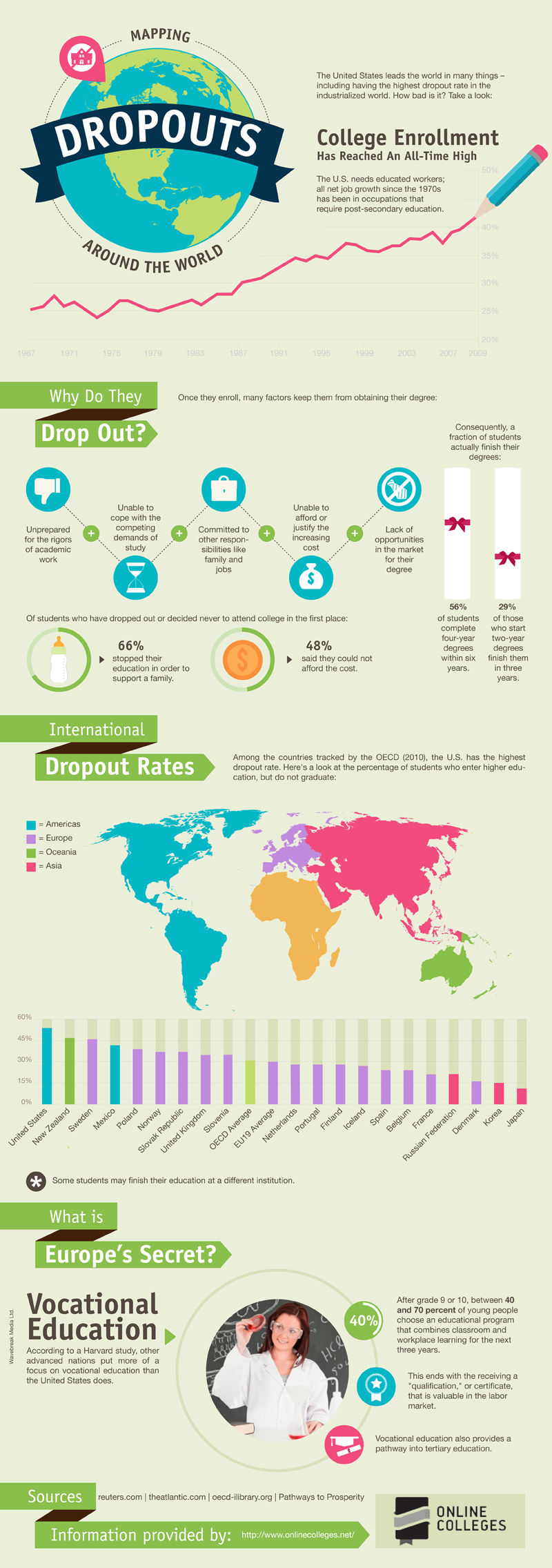
Image

Mapping Dropouts Around the World

Mapping-Dropouts-Around-the-World-800

This info-graphic is Courtesy of Online Colleges.net

Discover more about about this topic in Not Broken


Tags: , , , , , , ,

A literacy-based Racist Conservative Religious/Political Agenda

My parents were both high school dropouts, but I grew up seeing them read books almost every day and that was probably the most important reason I did not grow up illiterate or functionally illiterate.

Millions of children in America are not that fortunate and never see his or her parents read anything. This image of the most important role model in a child’s life ends up being the foundation that leads to illiteracy.

On February 14, 2013, Valentine’s Day, President Obama said, “Let’s make it a national priority to give every child access to a high-quality early education.”

This message was also included in his second State of the Union address.

But conservatives have made it clear that they are against public supported, high-quality early education. Instead, conservatives want to give taxpayer money to private or church-based preschools and leave it up to parents to decide to send his or her children. Source: Mike the Mad Biologist

Mike the Mad Biologist quoted the Heritage Foundation, a far-right conservative think tank that is also part of the Koch Foundation Associate Program. To learn more about the political/religious agenda of the billionaire Koch brothers, click Discovering the four Koch brothers.

Then President Obama also said, “Fewer than 3 in 10 four-year-olds are enrolled in a high-quality preschool program.”

Because of those facts, the United States must take it one step further and make it mandatory for children that are not learning literacy skills at home before age four to start a high-quality early education literacy program in the public schools.

To do that, all children must be tested starting at age three and six months by having them read out loud to a properly credentialed educator-teacher to demonstrate that the child is learning to read simple, basic one-syllable words in simple sentence in addition to demonstrating understanding. Then every twelve months before starting kindergarten, those children must be tested again to see that he or she is improving. It would be easy. Every public school in America would receive the mandate and funding to support this simple test.

Children that fail the test would be enrolled in the type of program President Obama is talking about.

Obama said that these young children must be in a safe learning environment with high quality teachers that are held accountable.  Private and religious schools are not held as accountable the same as the public schools. Private and religious schools have no oversight—no one watching what is going on in that classroom.

In addition, if illiterate parents wanted to make sure his or her children grew up literate and a lover of reading, there are already many nonprofit organizations offering free programs to combat illiteracy. For example: Reach Out And Read; Literacy for Incarcerated Teens (LIT); First Book; Reading Tree; United Through Reading; Literacy Inc.; Building with Books; Books for the Barrios; Dollar General Literacy Foundation, and in the United States, community, public libraries offer free literacy programs (source: Public library efforts to promote literacy).

There are an estimated 121,169 libraries of all kinds in the United States today.

These facts say if we leave it up to most illiterate parents of illiterate children to enroll those children in a voluntary literacy program before age four, it will not happen—not in the United States.

In Finland, the parents do this at home.  In Finland, most parents start teaching their own children how to read by age three. That does not happen to millions of young children in the United States.

The reason I think the conservative religious/political agenda regarding a high-quality early (public) education program in America is racist is because of the following numbers.

In 2003, about seven percent of white adults were reading below basic (this means they were functionally illiterate or illiterate), compared to 24% of Blacks, 44% of Hispanics, and 14% of Asian/Pacific Islanders.  Source: National Center for Education Statistics

If we are going to break the cycle of the high ratio of race-based illiteracy in America, we must make it mandatory for children that are not learning literacy skills at home to be in a supervised public education, literacy programs before age four so the public in the United States knows that every child is safe from a possibly biased, conservative political and/or religious agenda.

_______________________

Lloyd Lofthouse, a former U.S. Marine and Vietnam Veteran, is the award winning author of The Concubine Saga.

His latest novel is Running with the Enemy. Blamed for a crime he did not commit while serving in Vietnam, his country considers him a traitor. Ethan Card is a loyal U.S. Marine desperate to prove his innocence or he will never go home again.

And the woman he loves and wants to save was trained to hate and kill Americans.

To follow this Blog via E-mail see upper right-hand column and click on “Sign me up!”


Tags: , , , , , , ,

Winning the Genetic Lottery may not be enough

For months, I’ve been searching for studies that show the odds of winning the job/career lottery that leads to a glamorous/famous, wealth growth job.

I didn’t find my answer from a study. I found it from a super model, Cameron Russell.

What Cameron Russell says in this YouTube TED video is the real story of dream jobs. She says, “I am standing on this stage because I am a pretty white woman and in my industry we call that a sexy girl. … The real way I became a model is I won a genetic lottery and I became the recipient of a legacy. Saying you want to be a model when you grow up is akin to saying you want to win the Powerball when you grow up. It’s awesome and it’s out of your control and it’s not a career path.” Source: Shine.Yahoo.com


Pay attention to Cameron’s words. She offers wise advice about reality and life.

Before I go on, I want to say that genetics is not the only factor in many dream jobs/professions. Dedication, hard work and persistence also play a part in fields such as sports, acting, the arts, etc.

But, what Cameron has to say holds truth for all of the dream jobs that so many young people chase often destroying his or her future.

It’s okay to have a dream but dream realistically.  The odds are against anyone becoming a super model like Cameron Russell, an icon in football, baseball, or basketball, for example. This also applies to acting, the music industry and being a published author no matter what path an author takes such as indie, self-published or traditional.

That is why I believe every child, teen and young person must have a backup plan that is realistic but often leads to a boring job—when dreams fail to materialize—that pays more than working for Wal-Mart, the fast-food industry, cleaning pools, cutting crass, washing dishes, tending bar or waiting on tables.

Being a life-long-learner is important to having a backup plan and this message is for parents. It is your job to make sure your child loves to read and sees that learning is important and not boring and a waste of time. The future belongs to life-long learners.

Education is getting a bad rep from the media in the United States and college educations are under attack. Why?

Who stands to benefit from an ignorant, functionally illiterate population struggling to survive on minimum wages working in insecure jobs?

Discover Education’s Accountability Dilemma

_______________________

Lloyd Lofthouse, a former U.S. Marine and Vietnam Veteran, is the award winning author of The Concubine Saga.

His latest novel is Running with the Enemy. Blamed for a crime he did not commit while serving in Vietnam, his country considers him a traitor. Ethan Card is a loyal U.S. Marine desperate to prove his innocence or he will never go home again.

And the woman he loves and wants to save was trained to hate and kill Americans.

To follow this Blog via E-mail see upper right-hand column and click on “Sign me up!”


Tags: , , , , , , , , , ,

What makes Education Toxic?

A comment left for a postNC Teacher: “I quit”—on Diane Ravitche’s blog made a good point, and I posted a reply:

I think you have made a great point or at least inadvertently focused a spotlight on an important issue and why it is there.  Turnover in a school or school district may be a red flag—a strong warning sign— that the school board/administration/students are not the easiest to work with or work for [another word would be dysfunctional ].

This could be extended to an entire state since each state has its own department of education that decides policy in that state as directed by the elected politicians from the governor of a state on down. Due to a need to gain votes, religious and/or political agendas tend to rule in such organizations and the winds may shift at any time.

For example, I friend sent me this about the current situation in the high school in Southern California where he now teaches.

I was a public school teacher from 1975 – 2005 and we worked together before dysfunctional administration at our high school and in our school district drove him to quit and find a job in another district that at the time was a better place to work.

But beware of the grass is greener over there syndrome because a drought will kill the green grass leaving behind sweltering heat and dust.

During my thirty years in the classroom, I worked under nine-different principals. Some were great, some good and some horrible.

The horrible ones drove teachers, counselors and VPs out of the schools where they ruled Nazi style and turnover could reach as high as fifty percent in a few years.

Good principals, who are usually a sign of good administration and a sensible school board, tend to hold on to staff.

I mean, how many people quit jobs—any job—with a boss that knows what he or she is doing; a boss that supports his workers in the best possible ways to make the work environment a place where we want to spend twenty to forty years of our lives?

My friend said of this school year (2012 – 2013):

“112 scheduling changes in the first three weeks (the classes he teaches)

“75% of the administrative team is new; a lot of chaos

“50% of the counselors are new; a lot of chaos

“We lost our department chairs, so there is no communication between the teachers and administration

[This high school, he says] “once had a top-notch academic program; however, we are falling apart at the seams; our test scores have flat-lined and they will continue to flat-line because there are just too many new faces at our school; two of our Vice Principals have never been a VP before; they’re nice people, but we have to wade through their learning curve.”

For another example: at the high school where I taught for the last sixteen of the thirty years I was in the classroom as a teacher, we had one new teacher quit at lunch on his first day on the job with two more classes to teach after lunch. During the lunch break, he walked in the principal’s office, tossed his room keys on the desk and said, “If they won’t show some respect for me and attempt to learn, then I refuse to teach them.”

I know from experience, that district did not do a good job creating a positive, supportive educational environment for its teachers because I worked in that district for thirty years. Instead, it was more of a combative environment that did not offer the support teachers wanted or needed to teach.

It is a fact that teachers teach and students learn. However, that is not always the case. Instead, teachers in a toxic educational environment often struggle to teach while too many students make no effort to learn.

Elected School Boards and the administrators they hire should support an environment where teachers may teach and students will learn, and we can learn from two of the best public educations system in the world: Finland and Singapore.

In Finland, the teachers have a strong union and the teachers make the decisions in a supportive educational environment and it works. Parents start teaching children how to read at age three but the first year of school is at age seven.

In Singapore, merit rules. Students must compete academically to earn where they are tracked and the system is heavily tracked based on performance. There is no self-esteem driven educational environment; there is corporal punishment and students may be publicly beat with a bamboo cane if caught breaking strict-rules built to support a merit based education system.

Why can’t we in the United States learn from Finland and Singapore?

Discover What is the Matter with [American] Parents these Days?

______________

Lloyd Lofthouse is the award-winning author of The Concubine Saga.

To follow this Blog via E-mail see upper right-hand column and click on “Sign me up!”


Tags: , , , , , , , , , ,

Focusing too much on the gods of football, baseball and basketball

I agree with a post I read at the quiet voice that there is too much of an emphasis in America’s public schools on sports and not enough focus on academics. But is that the fault of the public schools or the fault of the parents and the English speaking culture?

There is a vast difference between the US public education system and other countries such as Finland, China and Singapore. Because of those differences, to be fair, we cannot compare the results of US students with those countries unless we separate the genetically modified chaff from the organic grain and also compare apples to apples.

As a public high school teacher in California for thirty years (1975 – 2005), I taught four periods of English and one period of journalism for several years in addition to being the advisor of the student run high-school newspaper. One year, my journalism students were invited to write a series of pieces for a European magazine called “Easy Speakeasy“, headquartered in France.  “Easy Speakeasy” expressed interested in the sports programs in US schools because we were told that these programs did not exist in France and other European countries. Sports in Europe were mostly outside of the public schools sort of like Pop Warner Football in the US.

Pop Warner was founded in 1929, continues to grow and serves as the only youth football, cheerleading & dance organization that requires its participants to maintain academic standards in order to participate. Pop Warner’s commitment to academics is what separates the program from other youth sports around the world. In fact, studies show that kids involved in sports that require them to maintain their academic grades above a 2.0 GPA graduate in higher numbers than students that do not participate in sports.  Europe has programs similar to Pop Warner and I understand this is the only place students in Europe may participate in organized sports because these programs do not exist in European schools. In Europe and most countries, the focus in the public schools is academic and vocational—no sports, drama or music programs as in the US.

I can only guess that “Easy Speakeasy’s” editors invited my journalism students to write for their European publication because the high-school newspaper I was adviser for had won international recognition several years in a row from Quill and Scroll out of the University of Iowa.

In the English classes I taught there was a lot of chaff and only a little grain but in that journalism class, I taught the organic cream of our high school—students willing to be at school as early as six in the morning and stay as late as eleven at night to produce the high school newspaper—while many of my English students did not bring textbooks to class, do class work or even consider doing homework. Instead, there were students in my English classes that waged an endless war against academics disrupting the educational environment as often as possible.

Who do we blame for this educational environment in the United States?

Quill and Scroll offers academic scholarships. There is another organization called JEA (the Journalism Education Association) that also awards academic scholarships related to writing/academics. I know this because one of my journalism students earned a JEA scholarship. I required my journalism students to compete at the regional, state and national level in JEA academic writing competitions.

In addition, in most of the world there are two tracks in high school:  academic and vocational and students in those countries may graduate from high school either with a degree earned in the academic or vocational. For that reason, comparing graduation rates in the US with other countries does not count because in the US we only graduate through academic programs but still graduate a higher ratio of students through the academic track than any other country on earth.

Then there are children in the United States that cannot read and are functionally illiterate. When we compare the US to all other English speaking countries, the rate of functionally illiterate children is about the same telling us that this is more a product of a culture that does not value learning and reading as much as countries such as Finland where the majority of parents start teaching his or her children how to read at home by age three so those children can already read when they start school at age seven.

But in the US, many parents leave it up to the schools to start teaching children to read at age five or six and only those children that were taught by his or her parents start out on track and move ahead.

Then there is the fact that the US may be the only country on the planet that mandates children stay in school, no matter what, until age sixteen to eighteen.  In China, for example, there are about 150 million children in the grade schools but only about 10 million that remain in high school at age 15.

When the International PISA test is given in countries around the world, that test is given to a random sample of fifteen year old students. That means in the US, because almost every fifteen-year old is still in school, America’s students are being compared to the very best in countries such as China where students that are not the best academically have left the system by the time the PISA people show up.

However, when we filter out the chaff and leave only our most proficient students—for example: the journalism students that I taught—and compare them to the most proficient students of other countries, this being apples to apples, the US students beat every country in the world in every academic area tested. You will never hear these facts from the critics of public education in the US.

Discover The Legacy of the British Empire on Literacy

______________

Lloyd Lofthouse is the award-winning author of The Concubine Saga.

To follow this Blog via E-mail see upper right-hand column and click on “Sign me up!”


Tags: , , , , , , , , ,

Are you aware of James Samuel Coleman’s work? The Coleman report was published in 1966 and is considered the most important education study of the 20th century. In 1970, he served as adviser to President Richard Nixon and, in a “Forbes” article in 1987, he wrote that we cannot blame the deteriorating school system “all on the teachers: the greatest culprits are parents and changes in family structure.”

Lisa Myers's avatarlisamyers.org

Please see the follow-up to this letter at http://lisamyers.org/2012/12/31/a-follow-up-to-dear-america-from-a-teacher/.

Dear America,

It feels strange to hear your voice praising teachers for their selflessness, dedication, and love for their students. We’re listening to what you’re saying, but we must admit that we are listening with tilted head and quizzical eye. Why? Because we’ve become accustomed to hearing a very different voice from you.

For the past few years, you’ve been certain that most of society’s problems stem from our schools, more specifically the teachers in those schools. We are lazy and useless, we are only in it for the money, we only teach for the vacation time, we don’t possess the intelligence to teach anyone much of anything, our demands for a respectable wage are selfish, we don’t teach students respect, we are leeches sucking the blood from State coffers, we don’t even work a full day like everyone else, and…

View original post 596 more words


Why does the GOP and the Tea Party want to abolish the Department of Education?

Under President George W. Bush, the No Child Left Behind Act (NCLBA) increased the Department of Education’s (DOE) budget from $46 Billion to $60 Billion (In 2012, the budget reached $68.1 Billion). For a comparison, under Bush, the Department of Defense (DOD) budget went from $308.9 Billion in 2001 to $729.6 Billion in 2008—an increase of $420.7 Billion compared to the $14 Billion increase for the DOE.

Meanwhile, in 2012, the federal deficit was $1.327 Trillion and the Interest on the debt was $224.8 Billion.

But the GOP wants to save money by abolishing the DOE while increasing the budget for the DOD. I’m confused because this makes no sense, and I wonder what the real reason is. What are they not telling us?

The NCLBA was enacted due to an act of Congress, and Congress represents the fifty states. The NCLBA gave the DOE more responsibilities to monitor public education in all fifty states.

When congress voted and authorized the NCLBA that gave the DOE more responsibility and more funding on May 23, 2001, the House of Representatives voted 384 – 45,  and the Senate voted 91 – 8 in favor of the act.

In 2001, the 107th Congress had a Senate that was split 50-50 and the House of Representatives had 221 Republicans to 212 Democrats.

In truth, it was an imperfect bill incapable of solving the challenges of public education in part because it put the blame and responsibility on the shoulders of teachers and none on parents and students.

In 2001, the Republican Party held majorities in both the House of Representatives and the Senate with a GOP president in the White House.

If you were to read the history of the DOE, you would discover it was created in 1867 to collect information on schools and teaching that would help the States establish effective school systems. Over the last 145 years, this goal of gathering information on what works in education continues. Source: ed.gov

In fact, in 1867, in the 40th Congress, the GOP held a vast majority in both Houses: 42 to 11 in the Senate and 143 to 49 in the House.

As you have now learned, the GOP, as the majority, created the DOE in 1867, and played a crucial role increasing its responsibility in 2001, so why has the Republican Party in recent years set a goal to abolish the DOE?

Think Progress.org reported, “As recently as 1996, the Republican Party platform declared, ‘The Federal government has no constitutional authority to be involved in school curricula or to control jobs in the market place. This is why we will abolish the Department of Education.’ … Now, a new wave of Republicans (along with many old hard-line conservatives) are trying to number its days once again.” …

“A comprehensive review of the voting records and statements of Republican incumbents and candidates finds that there are 111 GOPers (Republicans) who support shutting down the Department of Education,” Think Progress said.

Yet, in 145 years, the Supreme Court of the United States has never questioned the Constitutionality of the DOE and the mandate it was given by more than one act of Congress.

For a comparison, the federal government only had 2.8 million civilian employees in 2010 and 25.6% of federal civilian employees worked for the DOD while only about two tenths of one percent (0.17%) work for the DOE. In addition, the DOE’s share of the federal budget is 5%, while the DOD’s budget has increased to about 55% of the federal pie.

If the DOE were abolished, public education in the US would lose its eyes and ears, and abolishing the DOE would do nothing to stem the tide of the national debt. It would literally be a drop in the ocean.

In addition, public education in the US is often compared as inferior to Finland’s schools that are ranked as one of the best public educational systems in the world. Compared to the top thirty-three ranked countries for 2009, Finland was 2nd in Reading, 1st in Math, and 1st in Science. The US was ranked 33rd, 27th, and 22nd respectively.

If we want to learn something from Finland, it helps to know that in the Finnish Government, the Ministry of Education and Culture is responsible for developing educational, science, sport and youth policies and international cooperation in these fields. The Ministry also allows the teachers’ union a role in decision making on duties, conditions of work, salary scales and instruction time. However, in the US, teachers are often not part of the decision making process and teachers’ unions are under constant attack and criticism.

It is obvious that as long as the US has fifty different educational systems each based on conflicting political and religious agendas, then the US educational system will never compete equally with countries such as Finland. If we are to compete with Finland, we must learn from what they do–not just compare rankings and blame our teachers and teachers’ unions.

Therefore, why are hard-line conservative types taking aim at the DOE in the US? (For example: think of the Tea Party that was founded and supported in large part by two of the four Koch brothers and the Wal-Mart, Walton family that has pushed hard for voucher schools. This list also includes fundamentalist, evangelical, born again Christians that want the schools to teach creationism instead of evolution and science.)

What is the political agenda of these factions of the Republican Party? Why do these factions in the GOP want to cripple and blind the public education system in the United States leaving it fractured in fifty different pieces? What will these hard-line conservatives and capitalists gain if they succeed?

The answer may be found, in part, from these facts: In the US, there are about 16,000 school districts and approximately 49 million students attending more than 98,000 public schools and 28,000 private schools. To pay for this, the fifty states raise (mostly through local and state taxes) and spend almost one trillion dollars annually for public and private funded education. The budget of the DOE represents about 6.8% of that total. The DOE is the guard dog that gathers information on education in all fifty states and reports to Congress and the president what it learns. If any states or school districts are found to be in violation of laws enacted by the Congress, then the President of the United States is duty bound by his or her oath of office to protect and defend those laws.

Discover the National Debt info-graphic by president 1945 – 2012

______________

Lloyd Lofthouse is the award-winning author of The Concubine Saga.

To follow this Blog via E-mail see upper right-hand column and click on “Sign me up!”


Tags: , , , , , , , , , , , ,

“Half Nelson” teaches a truth about K-12 education in the US

What causes a dedicated and charismatic teacher to become addicted to crack cocaine—to become burned out and a victim of drugs and/or PTSD?

The answer is not broken schools, teacher unions, or incompetent teachers, but a dysfunctional culture and society demanding through laws and legislation that teachers fix the problem or be accused of failure.

While critics of public education often play the political game by blaming teacher unions and so-called incompetent teachers (even though there are no reputable studies or evidence to prove these alleged claims), few seem to care about what Forbes reported in High Teacher Turnover Rates are a Big Problem for America’s Public Schools.

In March 2011, Forbes reported, “NCTAF’s findings are a clear indication that America’s teacher dropout problem is spiraling out of control. Teacher attrition has grown by 50 percent over the past fifteen years. The national teacher turnover rate has risen to 16.8 percent.  In urban schools it is over 20 percent, and, in some schools and districts, the teacher dropout rate is actually higher than the student dropout rate.”

Forbes says, “Teachers cite lack of planning time, workload, and lack of influence over school policy among other reasons for their decision to leave the profession or transfer schools.”


And if you think Charter Schools are any better, you may be surprised to discover what The Washington Post reported, “Teacher turnover, which tends to be alarmingly high in lower-income schools and districts, has been identified as a major impediment to improvements in student achievement.”

The Washington Post said, “The authors (of a study) find that the odds of charter teachers exiting are still 33 percent higher than those of regular public school teachers. There is an even larger difference in secondary schools, where charter teachers are almost four times more likely to leave.”

Half Nelson reveals a primary reason so many teachers quit even if they have the so-called job protection of tenure (a report from the public schools of North Caroline says about a third that quit annually have that so-called precious tenure critics complain of).

Why would someone with such an easy, kick-back job with labor union protection quit?

Dan Dunne (played by Ryan Gosling) is a young, urban, middle school, inner-city history teacher taking drugs to make it through the nights and weekends but during the weekdays he is a popular teacher—the kind that  students see as a role model.

I identified with this movie. For thirty years, I taught in public schools surrounded by barrios infested by teen street gangs that had been around for generations. I witnessed drive by shootings from my classroom doorway, riots between gangs, grieved with my students when kids were shot down in the streets never to return to school, and a year didn’t go by that some gang banger that was also a student in one of my classes didn’t threaten me by asking what I would do if a gang jumped me.

Half Nelson brings us closer to that world and reveals another reason why so many teachers quit and never return to the classroom.

If you want to discover the truth about many of America’s schools and why teachers and possibly many students drop out, I suggest you watch this movie that the odds say you haven’t seen.

If the average ticket price of a movie in 2006 was $6.55, and Half Nelson earned $2.7 million in North America, that means less than 500 thousand people saw the film and there are more than 314 million Americans that did not see it.

Maybe most Americans do not want to know the truth, because many parents would have to accept the blame for illiterate and/or failing students. Parenting is a serious job—not a game.

Discover a film with a clear political agenda against teacher unions

______________

Lloyd Lofthouse is the award-winning author of The Concubine Saga.

To follow this Blog via E-mail see upper right-hand column and click on “Sign me up!”


Tags: , , , , , , , , , ,