RSS

Tag Archives: Teaching

The US Department of Education Should not be Eliminated. Still, it must be reformed.

If you don’t have an attention span that lasts long enough to learn what I’m teaching in this post, start with the conclusion first. Then if you want to read the evidence following the CONCLUSION, it is your choice to stay ignorant, unless you already know what all the evidence shows us.

CONCLUSION

The United States should not eliminate the US Department of Education.

Still, the US Congress must pass legislation that standardizes teacher training to be more in line with what Finland does and require all K-12 teachers [in all K-12 schools private and public — that’s how it’s done in Finland] to complete a training program similar to what Finland does. The U.S. already has one that’s close, the U.S. Urban Teacher Residency programs.

Each state will still be in charge of education in their state, but setting standards for teacher training, and support for those teachers, should be the federal government’s responsibility.

In the United States, the best public schools are well funded Defense Department schools [DOD].

Department of Defense schools [DOD], are often considered to be “good” because of their consistent, well-funded structure, high expectations for student achievement, a strong focus on addressing the needs of military families with frequent moves, a culture of parental involvement, and a relatively uniform quality of education across all bases, resulting in high standardized test scores compared to many public schools.

The NY Times has an article about DOD schools, stating, “this school system outperformed all 50 states on reading and math scores for both eighth graders and fourth graders.” — Oct 10, 2023

The rest of the country must fall in line and stop fighting to see who can race to the bottom the fastest. No more teacher bashing. They get what you pay for. When they set low expectations and standards for teacher training like Teach for America [TFA] does, they can’t expect those teachers to turn out like Finland or the DOD’s public-schools.

For that to happen, the U.S. Department of Education [ED] must be reformed to be more like Finland’s Ministry of Education, with a mandate to insure all fifty states end up with highly trained and professional teachers in schools that perform like the DOD’s K-12 public schools.

End of Conclusion

Now you may start with the evidence if you haven’t fallen asleep yet.

The U.S. Department of Education [ED] is responsible for:

  • Establishing policy: The ED creates policies for federal education assistance, including financial aid and civil rights laws
  • Administering programs: The ED manages the distribution of federal funds for education programs, including grants and other assistance
  • Monitoring programs: The ED tracks how federal funds are used and ensures they are used effectively
  • Enforcing civil rights laws: The ED ensures that students have equal access to education and that programs receiving federal funds are free of discrimination
  • Researching education: The ED collects data and conducts research on education, including teaching techniques and best practices
  • Identifying issues: The ED identifies problems in education and recommends solutions
  • Raising awareness: The ED informs the public about education challenges and best practices
  • Helping communities: The ED works with communities to develop solutions to educational issues
  • The ED’s programs must be authorized by Congress and signed into law by the president
  • The ED’s budget is a portion of the total federal budget
  • The ED’s budget includes funding for programs like Pell Grants, early childhood education, and work assistance

Next Finland, a country considered one of the top in the world for education. It consistently ranks in the top ten for every subject in the Program for International Student Assessment (PISA).

This is what Finland’s Ministry of Education is responsible for:

  • Developing education and TRAINING
  • Early childhood education
  • Lifelong learning
  • Internationalization
  • Preparing educational legislation
  • Making decisions about education
  • Managing the country’s budget for education

In Finland, teacher training is highly selective, requiring a master’s degree in education which includes extensive pedagogical studies, substantial teaching practice in real classrooms, and a strong emphasis on research-based practices, aiming to produce teachers capable of independent problem-solving and exploring new teaching approaches; essentially, becoming a teacher in Finland is considered a prestigious career path due to the rigorous training involved.

In the United States, there is no standard for teacher training. Instead, each of the fifty states in the US sets its own standards for teacher training and licensure. Teacher training ranges from programs like Teach for America [TFA], to an Urban Teacher Residency [UTR] program.

TEACH FOR AMERICA [TFA] training takes place both virtually [on a computer at home] and in-person over the course of about two months for about 6 to 8 hours a day. After completing that short program without much or any actual experience working with students in a real brick and mortar classroom, the TFA teacher trainees enter K-12 public schools and go straight into teaching. According to research, the average retention rate for TFA teachers is significantly lower than non-TFA teachers, with only around 25% of TFA teachers remaining in the classroom for five years or more.

I am a US Marine, combat vet where what we learned in basic training was discipline, how to obey orders, and how to fight in a team and as an individual. Lots of muscle challenge sweaty exercise, too. Our training days ran longer than 8 hours. We didn’t get weekends off. Boot camp lasted for 13 weeks, much longer than TFA teacher training.

Now for the teacher training program I went through a few years after I was honorably discharged from the U.S. Marines and earned AS and BA degrees. The MFA came later.

In the United States URBAN TEACHER RESIDENCY (UTR) programs that train teachers combine academic coursework with teaching experience in urban school districts. UTR programs are designed to help close achievement gaps in high-need schools.

Partner with universities and school districts — UTR programs work with universities and school districts to provide aspiring teachers with teaching experience and a master’s degree.

  • Work with a mentor teacher — UTR programs place teacher residents with experienced mentor teachers for a full school year.
  • Commit to teaching in the school district — After completing the residency, teachers agree to teach in the school district for at least three years. I stayed in the same district where I was trained in 1975-76 until 2005, when I retired from teaching.

According to research on teacher residency programs, the average retention rate for UTR teachers is typically between 80-90% within the same district after three years, and 70-80% after five years, indicating a significantly higher retention rate compared to traditional teacher preparation programs.

More than 65,000 teachers have earned their teaching credentials through TFA compared to nearly 4,200 through UTR programs.

As one of the few UTR trained teachers, my students learned problem solving and critical thinking skills, and how to understand what they read, and to write poetry, short stories, essays, et al. Starting in the late 1970s, students I worked with in middle school won awards in state poetry and short story contests in competition with other junior high schools

In high school, my journalism students won regional, state, national, and international awards competing with other high school journalism students and student newspapers. The English [teaching literature, how to understand it, and how to write essays] students I worked with dramatically outscored other students throughout the school on those annual rank-and-punish standardized tests. Still, I hated those tests and still do. While other teachers sweated bullets teaching to those tests, I focused on the literature and writing, ignoring those tests.  Finland has standardized tests, but it is up to the teachers to use them. Standardized testing in that country is not mandatory.

All teachers in Finland are required to have a master’s degree, which can be specialized based on the subject they will teach, meaning there are different programs for primary school teachers, subject-specific teachers in secondary school, and other educational areas, but all require a high level of academic study and rigorous practical training. Entrance into teacher education programs is highly competitive, with rigorous entrance exams and interviews to ensure only the most qualified candidates are admitted. Finnish teacher education is heavily focused on research and evidence-based practices. Teacher programs include significant in-school practice teaching with close supervision.

Take a glance at the list of teacher training options for the United States.
Don’t miss the last paragraph.
It may blow your mind.

K-12 teacher training programs in the US include traditional Bachelor’s degree programs in education, focused subject area specializations within a Bachelor’s degree, alternative certification programs, post-baccalaureate teacher certification programs, and various professional development courses covering different teaching methods and subject areas, often with options for online learning and specific grade level focuses like early childhood education or secondary education.

Key types of K-12 teacher training programs:

  • Traditional Bachelor’s in Education:

A standard 4-year degree program with a focus on general education coursework alongside specific teacher training classes, often allowing for specialization in a particular subject area like math, science, or elementary education. 

  • Subject-Specific Bachelor’s Degree with Teacher Certification:

A degree in a specific subject (e.g., biology, history) with additional education courses to qualify for teaching licensure at the secondary level. 

  • Early Childhood Education Degree:

A focused program preparing teachers to work with young children in preschool and early elementary grades. 

  • Alternative Teacher Certification Programs:

Designed for individuals with a bachelor’s degree in a non-education field, allowing them to gain teaching certification through a shorter, more targeted training program, often including accelerated coursework and intensive classroom practice. 

  • Post-Baccalaureate Teacher Certification Programs:

For individuals with a bachelor’s degree who want to add teaching credentials, offering focused coursework and additional student teaching to qualify for licensure. 

Areas of focus within K-12 teacher training programs:

  • Special Education: Training for teaching students with learning disabilities or other special needs 
  • Bilingual Education: Preparing teachers to work with students from diverse language backgrounds 
  • Gifted Education: Training for teaching highly gifted students 
  • Math Education: Focused curriculum and pedagogy for teaching mathematics at various grade levels 
  • Literacy Education: Training for teaching reading and writing skills 
  • Science Education: Specialized instruction in science concepts and inquiry-based teaching methods 

Professional development options for K-12 teachers:

  • Online Courses:

Flexible learning opportunities through online platforms covering diverse topics like classroom management, curriculum development, and instructional technology 

  • Workshops and Seminars:

Short-term training sessions focused on specific skills or pedagogical approaches 

  • Coaching and Mentoring:

Individualized support from experienced educators 

  • Professional Learning Communities (PLCs):

Collaborative groups of teachers focused on improving instruction through peer feedback and shared learning 

All states except Minnesota and Rhode Island allow individuals to become teachers through alternative certification, even if they don’t have a degree. However, each state has its own requirements for alternative certification. Many states in the United States allow high school graduates to substitute teach in K-12 public schools without a specific substitute teaching certificate. In some states, a high school diploma or GED is enough to start substitute teaching. Some states may also accept a bachelor’s degree or college credits. However, some states, like California, require a bachelor’s degree for all teachers, including substitute teachers.

In the majority of states, you don’t need a specific substitute teaching certificate to get started. This means you can often begin your substitute teaching journey with just a high school diploma or GED, and sometimes, a bachelor’s degree or some college credits.

Your Guide to Substitute Teaching Across the U.S.: Certification Requirements by State

 

Tags: , , , , , , , , , , ,

Is it possible that offering support instead of punishment leads to Better Teachers? – Part 1 of 3

View as Single Page

To discover the answer, I turned to the top eight ranked countries on the 2012 International PISA Test. To come up with the top eight, I dropped China from the list because Shanghai, Hong Kong and Macao do not represent all of China’s 15 or 16 year old children. I’ve also dropped Liechtenstein and Estonia, because it’s ridiculous to compare the United States—with more than 316 million people and almost 50 million children in its public schools—to Liechtenstein with a total population that’s less than 37 thousand and Estonia with about 1.3 million.

To repeat, the United States has almost 50 million children attending K–12, 4 million teachers, and 1 in 4 children live in poverty—the United States is much more diverse and has challenges the top ranked countries don’t have to deal with. Liechtenstein, for instance, has one of the highest standards of living in the world with one of Europe’s most affluent communities. Estonia has 589 schools and compulsory education only goes to 9th grade.

Fair Test.org reports “The U.S. is the only economically advanced nation to rely heavily on multiple-choice tests (But Pearson is working hard to change that and add more countries. To learn more, I suggest you read No profit left behind). Other nations use performance-based assessment to evaluate students on the basis of real work such as essays, projects and activities. Ironically, because these nations do not focus on teaching to multiple-choice and short-answer tests, they score higher on international exams.”

Truth Out.org reports, “Among the most prominent members of the testocracy are some of the wealthiest people the world has ever known. Its tsars include billionaires Bill Gates, Eli Broad, and members of the Walton family (the owners of Walmart), who have used their wealth to circumvent democratic processes and impose test-and-punish policies in public education. They fund a myriad of organizations—such as Michelle Rhee’s StudentsFirst, Teach for America, and Stand for Children—that serve as shock troops to enforce the implantation of high-stakes testing and corporate education reform in states and cities across the nation.”

I also think it’s important to compare the racial diversity and total population of the United States with the eight top ranked PISA countries. It is also worth noting that children represent more than one-third of the 46.5 million Americans who live in poverty. In addition, blacks and Hispanics are more likely than whites to be poor and to be in poverty and deep poverty (For instance, only 10% of Whites live in poverty compared to 27% of Blacks and 24% of Hispanic/Latino – The Henry J. Kaiser Family Foundation). The poverty rate (the percentage of all people in the United States who were poor) also remained at high levels: 15.1% for all Americans and 21.8% for children under age 18.

  • 77.7% of Americans are White – 248 million
  • 17.1% Hispanic or Latino – 54.5 million
  • 13.2% or Black – 42 million
  • 5.3% are Asian – 16.8 million
  • 1.2% are American Indian and Alaska Native – 3.8 million

2014 population estimate = 318.8 million
http://quickfacts.census.gov/qfd/states/00000.html

Singapore – 5.4 million and 26% or 1.4 million live below poverty line compared to 46.5 million in the United States or 861% of the total population of Singapore. BBC.com reports, that in Singapore everyone is provided an education, health care and public housing if they can’t afford their own. What they pay for housing is based on what they earn. If one compares the poor in Singapore to those in countries such as India and China, or even the homeless in the US, it is indeed true that the situation here is not as dire. ”Singapore has an extensive social safety net,” said a ministry spokesman. ”Singaporeans enjoy subsidized housing, healthcare and education.”

  • 77% Chinese
  • 14.8% Malays
  • 7% Indians
  • 1.2% Other

Taiwan – 23.34 million and 1.16% or 27 thousand live below the poverty line compared to 46.5 million in the United States or 199.2% of the total population of Taiwan.

  • 84% Taiwanese (including Hakka)
  • 14% mainland Chinese
  • 2% indigenous

South Korea – 50.22 million and 15% or 7.53 million live below the poverty line compared to 46.5 million in the United States or 92% of the population of South Korea.

  • Koreans except for 20,000 Chinese

Japan – 127.3 million and 16% or 20.3 million live below the poverty line compared to 46.5 million in the United State or 36.5% of the total population of Japan.

  • 95% Japanese
  • 5% foreign citizens

Switzerland – 8 million, but only 1.93 million are permanent residents (23.8% of the total population), and 6.9% (not sure if this is based on permanent or total) live below the poverty line compared to 46.5 million in the United States or 581.25% of the total population of Switzerland.

Netherlands – 16.8 million and 10.5% or 1.764 million live below the poverty line compared to 46.5 million in the United States or 277.78% of the total population of the Netherlands.

  • 78.5% Dutch
  • 5% EU
  • 2.2% Indonesian
  • 2.3% Turkish
  • 2% Surinamese
  • 2% Moroccan
  • 6% other

Finland – 5.4 million. Finland has one of the lowest poverty rates in the world compared to 46.5 million in the United States or 861% the total population of Finland.

  • 89.33% Finish
  • 5.34% Swedish
  • 5.33% 35 Other Ethnic groups

Canada – 35.1 million and 9.4% or 3.3 million live below the poverty line compared to 46.5 million in the United States or 132.5% the total population of Canada.

  • 86% White (European Canadian)
  • 8% Aboriginal
  • 5% East Asian
  • 4% South Asian
  • 2% Black
  • 4% Southeast Asian
  • 9% Other

Continued in Part 2 on April 9, 2015

View as Single Page

_______________________

Lloyd Lofthouse is a former U.S. Marine and Vietnam Veteran,
who taught in the public schools for thirty years (1975 – 2005).

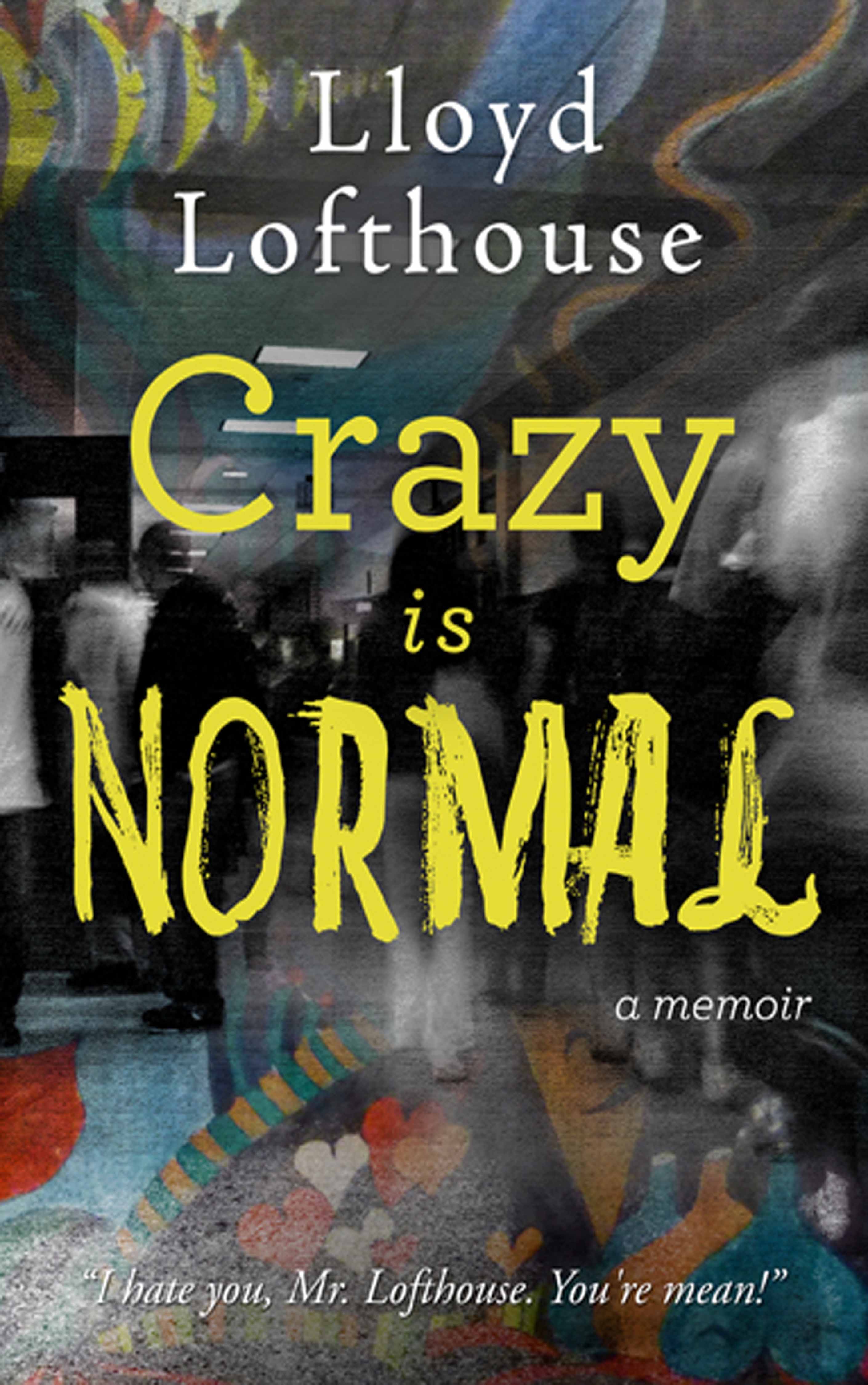
Crazy is Normal promotional image with blurbs

Lofthouse’s first novel was the award winning historical fiction My Splendid Concubine [3rd edition]. His second novel was the award winning thriller Running with the Enemy. His short story A Night at the “Well of Purity” was named a finalist of the 2007 Chicago Literary Awards. His wife is Anchee Min, the international, best-selling, award winning author of Red Azalea, a New York Times Notable Book of the Year (1992).

To follow this Blog via E-mail see upper right-hand column and click on “Sign me up!”


Tags: , , , , , ,

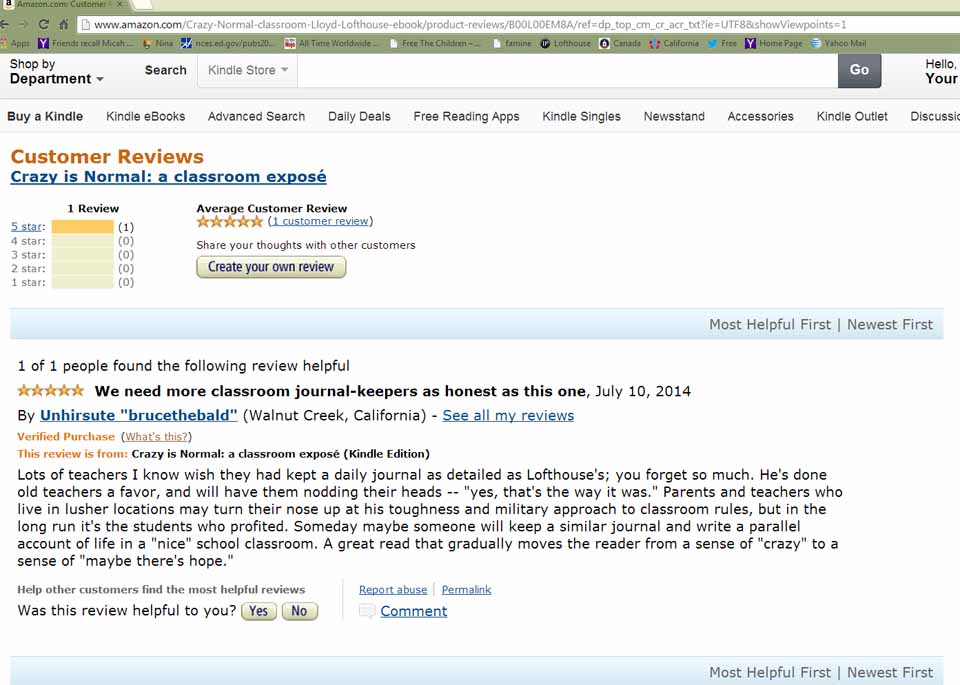
First 5-star review of “Crazy is Normal, a classroom expose”

The reason for this Blog that I launched in January of 2010 was to support this memoir. Crazy is Normal, a classroom expose is based on a daily classroom journal that I kept as a teacher in 1994-95.  I have friends who are still teaching, and I know that the work climate for public school teachers is worse today than it was back then thanks to two presidents: George W. Bush and even worse, Obama, who, like a fool, I voted for twice, because I had no idea of his agenda to destroy the public schools and replace them with corporate, for profit schools that would not be answerable to the public while the public supported them with the taxes they pay.

Why do you think President Obama partnered will the richest man on the planet to make this happen. Yes, Bill Gates is Obama’s partner in the destruction of the democratic public schools that have a 175 years of history behind them and nothing but a record of improvement that continues to this day regardless of the lies you might hear or read from the media.

The e-book came out in June 2014.  The paperback is available @ Crazy is Normal, a classroom expose

Here’s the first reader review for the e-book on Amazon:

First 5-star review on July 10-2014

_______________________

Lloyd Lofthouse is a former U.S. Marine and Vietnam Veteran,
who taught in the public schools for thirty years (1975 – 2005).

99 Cent Graphic for Promomtion OCT 2015

Where to Buy

Lofthouse’s first novel was the award winning historical fiction My Splendid Concubine [3rd edition]. His second novel was the award winning thriller Running with the Enemy. His short story A Night at the “Well of Purity” was named a finalist of the 2007 Chicago Literary Awards. His wife is Anchee Min, the international, best-selling, award winning author of Red Azalea, a New York Times Notable Book of the Year (1992).

To follow this Blog via E-mail see upper right-hand column and click on “Sign me up!”


Tags: , , , , , ,

Let’s reverse “Those who can’t, teach”

There’s an old proverb that disparages teachers. It goes like this: “Those who can, do; those who can’t teach.” It means that people who are able to do something well can do that thing for a living, while people who are not able to do anything that well make a living by teaching.

I’ve worked in both worlds—the private sector and the public, and I can assure you that old proverb is wrong and anyone who disagrees with me, well, those will be fighting words.

I started at fifteen washing dishes in a coffee shop nights and weekends thirty hours a week for three years while I went to school days until the day the mean boss told three of us that we had to stay later than usual and do someone else’s job who didn’t show up for work, and he wasn’t going to pay us. All three of us quit. If I had done as told, I probably could’ve stayed working in restaurant jobs for the rest of my life. In that job, when I clocked out, I never took work home.

A few weeks later, I joined the U.S. Marines and went to boot camp after graduating from high school. I fought in Vietnam where snipers came close to taking me out more than once, and I decided I didn’t want to make a career out of the Marines. I could have. After all, I survived three years and earned an honorable discharge. I did bring PTSD home and still have it.

My third act was going to college on the GI Bill, and while in college, I worked a series of part-time jobs and I didn’t consider any of them jobs I’d want to work for a lifetime.

For instance, I worked on a crew that cleaned a new Sears store before it opened. In the morning, I clocked in and worked my eight hours and then clocked out. There was no stress, no challenges, and I didn’t take any work home.

In my next job, I walked door to door sixteen hours a day, seven days a week as a Fuller Brush Man where I was told three months later—after more than a thousand hours of work—that I had sold more product than anyone else in the region. I quit, because all I earned for all the door to door walking and sore feet was four hundred dollars—that wasn’t enough for even one month’s rent.

Next job, I bagged groceries in a super market for two years, and I never took any work home. It was an easy job and the people I worked for were good people. The manager of the store was also a nice guy.

After the market job, I stocked shelves and dressed manikins for window displays at a J.C. Penny, and I never took any work home. The store manager was also okay as a boss.

Then I worked one summer near Fresno at a Gallo Winery in a seasonal job during the grape crushing season and before summer ended I was offered a full-time job that came with health benefits and decent pay, but I turned it down, because I wanted to finish college. I also never took any work home while I worked for Gallo. When I clocked out, the work ended.

After graduating from college with a BA in journalism, I landed a job in middle management in a large trucking company. After several years of repetitive paperwork and long hours sitting at a desk in a glass walled office, I quit and went back to college to earn a teaching credential. While working that job, I never took any work home, and my boss was a decent guy to work for. He was fair and kind. From there, in 1975, I returned to college and earned a teaching credential.

In the early 1980s, while teaching days at a tough intermediate school, I worked for a few years at night and on weekends for a fancy nightclub/restaurant called the Red Onion in West Covina, California. At the time, there were several Red Onions in Southern California. The one where I worked had three dining rooms—one with a glass ceiling and a few full-sized palm trees—on one side of the lobby. On the other side was a three-bar nightclub that held a thousand drinkers and dancers. After a few months, I was promoted to the maître d position and put in charge of the front desk. Then the owner of the chain, who drove a white Rolls Royce, offered me a job in management, but I said no and stayed in the classroom as a teacher. The only thing I took home from that job was a few women I met at the night club and dated, and I have no complaints about that. All the managers I worked for were all decent, kind, hard working men.

When I compare all of the jobs I worked in my life, the toughest and most challenging job was teaching where I often worked sixty to one hundred hours a week. Twenty-five to thirty hours a week was teaching and the rest of the sixty to one hundred hours was planning lessons, making phone calls to parents, paperwork (grades, etc.), and correcting student work.

In fact, I took work home during the school year almost every night and weekend often working until I was too tired to keep going.

When I retired from teaching in 2005, I decided that if for any reason I ever had to go back to work, I’d rather be an old  U.S. Marine fighting in a war zone like Vietnam, Iraq or Afghanistan. In fact, to avoid teaching again, I’d be willing to volunteer and strap on explosives and blow myself up along with a group of al Qaeda or Taliban terrorists before I’d go back in the classroom to be demeaned and abused by students, parents, administrators and our nation’s elected leaders, who make all the decisions for the public schools but accept none of the blame for anything that goes wrong and doesn’t work. Teachers are rarely part of the decision process. They are just the scapegoats for fools who say, “Those who can, do; those who can’t teach.”

I know the public schools are not broken. The crises in public education has been manufactured by a bunch of unscrupulous fake education reformers who are mostly interested in how much money they can steal from tax payers with the approval of the Obama White House.

To find out what it’s like to be a public school teacher in the United States, I suggest that you read my memoir, Crazy is Normal, a classroom exposé. You see, I kept a daily journal in 1994-95 for one of the thirty years I was a teacher and captured that job in detail. The other option is to actually go teach in a school similar to the one where I taught.

_______________________

Lloyd Lofthouse is a former U.S. Marine and Vietnam Veteran,
who taught in the public schools for thirty years (1975 – 2005).

His third book is Crazy is Normal, a classroom exposé, a memoir. “Lofthouse presents us with grungy classrooms, kids who don’t want to be in school, and the consequences of growing up in a hardscrabble world. While some parents support his efforts, many sabotage them—and isolated administrators make the work of Lofthouse and his peers even more difficult.” – Bruce Reeves

lloydlofthouse_crazyisnormal_web2_5

Lofthouse’s first novel was the award winning historical fiction My Splendid Concubine [3rd edition]. His second novel was the award winning thriller Running with the Enemy. His short story A Night at the “Well of Purity” was named a finalist of the 2007 Chicago Literary Awards. His wife is Anchee Min, the international, best-selling, award winning author of Red Azalea, a New York Times Notable Book of the Year (1992).


Tags: , , , ,

The Golden Age of Education in America is Today

The United States has never had a Golden Age of Education unless it is happening today, but the media and politicians with political/religious agendas—without exception—misrepresent the truth.  The art of deception is based on picking the facts you want the public to hear, and what’s left out of the message is what leads people to believe something that is false.

For example, the Smithsonian Magazine reported on July 30, 2013 that No, You’re Probably Not Smarter Than a 1912-Era 8th Grader. I wanted to read this piece when it first came out but didn’t get a chance until August 8th.

The piece goes into detail showing the sort of questions 8th graders were expected to know in 1912. What the Smithsonian does not mention is how many children were attending 8th grade in 1912 compared to today.

In 1912, 61.3% of 5-to-19-year-old whites were enrolled in school and less than 10% would graduate from high school. That percentage was even lower for Blacks and other races.

There is a huge difference between less than 10% of children motivated to learn who have supporting parents and the ninety percent of children who did not.

In fact, in 1918, every state required children to only complete elementary school.  And a movement in 1920 to extend compulsory education to 12th grade failed and would not be revived until after World War II.

WiseGeek.org says, “Prior to the passing of compulsory school attendance laws, education was primarily localized and available only to the wealthy, and it often included religious teachings. …

“By the 1950s, compulsory education had become well established, but the K-12 education system was really still in its infancy. Schools were still primarily localized, but education was no longer available only to the wealthy. Even in the 1950s, however, segregation by race was still common practice in public schools in the US.

“Then in 1954, in the US Supreme Court case Brown v. Board of Education of Topeka, Kansas, the Supreme Court ruled unanimously that racial segregation in public schools was unconstitutional.”

The Smithsonian piece is misleading because in 1912, students attending school were there because their parents believed in the value of an education, and sending children to school was still a luxury for most Americans who could not afford to send a child to school or felt an education was a waste of time.

Back then, many poor parents even sold their children as young as age five into servitude in the coal mines or factories—those children never had a chance to go to school. In some industrial cities, half the workforce was made up of children, who were much cheaper to employ and easier to manage than teenagers or adults. In some states it was also legal for parents to sell children into prostitution.

How bad was it? For example, in 1916, President Wilson pushed the Keating-Owen Act through Congress barring interstate commerce of goods produced by child labor, but a conservative U.S. Supreme Court ruled in 1918 that this law was unconstitutional because it infringed on states’ rights and denied children the freedom to contract to work. Source: Scholastic.com [recommended reading]

And in 1912, there was no parent-driven self-esteem movement that values dreams, having fun and feeling good over working hard to earn an education. There was also no TV, no video games, and no cell phones. A lot has changed in the last century.

I also compared the high school graduation rate for 17/18 year olds in 1912 with today. According to A Hundred Years Ago.com, “only 20% of youth attended high school in 1911 and less than 10% graduated.”

Today, even most high school dropouts are better educated than 90% of Americans in 1912. Since 1968, the US high school graduation rate has fluctuated in the 70% range and it has never been higher in the history of this country. In 2012, Wisconsin had the highest rate at 90% with Vermont a close 89.6%.

In 2012, The Washington Post reported, “Researchers found that graduation rates vary by race, with 91.8 percent of Asian students, 82 percent of whites, 65.9 percent of Hispanics and 63.5 percent of blacks graduating on time.”

If you are interested in the graduation rate of each state, click Governing.com, and you will discover that even the state with the lowest graduation rate today beats 1912 by a wide margin.

Do not be fooled again, because politicians, the media and critics of public education will keep telling us that the public education system in America is failing, but now you know the truth. It’s not perfect but it has never been better and it is still evolving—for better or worse.

Discover Educating Children is a Partnership

_______________________

Lloyd Lofthouse is a former U.S. Marine and Vietnam Veteran,
who taught in the public schools for thirty years (1975 – 2005).

His third book is Crazy is Normal, a classroom exposé, a memoir. “Lofthouse presents us with grungy classrooms, kids who don’t want to be in school, and the consequences of growing up in a hardscrabble world. While some parents support his efforts, many sabotage them—and isolated administrators make the work of Lofthouse and his peers even more difficult.” – Bruce Reeves

lloydlofthouse_crazyisnormal_web2_5

Lofthouse’s first novel was the award winning historical fiction My Splendid Concubine [3rd edition]. His second novel was the award winning thriller Running with the Enemy. His short story A Night at the “Well of Purity” was named a finalist of the 2007 Chicago Literary Awards. His wife is Anchee Min, the international, best-selling, award winning author of Red Azalea, a New York Times Notable Book of the Year (1992).

To follow this Blog via E-mail see upper right-hand column and click on “Sign me up!”


Tags: , , , , , , , , , ,

A Lesson in Misleading an Ignorant Public

Dr. Mark J. Perry writes a Blog called Carpe Diem at Blogspot.com. He bills himself as an expert in economics and finances.

Due to his Blog’s search engine rank, he probably has a wide following so he is misleading many people when he says, “Teachers in CA Receive More in Retirement than Active Teachers in More than Half of the U.S. States.”

While his statement and the chart he included with his post may be true, it doesn’t report all the facts and may mislead many who will then blame California’s retired teachers for part of the financial problems in the US.

However, I’m one of those teachers that retired after working thirty years in California’s public schools often spending 60 to 100 hours a week ten months each year teaching, planning and correcting student work at school and at home all hours of the week and weekends with no pay during the summer break.

In addition, the work didn’t stop when the winter or spring break arrived. Most teachers take work home and spend many days of the three weeks of paid vacation time catching up correcting student work and filling in grades in the grade book.

The only time the work stops is during the summer when there was no monthly pay for two full months.

In fact, after teaching thirty or more years, most teachers are at the high end of the pay scale making the average pay appear higher for retired teachers, and the retirement amount is based on the average annual earnings of the last three years of teaching.

When I retired, the calculation was about 1.95% x 30 (years) = 60.45% times the average of my last three years of earnings. That means I retired with a cut in pay equal to almost 40% of what I was earning my last year in the classroom but it was still higher than a teacher starting out was.

That is why when an average is figured for all active teachers, many are at the low end of the pay scale since so many Boomers are retiring and younger Americans are taking their place in the classroom, which lowers the average annual pay for active teachers.

In addition, California has the highest population in the country, which means more teachers boost that average retirement number higher since there are more teachers in the equation.

When I started teaching full time under contract in the 1970s, I earned about $12,000 annually with medical benefits and paid 8% of my pay into the California State Teachers Retirement System (CALstrs) for the next thirty years with California matching my contribution.

Unlike Social Security (SS), which is broke because the federal government spent the SS money workers paid, CALstrs is a retirement fund with more than 130 billion dollars that is invested in the private sector earning a 7% or higher rate of return annually besides the money flowing into the fund from active teachers that are still paying their annual 8% before taxes and the state’s matching funds.

The money that pays teacher retirement in California does not come out of the general fund that taxpayers pay into except for those matching dollars.

CALstrs reported recently that it is fully funded and has enough money to pay full retirement benefits for the next forty years as long as nothing changes.

Unlike Social Security and many other retirement plans across the country, the American taxpayer is not stuck paying for a teacher’s retirement in California.

However, I’m sure there are many politicians drooling over those billions of dollars that fund the CALstrs retirement system. California governors have borrowed from CALstrs before to balance the state budget then refused to pay hundreds of millions of dollars back to keep the CALstrs system funded.

Then the CALstrs board took the governor and the state to court and won each time so that borrowed money was paid back keeping CALstrs solvent.

Although I worked more than ten years (I started working at 15) before I became a teacher in 1975 to 2005, I cannot collect any SS yet I earned it. The federal government calls that double dipping since I collect retirement from CALstrs and California collects Federal dollars to fund parts of its educational system.

I also retired without medical as most teachers do in California. Only one or two school district out of hundreds in California offers a medical plan as part of the retirement. The district I worked for did not offer one except for COBRA, which is expensive for the retired teacher and only lasts until the retired teacher qualifies for Medicare.

The pay a teacher earns while teaching full time is based on the number of years in the classroom and how many degrees/units one has earned from college/universities. Teachers at the high end of the pay scale in California after thirty years may earn about $75,000 annually while a beginning teacher earns about $38,000 starting out (these were the figures I knew of in 2005).

Each school district has its own pay scale negotiated between the local branch of the teachers union and the school board so pay varies between school districts. Rural school districts in California often pay less than urban ones.

I suspect that applies to the nation too.

Where cost of living is higher, the pay would be higher and real estate in urban areas of California are expensive so the cost of living is higher than most of America.

In California, a teacher that retires after 42 years with a Masters Degree will earn 100% of his or her active teaching pay. However, if the teacher retires after 20 years of teaching at age 55, which is the earliest a teacher may collect at a reduced rate, that retirement pay will not even be 40% of the active teacher’s annual earnings.

__________________________________

Lloyd Lofthouse is a former U.S. Marine and disabled Vietnam Veteran, with a BA in journalism and an MFA in writing, who taught in the public schools for thirty years (1975 – 2005).

Crazy is Normal promotional image with blurbs

Where to Buy

To follow this Blog via E-mail see upper right-hand column and click on “Sign me up!”


Tags: , , , , , , , ,

Semper Fidelis—Always Faithful. The Few. The Proud.

The twelve year old girl’s father sat there looking at me as if I was something scrapped from the bottom of a slimy trashcan.

“Were you in the Marines?” I asked.

He looked suspicious and said yes.

I pulled out my old Marine Corp ID, which I still carried. The volcanic atmosphere vanished and the air-cooled. We spent the next half-hour talking about the Marines and Vietnam. Simper Fi was stronger than his daughter’s attempt to get rid of me with lies and deceit.

Before he left, he turned to her and said, “No more complaints. If Mr. Lofthouse tells you to do something, you do it.”

Just as I was starting to gain control, the regular teacher returned.  She had released herself from the hospital and demanded her job back. A month later, she left after a second breakdown. I was called again. I asked for a written guarantee that the regular teacher wouldn’t be coming back. They couldn’t give it to me. I turned the job down.

If you didn’t start reading this four part series with “It’s the Parents, Stupid“, click here.


Tags: , , , , ,

Teaching or Writing with Pain, Pollution and People – Part 1/4

It’s difficult to teach or write when I’m gasping for air and exploding my sinus.

When I was still teaching (1975 – 2005) there were years when walking into the empty classroom in the morning made me sick—and no, I wasn’t allergic to my students.

Then I retired from teaching (but not from life), and I have been free of wheezy lungs and sinus infections that always arrived with the start of each school year when I worked in those old buildings at the high school where I taught. Have you heard of sick building syndrome?

I lived it.

This new, peaceful world changed when workers came with power tools and mud-caked boots.

I should have fled, but I stayed at my computer as a stupid, stubborn, former United States Marine would.

My office has three doors. One that leads to to rest of the house and one that opens to the outside.

Then there is the door that opens to the space under the second story.

Once under the house, that crew drilled into the foundation, pounded, cut and tracked dirt from room to room—always in my office.

I had trouble concentrating. I suffered memory loss. Plastic tarps covered most of the furniture, and I couldn’t find things.

Continued in Teaching or Writing with Pain, Pollution and People – Part 2

______________

Lloyd Lofthouse is the award-winning author of the concubine saga, My Splendid Concubine & Our Hart. When you love a Chinese woman, you marry her family and culture too.

If you want to subscribe to iLook China, there is a “Subscribe” button at the top of the screen in the menu bar.


Tags: , , , , , , ,

Where it Started – Part 1/2

There is a reason why half the teachers in America leave the classroom within three to five years and never return to education.

In fact, I don’t blame them.

Even now, almost five years after leaving the classroom, I can honestly say that I’d rather be sent to Iraq or Afghanistan to fight in a real shooting war than go back into a classroom.

And I know what war is like. I served in the United States Marines and fought in Vietnam in 1966.

My path to becoming a teacher started while I was earning a BA in journalism during the early 1970s, at California State University, Fresno. A grade school teacher and her husband lived in a first-floor apartment in the same building. We became friends

One night during dinner, she asked if I wanted to come to her classroom and read a story to her students. I agreed, but I had no story so I quickly wrote one called The Wind is my Friend.

Reading to her third graders went well, and she asked if I had ever considered becoming a teacher. She said I worked well with kids. That stuck in my mind. The seed had been planted.

I went on to graduate from Fresno State in 1973, and moved back to Los Angeles. Although I interviewed for jobs with newspapers and magazines, the pay was too low. I wouldn’t have earned enough to pay the rent on the apartment my wife and I lived in, so with help from my father-in-law, I found a job in industry.

However, the seed sprouted and in 1975, I quit a job with Pacific Motor Trucking to return to school at Cal Poly Pomona where I earned a multiple-subject life credential.

Continued at Where It Started – Part 2

______________

Lloyd Lofthouse is the award-winning author of the concubine saga, My Splendid Concubine & Our Hart. When you love a Chinese woman, you marry her family and culture too.

To subscribe to “Crazy Normal”, there is a “Subscribe” button at the top of the screen in the menu bar.


Tags: , , , , , , , , , , , ,

A Square Peg in a Round Hole

I am the square peg that fit in a round hole. I’m the last guy anyone would expect to teach poetry, grammar, writing and literature.

In fact, I did not enjoy kindergarten through twelfth grade. In grade school, I was the puny guy bullies lined up to terrorize. In high school, I was six-foot four and weighed one-hundred-and-twenty-five pounds. If I turned sideways, I disappeared—a good way to hide.

In high school, I read an average of two paperbacks a day. During lectures, I sat in the back dressed in black wearing shades reading Andre Norton or Isaac Asimov or Ray Bradbury. I read a series of books about the Civil War while my history teacher talked about the Revolutionary War.  When other kids played baseball, football or basketball, I was reading about Alexander the Great or Genghis Khan.

When I graduated, my GPA had a decimal in front of it. After high school, I joined the Marine Corps.

Then LBJ lied about the Tonkin Gulf incident and became George W. Bush’s role model for the future invasion of Iraq. What irony, a Democrat teaching a Republican how to use false evidence to start a war. That might be the only time a Republican learned anything from a Democrat.

I came back from Vietnam with a dose of Post Traumatic Stress and almost drowned in booze. When I was honorably discharged from the Marines in 1968, I had no idea what was causing me to wake up sweaty seeing Vietcong in the room.

I slept with an eight-inch blade.

In Vietnam, a sniper came within an inch of killing me. The round caressed an ear, and I thought, “God, get me home alive in one piece, and I will go to college like my parents wanted.”

In 1973, I graduated with honors with a BA in journalism from FSU. In 1975, at thirty, I earned a teaching credential at Cal Poly Pomona.  The MFA arrived later.

From 1975 to 2005, I taught English, reading and journalism in the public schools, and I didn’t torture or shoot anyone.

Discover why Substitute Teaching is not a “Tea Party”

_______________________

Lloyd Lofthouse, a former U.S. Marine and Vietnam Veteran, is the award winning author of My Splendid Concubine [3rd edition].

His latest novel is Running with the Enemy. Blamed for a crime he did not commit while serving in Vietnam, his country considers him a traitor. Ethan Card is a loyal U.S. Marine desperate to prove his innocence or he will never go home again.

And the woman he loves and wants to save was trained to hate and kill Americans.

To follow this Blog via E-mail see upper right-hand column and click on “Sign me up!”


Tags: , , , , , ,