RSS

What Tests and Teachers Cannot Fix in any Schools

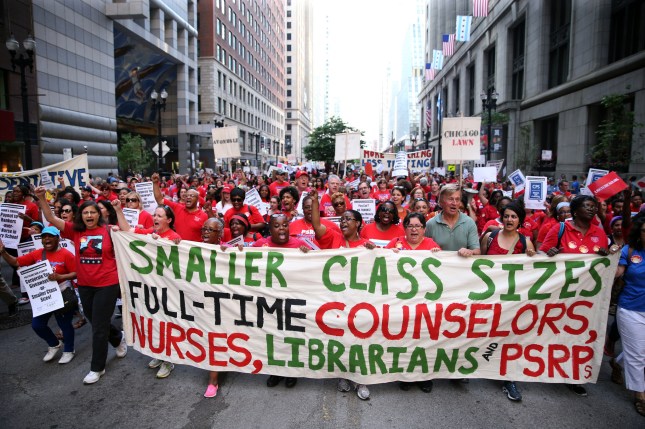
We live in an era where traditional American, community based, democratic, transparent, nonprofit, publicly funded, public schools are starved of funds and even closed while professional, dedicated, hardworking teachers are punished or fired based on student test results; tests that profit the private sector corporations that produce them.

The result is that more of our children end up in autocratic, CEO controlled, opaque (secretive), often child abusing, fraudulent-and-inferior, no excuses, test centered, publicly funded, private sector corporate charter schools where management gets paid a lot more, and teachers are paid less but work longer hours. WNYC.org reports, “Charters spend $774 more per pupil on administration, and $1,140 less on instruction, than do traditional publics.”

What’s ignored is the fact that tests and teachers cannot fix the effects of: 1. Childhood poverty, 2. Depression, 3. Blood-sugar imbalances, 4. Childhood PTSD, 5.Substance abuse, and 6. Lack of sleep.

  1. Effects of Poverty, Hunger and Homelessness on Children and Youth

The American Psychological Association reports, “The nation’s economic crisis has deeply affected the lives of millions of Americans. Skyrocketing foreclosures and job layoffs have pulled the rug out from under many families, particularly those living in low-income communities. Deepening poverty is inextricably linked with rising levels of homelessness and food insecurity/hunger for many Americans and children are particularly affected by these conditions.”


  1. Childhood Depression

WebMD.com says, “Children who are depressed may not do well in school, may become socially isolated, and may have difficult relationships with family and friends, Fassler says. Depression in children is also associated with an increased risk for suicide. The rate of suicide among young people has nearly tripled since 1960 and is the sixth leading cause of death among children between the ages of 5 and 14, the third leading cause of death among 15- to 24-year-olds, and the second leading cause of death among college students.”


  1. Blood-sugar imbalances

The CDC’s National Center for Health Statistics found, “Kids consume too much sugar, mostly from processed foods.”

Learning Liftoff.com says, “It’s shocking to note that according to the U.S. Department of Agriculture, the average child under 12 consumes 49 pounds of sugar annually. That’s only three pounds less than the average adult despite children being much smaller. All that sugar consumption isn’t helping their overall health, but is it impacting their academic performance? You might be surprised at the answer.”

  • Sugar Decreases Attention Span and memory
  • Chronic Sugar Consumption Might Permanently Impair Memory Function
  • Sugar Foods Crowd Out Brain Food


  1. Childhood PTSD

The U.S. Department of Veterans Affairs reports, “Studies show that about 15% to 43% of girls and 14% to 43% of boys go through at least one trauma. Of those children and teens who have had a trauma, 3% to 15% of girls and 1% to 6% of boys develop PTSD. Rates of PTSD are higher for certain types of trauma survivors. … Besides PTSD, children and teens that have gone through trauma often have other types of problems. Much of what we know about the effects of trauma on children comes from the research on child sexual abuse. This research shows that sexually abused children often have problems with: fear, worry, sadness, anger, feeling alone and apart from others, feeling as if people are looking down on them, low self-worth, and not being able to trust others; behaviors such as aggression, out-of-place sexual behavior, self-harm, and abuse of drugs or alcohol.”


  1. Substance abuse

Alcohol Rehab.com says, “Children of parents who suffer from substance abuse problems can have problems at school as a result of the upheaval, unpredictability and violence they face at home. Some children have immense strength and can cope with their problems and still manage to maintain good school grades and relationships, but more often than not this is not the case. Bullying, fighting, bad grades, problems with attention span, fear of authority and emotional problems are all signs that a child is facing significant home problems.”


  1. Lack of sleep

The Douglas Institute in Quebec reports, “Reducing sleep may disrupt the ability of students to concentrate for long periods of time, and remember what they learn in class. According to a study, children with reduced sleep are more likely to struggle with verbal creativity, problem solving, inhibiting their behaviour, and generally score lower on IQ tests according to current leading research.”

Sleep Foundation.org recommends that school age children 6-13 sleep 9 to 11 hours and adolescents 14-17 should sleep 8 to 10 hours daily, but according to Sleep For Kids.org “It is clear from the poll results that we need to focus as much on the sleeping half of children’s lives as we do on the waking half.  Children are clearly not getting enough sleep,” says Jodi A. Mindell, PhD, who served as Chair of NSF’s 2004 Poll Task Force: “And a remarkable number of children have some kind of sleep problem.”

Why are billionaire oligarchs like Bill Gates, the Koch brothers, Eli Broad, and the Walton family ignoring what tests and teachers cannot fix and spending so much money to subvert democracy and destroy the publicly funded, community based, democratic, transparent, non-profit, public schools and replace them with autocratic, opaque, child abusing, often fraudulent and inferior, publicly funded, private sector corporate charter schools? If you don’t know the answers, start here: Behind Closed Doors of the Billionaire Foundations, The Plot Against Public Education, and The Billionaires’ War Against Public Education.

Discover more about why Corporate driven public education reform is destroying OUR children’s health and future

__________________________________

Lloyd Lofthouse is a former U.S. Marine and disabled Vietnam Veteran, with a BA in journalism and an MFA in writing, who taught in the public schools for thirty years (1975 – 2005).

Crazy is Normal promotional image with blurbs

Where to Buy

To follow this Blog via E-mail see upper right-hand column and click on “Sign me up!”


Tags: , , , , , ,

EduShyster: Behind the Closed Doors of the Billionaire Foundations

Bill Gates and Eli road find democracy to be a “hindrance,” an obstacle to the strategic plans to change America to what they want it to be.

dianeravitch's avatarDiane Ravitch's blog

EduShyster interviewed author Megan Tompkins-Stange about her new book “Policy Patrons,” which reports on the five years she spent working inside the big foundations that fund corporate-style reform: Gates and Broad, who pursue top-down reforms, and Ford and Kellogg, which are likelier to be “field-oriented.”

EduShyster says at the outset that the book shows the foundations to be “heavy with hubris,” certain that they have all the right answers. The Gates Foundation was giddy with joy to see how closely their goals meshed with those of the Obama administration.

EduShyster says, “We overhear the Broad folks reveling in their success in New Orleans and the failure of the opt out movement, and Team Gates crowing over, well, everything. But both have ended up getting some comeuppance of late—Gates over the Common Core and Broad over Eli Broad’s charter expansion plan in Los Angeles.

Tompkins-Stange responds:

I think what we’re seeing…

View original post 193 more words

 
Leave a comment

Posted by on August 29, 2016 in Uncategorized


Boston Globe: FOR Charters, AGAINST Teachers’ Union

If you don’t think that U.S. community based, democratic, transparent, non-profit, traditional public schools aren’t at war with profit-hungry, child-abusing, corporate autocrats, think again.

dianeravitch's avatarDiane Ravitch's blog

The Boston Globe used to be a liberal newspaper. But that was long ago. Now it opposes the teachers’ unions and it supports privatization of public education.

Massachusetts is the highest performing state in the nation, as judged by test scores; you would never know that if the Globe was your only source of information. Corporate reformers were audacious in choosing Massachusetts as their next big battleground to save poor kids from failing schools. Their ambition–to break public education–is outrageous in the nation’s top-performing state. Their promises ring hollow.

Our reader Christine Langhoff gives us an update on the escalation of hostilities as the air war for public opinion heats up.

She writes:

The Question 2 campaign continues to, as we say, “evolve”.

On Sunday, The Boston Globe published an advertorial scolding the Boston Teachers Union that it had better settle contract negotiations pretty quickly because “such changes are necessary…

View original post 708 more words

 
Leave a comment

Posted by on August 26, 2016 in Uncategorized


Steven Singer: Are Unions the Enemy of School Reform?

dianeravitch's avatarDiane Ravitch's blog

Steven Singer writes here about the corporate reformers’ war against teachers’ unions. In the comfortable, well-heeled world of hedge fund managers, they have every right to lead the fight to reform the public schools, but the unions do not. The unions don’t care about kids; teachers don’t care about kids. Only hedge fund managers really truly care about kids. Why should teachers or their unions have anything to say about their working conditions or their pay? Are they just greedy and selfish. So what if teachers earn less that the hedge funders’ secretaries?

Singer says the battle over the future of public schools has reached a critical juncture. The corporate reformers have lost control of the narrative. They want to hide behind benign names, like “Families for Excellent Schools,” hoping to hoodwink the public into thinking they are the families of children who want charter schools, when in fact…

View original post 601 more words

 
Leave a comment

Posted by on August 24, 2016 in Uncategorized


John Oliver Explains the Frauds and Scams in Charter World!

Widespread Corporate Charter School Fraud Revealed by HBO’s John Oliver.

dianeravitch's avatarDiane Ravitch's blog

John Oliver, who has a regular show on HBO, devoted a big chunk of his program last night to explaining the frauds perpetrated by unregulated and unsupervised charter schools. He also reminds his viewers that the language of competition and choice is a hoax when talking about education. You will see charters opening and closing like shoe stores in a mall. You will see charter owners fattening their bank accounts at the expense of the children. You will see charter operators plagiarizing their applications from others.

Readers of this blog will see some familiar scams–in Philadelphia, Florida, and Ohio, for example–but even you might be surprised by some of the stories he shows and documents.

With enough time, he might have devoted an entire hour to the scams in California, Texas, Indiana, and elsewhere.

But the great thing about his show is that this is the first time that a…

View original post 20 more words

 
Leave a comment

Posted by on August 22, 2016 in Uncategorized


A Conversation With Nashville School Board Member Amy Frogge

TC Weber's avatarDad Gone Wild

amy fI don’t think it would be breaking news for me to confess that I’m a big fan of Jennifer Berkshire and the work she does with her EduShyster blog. She’s inspired me to want to do a series of interviews with people who work in education in Tennessee. I think these interviews will be particularly relevant based on the impact Tennessee’s educational policy has on national educational policy. Our proximity to Louisiana, the cast of characters including Kevin Huffman, Todd Dickson, Ravi Gupta, and Chris Barbic, the over investment in politics by Stand For Children, being one of the first states to win Race To The Top money – these things, along with vibrant teacher/parent advocacy groups, have placed us at the forefront of the education reform movement.

For my first interview, I chose Nashville School Board member Amy Frogge. She is a parent who first decided to run…

View original post 3,338 more words

 
9 Comments

Posted by on August 21, 2016 in Uncategorized


Do Unions Belong in the Fight Against Corporate School Reform?

stevenmsinger's avatargadflyonthewallblog

ct-chicago-teachers-rally-met-0610-20150609

In the fight for public education, the forces of standardization and privatization are running scared.

They’ve faced more pushback in the last few years – especially in the last few months – than in a decade.

The Opt Out movement increases exponentially every year. Teach for America is having trouble getting recruits. Pearson’s stock is plummeting. The NAACP and Black Lives Matter have both come out strongly against increasing charter schools.

So what’s a corporate education reformer to do?

Answer: Change the narrative.

They can’t control the facts, so instead they try to control the story being told about the facts.

It’s a classic propaganda technique. As Malcolm X put it:

“If you’re not careful, the newspapers will have you hating the people who are being oppressed, and loving the people who are doing the oppressing.”

Their story goes like this – yes, there is a battle…

View original post 1,327 more words

 
Leave a comment

Posted by on August 21, 2016 in Uncategorized


This is What K-12 School Choice Really Looks Like

Before our daughter graduated from a traditional community based, democratic, transparent, non-profit public high school where she worked, learned and earned an excellent education, she applied to several universities and was accepted by most and rejected by a few. Stanford was one of the acceptances and that’s where she went. It was her choice what colleges to apply to and the choice of the universities to accept or reject her. That’s how choice works. In the private sector, businesses have the right to reject customers and refuse to sell products and/or provide services to them.

The K-12 real public sector schools do not have that choice, because they are funded by tax payers, and the U.S. Constitution and/or state constitutions do not allow the highly successful, traditional public sector schools to do what the private sector is allowed to get away with.

But a comment left by Stephen Ronan in a post’s thread on Diane Ravitch’s Blog alleged that autocratic, opaque, often fraudulent (click Charter School Scandals to discover how much fraud) and inferior, publicly funded, private sector charter schools offer parents a choice and Ronan thinks that the choice is better than community based, democratic, transparent, non-profit, traditional public schools.  Ronan even compared K-12 corporate charter schools to Harvard and MIT.

Ronan was totally wrong and here’s why.

There is only one Harvard, one Stanford and one MIT. How many publicly funded, private sector, often fraudulent and inferior, autocratic and opaque K-12 corporate charter schools are there – thousands?

Harvard and MIT are not opaque and they are not financed with public funds from taxpayers.  Harvard also has $32.7 billion in cash on hand through its endowment.  MIT’s endowment totals about $13.5 billion. Stanford’s is $5.5 billion. How many of the 100,000, K-12 public schools in the United States have similar endowments?

Harvard admitted 2,106 undergrads from 39,041 applicants.  Applicants had a choice to apply but who decided what undergrads to accept and reject?

K-12 public schools do not operate that way. Every child who lives in the area a public school serves is accepted to that public school. There is no sifting or rejections. Public schools are not allowed to choose the students they are willing to teach, but publicly funded, private sector, corporate charter schools often reject students that apply.

The cost to attend Harvard for the average student is $60,659.


Jesse Ventura is a former professional wrestler, former Navy Seal, and former governor of Minnesota (1999-2003)

What’s the average cost to educate a K-12 public school student in the U.S.?  According to the National Council for Education Statistics: “Total expenditures for public elementary and secondary schools in the United States amounted to $620 billion in 2012–13, or $12,296 per public school student enrolled in the fall (in constant 2014–15 dollars, based on the Consumer Price Index). These expenditures include $11,011 per student in current expenditures for the operation of schools; $931 for capital outlay (i.e., expenditures for property and for buildings and alterations completed by school district staff or contractors); and $355 for interest on school debt.”

There is a huge difference between $60k and $12k.

Harvard’s acceptance rate is 5.2%. That means Harvard made a choice not to accept 94.8% of applicants. That is a lot of disappointed students who wanted to attend Harvard, but traditional public schools accept 100% of the students that live in the area they serve.

Stanford University’s acceptance rate is 4.7% (annual cost to average student is almost $60k)

MIT’s is 9% (annual cost to average student is $58,240)

This is what Ronan means by choice.

What are we getting with those autocratic, opaque, often fraudulent and inferior, publicly funded, private sector, corporate charter schools that have a choice to accept or reject children, a choice the traditional public schools do not have?

Figure 26: Academic Growth of Charter Schools Compared to Their Local Markets, Page 57, credo.stanford.edu

READING:
No Significant Difference – 56 percent
Significantly worse – 19 percent
Significantly Better – 25 percent

Translated: 75 percent are the same or worse than the public schools. What happens when a student takes a high-stakes test and gets 25 percent of the questions right? A 25 percent score is a failing grade.

How many years have the corporate charter schools had to achieve this level of failure?

MATH:
No Significant Difference – 40 percent
Significantly worse – 31 percent
Significantly Better – 29 percent

Translated: 71 percent of publicly funded, private sector corporate charters are the same or worse than the public schools. What happens when a student takes a high stakes test and gets 29 percent of the questions right? A 29 percent score is a failing grade.

How many years have the corporate charter schools had to achieve this level of failure?

Most if not all autocratic, opaque, often fraudulent and inferior, publicly funded, private sector, corporate charter schools are not Harvard, Stanford or MIT or even close, and those three private sector universities are not publicly funded.

In addition, let’s not forget the child abuse taking place in autocratic, publicly funded, private sector corporate charter schools. Jonathan Pelto reports Child Abuse in the form of the “No Excuses” education model and says, “the term ‘No Excuses’ is really a placeholder for a militaristic, highly disciplined, autocratic system in which children are forced to understand that discipline, conformity and following rules is the fundamental cornerstone that leads to academic achievement.”

__________________________________

Lloyd Lofthouse is a former U.S. Marine and disabled Vietnam Veteran, with a BA in journalism and an MFA in writing, who taught in the public schools for thirty years (1975 – 2005).

Crazy is Normal promotional image with blurbs

Where to Buy

To follow this Blog via E-mail see upper right-hand column and click on “Sign me up!”


Tags: , , , , , ,

What Real School Choice Would Look Like – And Why What They’re Selling Isn’t It

stevenmsinger's avatargadflyonthewallblog

pathdoc_Shuttertock_decision - Edited 

I can’t hear the words “School Choice” without thinking of Inigo Montoya from the classic film “The Princess Bride.”

I hear Mandy Patinkin’s voice saying, “You keep using that word. I do not think it means what you think it means.”

Because just like the constant cries of “Inconceivable!” from Sicilian boss Vizzini (portrayed by the inimitable Wallace Shawn), policymakers seem a bit confused.

You would expect School Choice to mean that parents would get to choose the school their children attend. However, the policy being pushed by corporate education reformers has nothing to do with that.

It’s about allowing schools to choose students, not the other way around.

Want your child to attend a charter school? Great! In many cases he needs to meet the requirements of admission – good grades, well behaved, no learning disabilities – otherwise they boot him back to the…

View original post 2,038 more words

 
Leave a comment

Posted by on August 15, 2016 in Uncategorized


How privatization of schools works: An infograph

How privatization of schools works: An infograph
 
Leave a comment

Posted by on August 13, 2016 in Uncategorized