The AFT convention is one meeting after another in a vast convention center… meeting slides into meeting.
The delegates arrived on Thursday, the 3,000 plus delegates from around the country. From New York, Chicago, Philadelphia, Washington DC, Miami, Detroit, Cleveland, the large city delegations as well as delegates from Montana, Utah, North Dakota and Montana and Virgin Islands and many other smaller local; public school teachers, college teachers, paraprofessionals, nurses and the newest chapter, professional workers at the United Nations, all prepared to listen to a wide range of speakers and participate in vigorous debate.
The locals around the nation submit resolutions, this year 91 resolutions were submitted and they were distributed to 13 committees. All delegates choose which committee they want to attend – the committees range from 75 delegates to as many as 800 delegates. The Executive Council, the three officers and the 43…
Reading this, I conclude that the AFT will not call for Arne Duncan’s resignation. This is the first time in my memory that the AFT was less militant than its larger brethren and sisters in the NEA.
It appears that there will be a floor debate about the Common Core. The Chicago Teachers Union is opposed to it. If my reading of the tea leaves is right, the New York City delegation is prepared to shoot that resolution down too. CTU is the outlier in this convention, battle-scarred and ready to fight. The NYC delegation has the numbers to vote them down.
Readers of this blog know my views. Arne Duncan is the most anti-…
AFT, please kill Obama’s Common Core standards. Put that Machiavellian agenda to out of our misery and stop the suffering of students and teachers. Refuse to help the fake education reformers profit off our children and taxes.
A very good thing will happen on Sunday, July 13, 2014, at the American Federation of Teachers (AFT) convention in Los Angeles: The Common Core State Standards (CCSS) will be debated on the floor.
Weingarten, for instance, has repeatedly said she supports Common Core, but she also made a deliberate decision to allow a long public debate — which will be livestreamed online — on the standards. She has said the AFT is a democracy and will adopt policies favored by a majority of members, even if that means a dizzying about-face on the Common Core.
I spoke with CTU President Karen Lewis on July 10, 2014, about my concern that CTU’s anti-CCSS resolution would be somehow stifled. I learned that Lewis was instrumental in pushing for an open debate on CCSS.
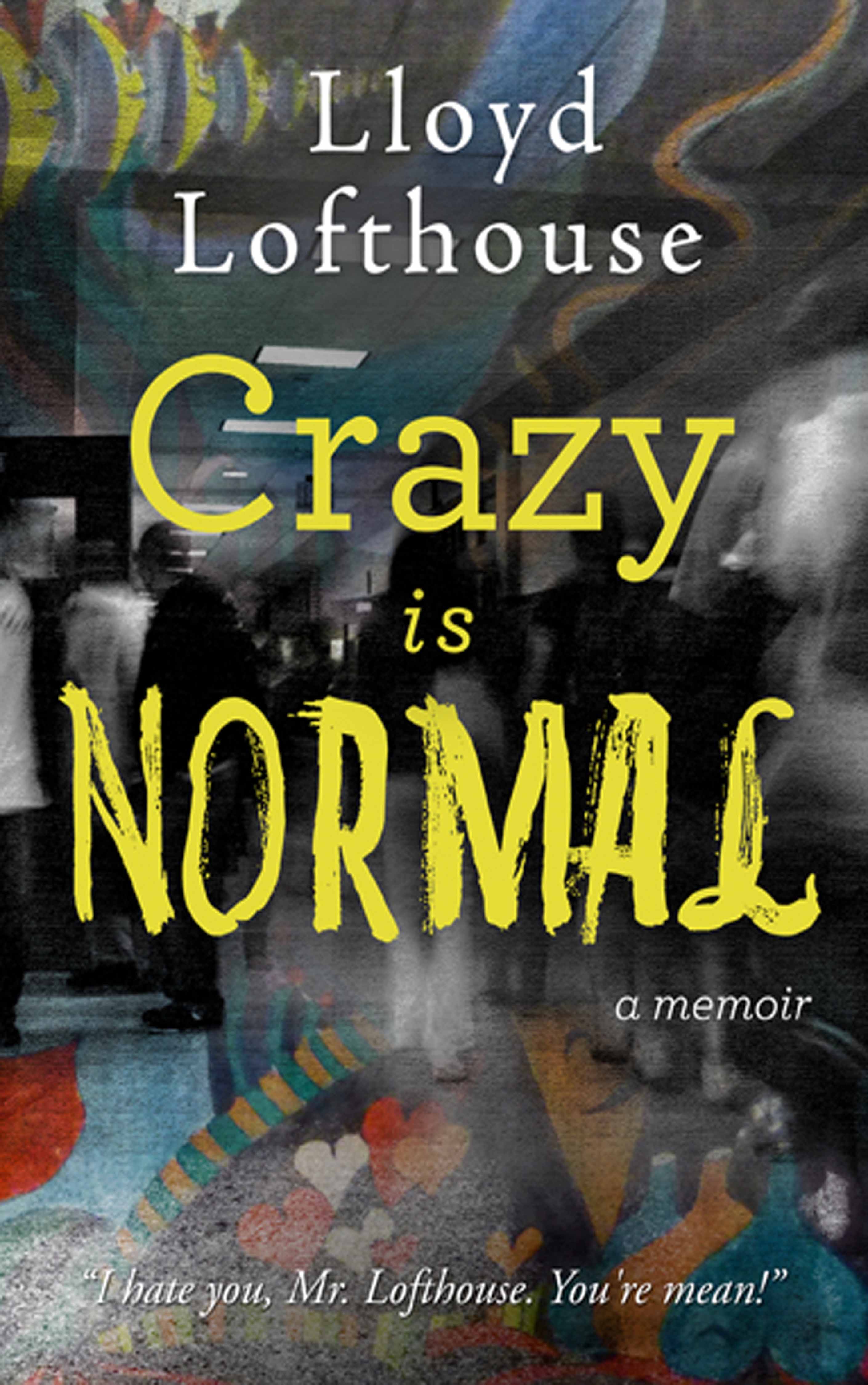
The reason for this Blog that I launched in January of 2010 was to support this memoir. Crazy is Normal, a classroom exposeis based on a daily classroom journal that I kept as a teacher in 1994-95. I have friends who are still teaching, and I know that the work climate for public school teachers is worse today than it was back then thanks to two presidents: George W. Bush and even worse, Obama, who, like a fool, I voted for twice, because I had no idea of his agenda to destroy the public schools and replace them with corporate, for profit schools that would not be answerable to the public while the public supported them with the taxes they pay.
Why do you think President Obama partnered will the richest man on the planet to make this happen. Yes, Bill Gates is Obama’s partner in the destruction of the democratic public schools that have a 175 years of history behind them and nothing but a record of improvement that continues to this day regardless of the lies you might hear or read from the media.
Lofthouse’s first novel was the award winning historical fiction My Splendid Concubine [3rd edition]. His second novel was the award winning thriller Running with the Enemy. His short story A Night at the “Well of Purity” was named a finalist of the 2007 Chicago Literary Awards. His wife is Anchee Min, the international, best-selling, award winning author of Red Azalea, a New York Times Notable Book of the Year (1992).
To follow this Blog via E-mail see upper right-hand column and click on “Sign me up!”
The California Teachers Association introduced the resolution calling for Arne Duncan to resign. Similar proposals had been defeated in 2011 and 2012. This one passed. Here it is.
Duncan is without question the most anti-teacher,anti-public schoolSecretary of Education in our history, and I say that advisedly. Both Bill Bennett Reagan’s second term Secretary) and Rod Paige (George W. Bush’s first term Secretary) had their faults, but they did nothing more than talk. Paige, remember, called the NEA a “terrorist” organization. But neither had the ability to open thousands of privately managed schools, neither persuaded states to judge teachers by the test scores of their students. Besides, both served Republican presidents so their antipathy to unions was not surprising. Duncan works in a Democratic administration. What is his excuse for applauding the mass firing of the staff in Central Falls, Rhode Island? The destruction of public education in New Orleans?…
President Reagan often talked of the silent majority as if he were its voice—like the Pope for the Catholics— but I think that was far from the truth. In this post, I’m going to reveal who that silent majority might be. But first, let’s eliminate the tea party people, who are not silent, because over time, various polls have found that slightly over 10% of Americans identify as a member of the tea party.
There are several groups that rule America, and they are not all in the Congress, the White House or the Supreme Court. Some are billionaires—for instance: the meddling Bill Gates, the Koch brothers, the Walton family, and Eli Broad along with a few other fools with too much wealth.
Then there are the citizens who vote, because they are a powerful force too. The popular vote may not elect the President of the U.S. or the…
The only education reform taking place is to move tax-payer dollars to for-profit, private Charter Schools with no proof that this is leading to improved education for our children because there is no way to monitor or evaluate what’s going on. So far, the Obama Race to the Top agenda is failing repeatedly and being ignored by most of the traditional media, the White House and most members of Congress while a well planned PR campaign is fooling as many Americans as possible.
Jeanne Kaplan recently retired as an elected member of the Denver school board. She has started her own blog where she will keep track of education in Denver.
Here is her inaugural post, where she lays out the facts about “reform” in Denver. The biggest “success” has been the steady increase in privately managed charter schools, most of which get free public space. The educational gains are harder to find.
She writes:
“My name is Jeannie Kaplan. I had the honor and privilege of serving on the Denver Public Schools Board of Education for 8 years, from 2005 through November 2013. Michael Bennet was superintendent, having been selected in June of 2005. Mr. Bennet served until January 2009 when he was selected to be the junior Senator from Colorado. His replacement was and continues to be Tom Boasberg, Michael’s childhood friend and former DPS Chief Operating Officer.
If the Obama White House has its way, this will be the beginning of the end of public education from kindergartener to graduate school PhDs. The Obama agenda envisions a future where every tax payer dollar that supports public education today will profit a corporation in some way—while corporations pay little or no tax—regardless of the quality of education being provided for future generations, becasue there will be no oversight—NONE! Fraud will be rampant. Teachers will have no job protection. Children will be taught to be obedient drones that are meant to only benefit corporate profits.
Laura Chapman writes in response to a post about OECD ratings for higher education in different nations based on ability of adults to answer standardized test questions. This comes as the U.S. Department of Education has declared its intention to rate, rank, and evaluate colleges and universities by a variety of criteria, then to tie funding to ratings. That is, to bring the data-based decision making of NCLB to higher education.
Chapman writes:
“OCED should not be messing around with ratings of higher education programs based on totally flawed assumptions, statistical and other wise.
“Meanwhile, two developments bearing on higher education in the United States are worth noting.
“ALEC, the conservative provider of model state legislation, wants to close a lot of public colleges and universities on a fast track.
“According to Politico (June 27, 2014) in ALEC’s next meeting members will consider endorsing the “Affordable Baccalaureate Degree Act,” which…
There’s an old proverb that disparages teachers. It goes like this: “Those who can, do; those who can’t teach.” It means that people who are able to do something well can do that thing for a living, while people who are not able to do anything that well make a living by teaching.
I’ve worked in both worlds—the private sector and the public, and I can assure you that old proverb is wrong and anyone who disagrees with me, well, those will be fighting words.
I started at fifteen washing dishes in a coffee shop nights and weekends thirty hours a week for three years while I went to school days until the day the mean boss told three of us that we had to stay later than usual and do someone else’s job who didn’t show up for work, and he wasn’t going to pay us. All three of us quit. If I had done as told, I probably could’ve stayed working in restaurant jobs for the rest of my life. In that job, when I clocked out, I never took work home.
A few weeks later, I joined the U.S. Marines and went to boot camp after graduating from high school. I fought in Vietnam where snipers came close to taking me out more than once, and I decided I didn’t want to make a career out of the Marines. I could have. After all, I survived three years and earned an honorable discharge. I did bring PTSD home and still have it.
My third act was going to college on the GI Bill, and while in college, I worked a series of part-time jobs and I didn’t consider any of them jobs I’d want to work for a lifetime.
For instance, I worked on a crew that cleaned a new Sears store before it opened. In the morning, I clocked in and worked my eight hours and then clocked out. There was no stress, no challenges, and I didn’t take any work home.
In my next job, I walked door to door sixteen hours a day, seven days a week as a Fuller Brush Man where I was told three months later—after more than a thousand hours of work—that I had sold more product than anyone else in the region. I quit, because all I earned for all the door to door walking and sore feet was four hundred dollars—that wasn’t enough for even one month’s rent.
Next job, I bagged groceries in a super market for two years, and I never took any work home. It was an easy job and the people I worked for were good people. The manager of the store was also a nice guy.
After the market job, I stocked shelves and dressed manikins for window displays at a J.C. Penny, and I never took any work home. The store manager was also okay as a boss.
Then I worked one summer near Fresno at a Gallo Winery in a seasonal job during the grape crushing season and before summer ended I was offered a full-time job that came with health benefits and decent pay, but I turned it down, because I wanted to finish college. I also never took any work home while I worked for Gallo. When I clocked out, the work ended.
After graduating from college with a BA in journalism, I landed a job in middle management in a large trucking company. After several years of repetitive paperwork and long hours sitting at a desk in a glass walled office, I quit and went back to college to earn a teaching credential. While working that job, I never took any work home, and my boss was a decent guy to work for. He was fair and kind. From there, in 1975, I returned to college and earned a teaching credential.
In the early 1980s, while teaching days at a tough intermediate school, I worked for a few years at night and on weekends for a fancy nightclub/restaurant called the Red Onion in West Covina, California. At the time, there were several Red Onions in Southern California. The one where I worked had three dining rooms—one with a glass ceiling and a few full-sized palm trees—on one side of the lobby. On the other side was a three-bar nightclub that held a thousand drinkers and dancers. After a few months, I was promoted to the maître d position and put in charge of the front desk. Then the owner of the chain, who drove a white Rolls Royce, offered me a job in management, but I said no and stayed in the classroom as a teacher. The only thing I took home from that job was a few women I met at the night club and dated, and I have no complaints about that. All the managers I worked for were all decent, kind, hard working men.
When I compare all of the jobs I worked in my life, the toughest and most challenging job was teaching where I often worked sixty to one hundred hours a week. Twenty-five to thirty hours a week was teaching and the rest of the sixty to one hundred hours was planning lessons, making phone calls to parents, paperwork (grades, etc.), and correcting student work.
In fact, I took work home during the school year almost every night and weekend often working until I was too tired to keep going.
When I retired from teaching in 2005, I decided that if for any reason I ever had to go back to work, I’d rather be an old U.S. Marine fighting in a war zone like Vietnam, Iraq or Afghanistan. In fact, to avoid teaching again, I’d be willing to volunteer and strap on explosives and blow myself up along with a group of al Qaeda or Taliban terrorists before I’d go back in the classroom to be demeaned and abused by students, parents, administrators and our nation’s elected leaders, who make all the decisions for the public schools but accept none of the blame for anything that goes wrong and doesn’t work. Teachers are rarely part of the decision process. They are just the scapegoats for fools who say, “Those who can, do; those who can’t teach.”
I know the public schools are not broken. The crises in public education has been manufactured by a bunch of unscrupulous fake education reformers who are mostly interested in how much money they can steal from tax payers with the approval of the Obama White House.
To find out what it’s like to be a public school teacher in the United States, I suggest that you read my memoir, Crazy is Normal, a classroom exposé. You see, I kept a daily journal in 1994-95 for one of the thirty years I was a teacher and captured that job in detail. The other option is to actually go teach in a school similar to the one where I taught.
_______________________
Lloyd Lofthouse is a former U.S. Marine and Vietnam Veteran,
who taught in the public schools for thirty years (1975 – 2005).
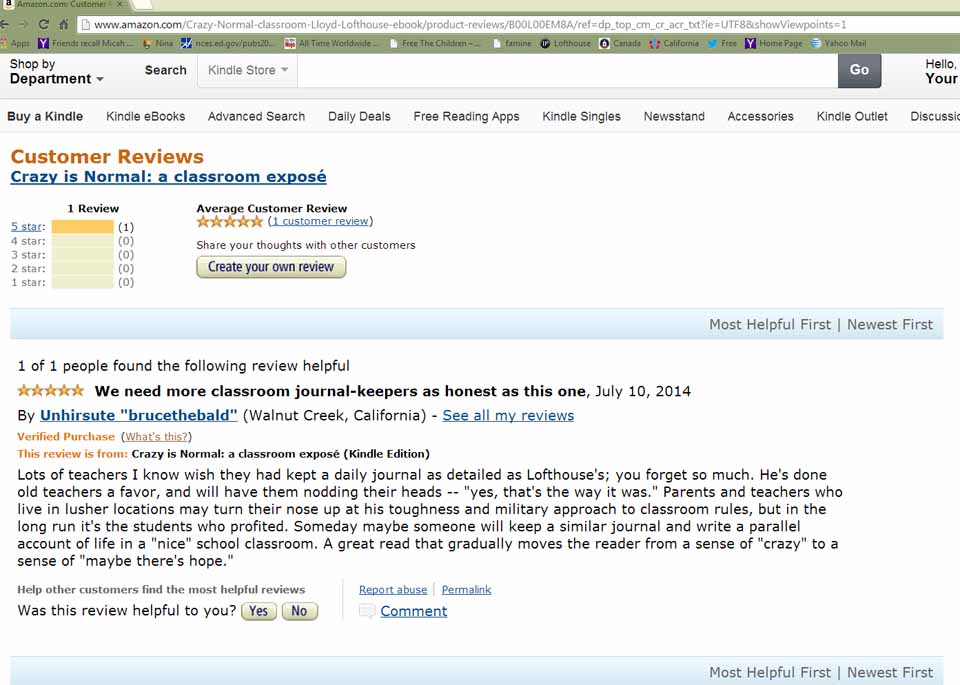
His third book is Crazy is Normal, a classroom exposé, a memoir. “Lofthouse presents us with grungy classrooms, kids who don’t want to be in school, and the consequences of growing up in a hardscrabble world. While some parents support his efforts, many sabotage them—and isolated administrators make the work of Lofthouse and his peers even more difficult.” – Bruce Reeves
Lofthouse’s first novel was the award winning historical fiction My Splendid Concubine [3rd edition]. His second novel was the award winning thriller Running with the Enemy. His short story A Night at the “Well of Purity” was named a finalist of the 2007 Chicago Literary Awards. His wife is Anchee Min, the international, best-selling, award winning author of Red Azalea, a New York Times Notable Book of the Year (1992).
This personal report about setting the cut scores for New York’s Common Core 11th grade ELA test was written by Dr. Maria Baldassarre Hopkins, Assistant Professor in the School of Education at Nazareth College. The cut score is the passing mark.
Apparently it took me a while to get it through my thick skull. I was reminded no fewer than three times at the cut score setting for the new Common Core aligned ELA Regents Exam that I am, indeed, not a psychometrician.
“Mary, are you a psychometrician?” I was asked when I made one of my frequent requests for more information.
My name ain’t Mary. And, no, I am not a psychometrician.
Last year I wrote critically of the cut score setting process for the 3-8 Common Core assessments. I was…




 Crazy Normal - the Classroom Exposé