The first paragraph says, “Obvious Trump supporters and/or conservatives have sent me emails, accusing me of being unfair regarding former President Trump and attacking American conservatives. They were referring to my thriller The Patriot Oath.”
The menu to the right of Lloyd Lofthouse has three new pages following links from my older blogs that are still on WordPress, and one of the new ones is the new Writer’s Blog:
Disruption: disturbance or problems which interrupt an event, activity, or process
Last Saturday, July 18, 2020, my blogging was disrupted by WordPress, and my temper, calm for months, exploded. Before the COVID-19 pandemic, I had lunch with friends every week and joined others in group meetups. Thanks to the virus, I have lived alone since March 13. No one has visited me, and I have visited no one. Zoom, e-mails, phone calls, and WebEx help but cannot replace face-to-face visits.
Back to July 18 when I logged onto my iLookChina.net blog to schedule three new posts for August, my first thought when I saw the new editing page for WordPress was, “What the FUCK!”
I complained to WordPress and the little help they offered did nothing to end the stress from the disruption they caused.
I learned that WordPress was changing the Classic Editor I had been using for a decade to a Block Editor (whatever that is). From what I saw, I did not like the Block Editor and that feeling has not changed.
I was comfortable using the Classic Editor. I have better things to do than being forced to learn something new that stresses me out.
On Sunday, July 19, I wrote an angry letter expressing my frustration to Matthew Charles Mullenweg, the Founder, and CEO of WordPress. When I write an angry letter, I never mail the rough draft. I wait a few days and then revise to filter out the worst of my anger. But that rough draft will never be revised and mailed to Mr. Mullenweg. Instead, that letter has been added to this post.
Matthew Charles Mullenweg, Founder, and CEO of WordPress
WordPress Corporate Office Headquarters Automatic, Inc.
60 29th Street #343
San Francisco, California 94110-4929
Dear Mr. Mullenweg:
This morning I attempted to start scheduling the August 2020 posts for my https://ilookchina.com/ blog [806,254 hits/visits], and ran into an “alleged” improvement to the page where bloggers like me create their posts and schedule them. The changes to the WordPress editing page were so drastic that I couldn’t complete that task. I did not know what to do. I was lost. All the old menus were gone. I did see how I would upload a photo from one of the files on my desktop. I am not in the mood to learn how to use the new and disruptive Block Editor that is replacing the Classic Editor.
I always write my blog posts offline and copy and paste them into the Classic Editor that I have been using for a decade for all four of my WordPress Blogs.
WordPress just became the flaming straw that set off the fuse to my explosive anger. Somehow I managed to stay calm since March while billions of people around the world (including you) are struggling to avoid dying of COVID-19. Last month, when the electrical circuits in my garage blew out, I still managed to stay calm. Then last week, my HVAC system stopped cooling my house in the middle of a heatwave. That HVAC was a new system installed in 2017 for $18k, but I still did not flip my lid.
Then along came WordPress with its NEW Block Editor.
Why change something that was working? Why not set up an easy to find a button where we are allowed to keep the old design over the new one? What is wrong with you guys? Keep it simple. Do not change the old so drastically that it becomes stressful to deal with.
In the short term, stress can leave us anxious, tearful and struggling to sleep. But over time, continuously feeling frazzled could trigger heart attacks, strokes, and even suicidal thoughts. “In short, yes, stress can kill you,” – The American Institute of Stress
In case you don’t know it, change is not always good.
Sincerely (not really, I’m too angry to feel sincere), Lloyd Lofthouse
High levels of cortisol caused by stress over a long period of time wreak havoc on your brain.
A few days after writing the letter to Matthew Charles Mullenweg, I read a piece from The San Francisco Chronicle. There’s a name for tech’s attitude problem: toxic positivity, Silicon Valley’s obsession with disruption and destruction of the existing order and evangelical embrace of the new. It’s better on the other side of the river, we promise … in recent years, that’s become its own kind of orthodoxy, where the only appropriate response to new technology, according to the insiders of Silicon Valley, is cheerleading. Criticism of technology isn’t viewed as rational skepticism by those for whom innovation has become a religion; it’s heresy.”
Forbes also published a piece on this topic. “The Myths of Disruption: How Should You Really Respond to Emerging Technologies? Disruption may be the most overused term in the business lexicon today. Every startup wants to disrupt the established order. Every incumbent is scared of being disrupted. Disruption is a rallying cry or a bogeyman, depending on where you sit. And no one is immune: if an executive dares to suggest that their industry is free from the threat of disruption, they are accused of being short-sighted or in denial, and heading the way of the Titanic or the T-Rex. I find this obsession with disruption a little disturbing. “
Years ago, I started rebelling against technology’s forced disruption.
I bought two Kindle e-readers. Then a couple of years later, I returned to reading books printed on paper and my kindles have been gathering dust ever since. Old fashioned books do not have batteries that need to be recharged and do not have software to update. This is ironic since the novels I have published have sold more than 60,000 e-books through Amazon, Barnes & Noble, and other bookselling sites.
The new should always be easier to use than the old.
I had a smartphone once, and after a couple of years I turned it in for a dumb phone. I do not text. I do not run around taking smartphone videos and photographs of myself. My dumb phone gets used about five-minutes a month. That smartphone was a fucking pain in the ass, always demanding attention to keep working.
Fuck that shit! If you want to replace something old with something new, keep it simple!
When I bought my first tablet computer, it lasted a day before I returned it, because it wasn’t easy to set up and use.
I have an HP laptop locked in a safe. I update the laptop once a month. If my desktop gets hijacked again by ransomware, that laptop will be my backup while the desktop is in the shop being unhacked.
The last two times I bought new cars, I refused to sign the contract unless the dealers replaced the satellite-linked, streaming radio with the fancy touch screen with a CD player that was easier to use. The only new shit I liked was the backup camera and the chirping thing that warns me when another car is in one of my blind spots.
I plan to do the same thing with the next car I buy. If the dealer wants my money, they have to replace the irritating new crap with a CD player, or I will start looking for an older, used car that predates the annoying disruptive tech. If I can afford to buy a new car every few years, I can afford to rebuild an old one when it wears out and even have someone add batteries and turn it into a plugin hybrid. I’ve read about people that have done that on their own.
I have news for disrupters like WordPress, Microsoft, Apple, and all the other tech geniuses. I do not want anyone else disrupting my life. I do that just fine by myself, and when it comes to learning new things, I want to make that decision and not have it forced on me.
This might be my last post for all of four of my blogs if I cannot get the Classical WordPress Editor back. There is enough stress in this world without Donald Trump and Silicon Valley companies like WordPress generating disruption.
Will this be my last blog post? I do not know. I have been blogging for a decade. I have written and published 2,455 posts for iLookChina, 614 for LloydLofthouse.com, 1.444 for Crazy Normal, the classroom exposé, and 269 for The Soulful Veteran. That is a lot of writing, research, and reading. Those posts have generated more than a million reads or visits.
Ω
Lloyd Lofthouse is a former U.S. Marine and Vietnam combat vet living with PTSD. He went to college on the GI Bill and earned a BA in journalism followed by an MFA in writing.
I broke a tooth over the weekend and visited the dentist this afternoon spending a few hours in THE chair. I hate those shots that numb your jaw making it feel swollen like a puffy blimp. In a few days I will return for the fitting of the crown.
But when I returned home with that numb jaw, there was a surprise—a double dose of what I think was good news.
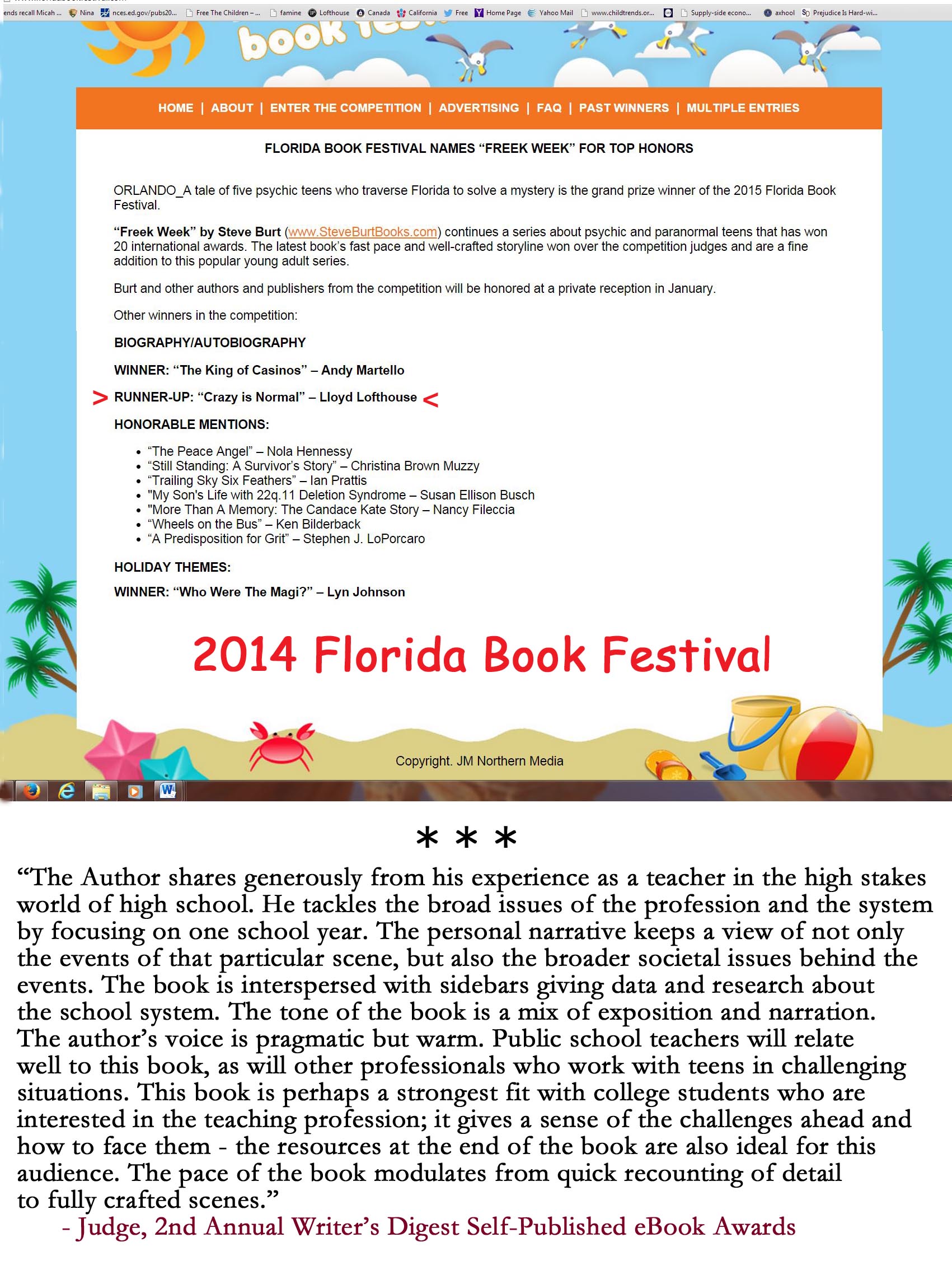
“”“Crazy is Normal, a classroom expose” didn’t earn any awards from Writer’s Digest, but the judge’s comments were appreciated. :o)
_______________________
Lloyd Lofthouse is a former U.S. Marine and Vietnam Veteran,
who taught in the public schools for thirty years (1975 – 2005).
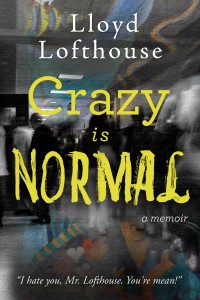
His third book is Crazy is Normal, a classroom exposé, a memoir. “Lofthouse presents us with grungy classrooms, kids who don’t want to be in school, and the consequences of growing up in a hardscrabble world. While some parents support his efforts, many sabotage them—and isolated administrators make the work of Lofthouse and his peers even more difficult.” – Bruce Reeves
Lofthouse’s first novel was the award winning historical fiction My Splendid Concubine [3rd edition]. His second novel was the award winning thriller Running with the Enemy. His short story A Night at the “Well of Purity” was named a finalist of the 2007 Chicago Literary Awards. His wife is Anchee Min, the international, best-selling, award winning author of Red Azalea, a New York Times Notable Book of the Year (1992).
To follow this Blog via E-mail see upper right-hand column and click on “Sign me up!”
You may want to skip this page if you prefer opinions without facts used as support (this is known as hot air or natural gas). I tend to support my opinions, some say, with too many facts (what I consider to be six cups of coffee).
There are more comparisons we should look at, and the first is comparing literacy in America with its northern and southern neighbors in addition to the top-ten countries with the highest reported high-school graduation rates.
In fact, there is another measurement that may be more meaningful than a country’s reported high school graduation rate. That measurement is functional illiteracy.
The United States and many other countries claim high literacy rates because the definition of literacy says, “The adult literacy rate is the percentage of people age 15 and above who can, with understanding, read and write a short, simple statement on their everyday life.”
However, functional illiteracy means that reading and writing skills are inadequate “to manage daily living and employment tasks that require reading skills beyond a basic level.”
Functional illiteracy is contrasted with illiteracy in the strict sense, meaning the inability to read or write simple sentences in any language.
For example, my older brother, (died age 64 in 1999) graduated from high school in the United States in 1953 and was considered literate due to the definition of literacy, because he could write and read at a second grade level. However, he was functionally illiterate and never read a newspaper, magazine or book in his life. In fact, he could not fill out an employment application.
Now, let’s cast serious doubt on comparing high school graduation rates in America with other countries.
According to the United Nations Human Development Report, the United Kingdom, that reported the highest secondary (high school) graduation rate in the world, has 21.8% of its adult population age 16 – 65 considered functionally illiterate.
Switzerland, in second place for high school graduation rates has a functional illiteracy rate among adults of 15.9%.
Norway, in third place, has a 7.9% functional illiteracy rate among adults.
I could find no information on functional illiteracy in South Korea, fourth place, and Japan, fifth place.
Italy, in sixth place for high school graduation rates, has a functional illiteracy rate of 46% among adults
Seventh place Ireland has a 22.6% functional illiteracy rate.
Eighth place Germany has a functional illiteracy rate is 14.4%
Ninth place Finland’s functional illiteracy rate is 10.4%
Tenth place Denmark’s functional illiteracy rate is 9.6%
America’s functional illiteracy rate was reported as 20% among adults.
However, for a better comparison with a similar culture that has similar values and similar problems, I looked north to Canada and discovered that among adults aged 16 to 65, about 42 per cent scored below Level 3 in prose literacy, which is considered the threshold needed for coping in society. Source: Vivele Canada
In addition, the CBC reported on Canada’s shame, saying that nearly 15 percent of Canadians can’t understand the writing on simple medicine labels such as on an Aspirin bottle and an additional 27% can’t figure out simple information like the warnings on a hazardous materials sheet.
For further proof that comparing high-school graduation rates between countries as a way to judge America’s public education system was and is wrong, in 2009, Canada’s high school graduation rate was reported as 78% but the country has a functionally illiterate adult population ages 16 – 65 of forty-two percent (more than twice that of the United States). Even comparing literacy rates is not a fair comparison between countries, for example, because in Finland most parents teach his or her child/children to read before they start school at age seven showing us that culture has a lot to do with literacy too.
However, in America studies show that 80% of parents never attend a parent-teacher conference.
What about Mexico—just south of the US. According to Mexico’s 2010 census 93.7% of Mexican males aged 15 and older were literate compared to only 91.1% of females, but what about functional illiteracy? Mexico comes close to Canada with 43.2% of its adult population aged 16 – 65 functionally illiterate as my brother was.
Compared to America’s closest neighbors, the public-education system in the US is doing a fantastic job. Is there room for improvement? Of course, but the overall evidence shows that America’s public schools do not deserve to be condemned as broken. Instead, the facts say that most of America’s public school teachers are doing the job they were hired to do while it is politicians that are telling them what to teach.
Another factor to consider is High School graduation rates by race/ethnicity in the United States
For the 2007-08 school year, 91.4% of Asian/Pacific Islanders graduated from high school (156,687); 81% of Whites (1,853,476); 64.2% of American Indian/Alaska Native (31.707); 63.5% of Hispanic (443,238), and 61.5% of Blacks (415,111). Source: U.S. Department of Education
Most schools have all five races/ethnicities represented in the same classrooms (the schools I taught in for thirty years did) with the same teachers. However, when the numbers are averaged, critics of public education blame the teachers.
When averaged, the graduation rate in 2008 was 74.9%, which makes the public schools seem to be earning a C while they are earning an A- for the Asian/Pacific Islanders and a B- for Whites.
Really? How can the same teacher be so successful with Asian/Pacific Islanders and Whites and not with the other ethnic groups?
This is the advise I told our daughter when she was in grade school: “The only excuse to fail and not learn in school is when students do not pay attention, ask questions, read, do homework, class work, etc. There is no excuse. Even if the teacher is incompetent, a motivated student will still learn.” And she did.
In addition, the graduation rates increase when the GED is included with traditional high-school degrees. In 2009, the completion rates of 18-through 24-year-olds was: 88.3% white, 87.1% black, and 76.8% Hispanic. Source: U.S. Department of Education
If an Asian or White student is successful with a teacher, why can’t the Hispanic or Black student have the same success with the same teacher? After all, the teacher is responsible to teach and the student is responsible to learn (or has this been forgotten). If the teacher wasn’t doing his or her job, then the Asians and Whites should have graduation rates similar to Hispanics and Blacks.
Yes, my wife and me felt it was more important that our daughter be happier as an adult than during her childhood, which is why we left the TV off, no video games, no social networking (at least until her second year in high school), limited the number of school dances she attended, no mobile phone for personal use and focused on her reading books, doing homework, learning ballet, piano, how to change a flat tire, install a toilet, change a lock, install drywall, tile a floor, etc.
And last but not least, we never bought or drank any brand of soda. There was water and then there was water (sometimes there was fruit juice such as apple or orange juice).
Needless to say, many of our daughter’s peers in middle and high school felt sorry for her, because she wasn’t having as much fun as they were. However, our daughter graduated from high school with a 4.65 GPA and was accepted to Stanford University (the only student from her high schoolthat year) where she is starting her third year majoring in biology with goals to pursue a medical degree.
Contrary to popular opinion, she’s happy and loves to dance and play the piano and enjoys reading books. She has a boyfriend at Stanford she loves too and the two share many similar interests. She might want to be happy every waking moment and have loads of fun but she learned as a child that there is a difference between work, happiness, entertainment, bring bored and depression.
To achieve a better chance at adult happiness, her mother and me had to say no to many things leading to boring hours doing homework and studying in addition to reading books to fill the empty hours.
After all, according to the law in California (it varies by state ranging from age 14 to 18), one is a child until his or her eighteenth birthday. Then the child becomes an adult with a life expectancy of at least 84.9 years (on average) if he or she has a college education and earns an above average income. You see, education and income has a significant impact on health and a higher life expectancy and the average college graduate earns much more than a high-school dropout or high-school graduate.
Science Daily reported, “New findings from Harvard Medical School and Harvard University demonstrate that individuals with more than 12 years of education have significantly longer life expectancy than those who never went beyond high school. … Overall in the groups studied, as of 2000, better educated at age 25 could expect to live to age 82; for less educated, 75.”
In addition, The Economic Policy Institute discovered “While life expectancy has grown across the United States between 1980 and 2000, the degree to which people live longer has become increasingly connected to their socio-economic status.” The average life expectancy of the least well-off in 2000 was 74.7 years while it was 79.2 years for those that were most well off—meaning they had more money and usually a better education.
However, if left up to most children in the average family that does not live in poverty, happiness means not exercising, eating lots of sugary foods swallowed with gallons of sugary sodas, watching TV, listening to music, social networking, playing video games, hanging out with friends after school and on weekends, sending daily text messages by the dozens—and according to surveys and studies that is what the average child in America is doing ten hours a day.
Where are the parents?
Then there is this thing about parents blindly encouraging kids to follow their dreams without a realistic backup plan.
PRESS RELEASE
FOR RELEASE before June 1, 2012
CONTACT:
Lloyd Lofthouse, author lflwriter@gmail.com
IN THE 19th and EARLY 20th CENTURY, ROBERT HART WAS CRUCIAL TO THE SURVIVAL OF CHINA!
WALNUT CREEK, CA (3/2/12) — Robert Hart (1835 – 1911) was the ‘Godfather of China’s modernism’ and the only foreigner the emperor of China trusted. In fact, Hart played a crucial role in ending the bloodiest rebellion in history, and he owed this success largely to his live in dictionary and encyclopedia, his Chinese concubine Ayaou. In Dragon Lady, Sterling Seagrave wrote that Ayaou “was wise beyond her years”. In Entering China’s Service, Harvard scholars wrote, “Hart’s years of liaison with Ayaou gave him his fill of romance, including both its satisfaction and its limitations.”
With sales in the thousands, award-winning author Lloyd Lofthouse brings My Splendid Concubine (2007) and the sequel, Our Hart, Elegy for a Concubine (2010) together in The Concubine Saga (2012).
My Splendid Concubine was the love story Sir Robert Hart did not want the world to discover.
In the sequel, Our Hart, Elegy for a Concubine, he was the only foreigner the Emperor of China trusted.
Soon after arriving in China in 1854, Robert Hart falls in love with Ayaou, but his feelings for her sister go against the teachings of his Christian upbringing and almost break him emotionally. To survive he must learn how to live and think like the Chinese and soon finds himself thrust into the Opium Wars and the Taiping Rebellion, the bloodiest rebellion in human history, where he makes enemies of men such as the American soldier of fortune known as the Devil Soldier.
My Splendid Concubine earned honorable mentions in general fiction at the 2008 London Book Festival, and in 2009 at the Hollywood Book Festival and San Francisco Book Festival.
Our Hart, Elegy for a Concubine earned honorable mentions in general fiction at the Los Angeles Book Festival, Nashville Book Festival, London Book Festival, DIY Book Festival and was a Finalist of the National Best Books 2010 Awards.
In addition, The Concubine Saga picked up an Honorable Mention in Fiction at the 2012 San Francisco Book Festival.
Lloyd Lofthouse served in the Vietnam War as a U.S. Marine and lives near San Francisco with his wife and family with a second home in Shanghai, China. As a former Marine, Lloyd earned a BA in Journalism and an MFA in writing. His Blog, iLook China.net, currently averages 600 views a day with more than 200,000 since its launch in January 2010. My Splendid Concubine.com, his Website, has had 72,000 visitors since December 2007. At Authors Den, his work has been viewed 336,000 times.
In addition, in 2008, following the launch of My Splendid Concubine, Lofthouse appeared as a China expert on more than 30 talk-radio shows from The Dr. Pat Show on KKNW 1150 AM in Seattle to The Smith and Riley Show on WFLF 540 AM in Orlando Florida.
As a child, reading the books of Edgar Rice Burroughs is still a fond memory. Before there was Star Wars, Star Trek, The Lord of the Rings, Interview With a Vampire and Harry Potter there was John Carter of Mars.
When I discovered several months ago that John Carter of Mars was going to be a movie, I was excited, and when the movie came out, I went to see it the first day it was released — it was everything I imagined it should be. I have no complaints except that I wanted more.
10 Minute Movie Review from the FLICK pick
There are eleven books in the series and they are free through Gutenberg.org or offered at a low price through Amazon Kindle with no waiting for years as we did for each Harry Potter book and the movies that followed.
The Barsoom series is responsible for me going on to read books such as The Lord of the Rings (three times), the Anne Rice vampire series starting with Interview of a Vampire, all of the books written by Ursula K. Le Guin, and C. S. Lewis along with dozens of other authors and hundreds of books.
ten minute extended clip – movie trailer
Since reading is crucial to cultivate life-long learning, what better way is there to motivate a child/teen to read books than to have them watch a movie such as John Carter first. Once curious, those eleven books are waiting.
In addition, TV-Addiction.com says, “Reading requires the child to imagine what the words represent and this acts like exercise for the mind, creativity, imagination, and constructive skills. Television (including computers) does the reverse and fills the mind with nonsense images that blunt the child’s intellect and imagination.”
John Carter – a surprisingly good movie
Then Veronica Scott writing for Ezine @rticles says, “With children and their development, nothing is more important than imagination to help the growth of thought processes and creativity, while research has proved that watching too much TV or spending too much time surfing the Internet stunts the imagination and actually retards the development of that area of the brain.”
Last, Life-Long Earning shows that Imagination and Creativity is vital for Critical Thinking and Problem Solving to take place.
What are you waiting for? If you haven’t seen John Carter yet, go, and do not forget the eleven books that are waiting to ignite a child’s imagination and love of reading.
To subscribe to “Crazy Normal”, look for the “E-mail Subscription” link in the top-right column, or click on the “Following” tab in the WordPress toolbar at the top of the screen.
Visiting both mobile and brick-and-mortar libraries as a child turned me into an avid reader and a lifelong learner leading to my earning an Associate of Science degree, a BA in journalism and an MFA in writing in addition to a teaching credential—about nine years of college.
As a child, one of the grade schools I attended was across the street from my parents’ home, which brings me to the cultivation of my imagination. Books!
Reading at home is important too!
However, learning to read wasn’t that easy for me. Soon after starting school, my fate and my future hung in the balance. Experts at the first grade school I attended tested me and told my mother I would never learn to read or write. In those days, there was no term for dyslexia. In fact, the “experts” didn’t know about dyslexia.
Nevertheless, my mother made liars out of those so-called experts and taught me to read at home. How she did it is another story, and it didn’t hurt that my parents both loved to read.
Both my mother and father did not have the opportunity to graduate from high school. The Great Depression and other family tragedies were responsible for both of them dropping out to find jobs and contribute to their financial survival at the age of 14. My mother ran away from home and found a job as a waitress and my father mucked out horse stalls at Santa Anita Race Track in Arcadia, California.
Fast forward to me as a child that learned to love reading books, and once a week, a county library bus visited the grade school I attended.
Years later, I worked in the high school library and managed to read sometimes two books a day. It was as if books were feasts for my imagination and soul. I read all the historical fiction I could find on the British Empire, Alexander the Great, Genghis Khan, and American history. Then I discovered science fiction and fantasy, which led to Edgar Rice Burroughs’ Barsoom series. Later, I would add westerns and mysteries to the mix and eventually start reading literature at a much older age. As a child, I wasn’t ready for literature — not exciting enough.
To subscribe to “Crazy Normal”, look for the “E-mail Subscription” link in the top-right column, or click on the “Following” tab in the WordPress toolbar at the top of the screen.
Over the years, as a teacher and a parent, I offered this advice to my students and children: “Follow your dreams but have a back-up plan. Sometimes your dreams don’t pay the bills.”
When we follow our dreams, whatever they may be, we often face failure and rejection, which may lead to depression and giving up. Since this is the story most people experience, it helps to read one where someone did not give up on her dream and struggled for almost a decade.
Amanda Hocking’s story is inspirational and the foundation of that inspiration was her persistence.
It wasn’t easy. She says, “In the past ten years, I’ve probably got hundreds or maybe thousands of rejection letters.”
As the rejections and criticism saying she couldn’t write arrived in the mail, she thought, “This sucks! I should just give up.”
However, her passion to write kept her going. In a recent post on her Blog, Hocking says, “You cannot control everything that happens to you. But you can control how you react to it and how you feel about it.”
In the first video, The Young Turks discuss Amanda Hocking’s story.
Tired of rejection, Hocking turned to the Kindle e-book in 2010 and self-published. She says she grossed $2,000 in 2009. Today, she is a millionaire.
Amanda Hocking is now the rock star in the e-publishing world – selling hundreds of thousands of self-published e-books. Her young adult paranormal books have caught on like fire, getting her attention from the traditional publishing world and even Hollywood, which recently optioned one of her trilogies in addition to Hocking signing a contract with St. Martin’s Press for $2 million.
Amanda Hocking was born in 1984 and completed her first novel at age 17. She has now written twenty-two novels (published and unpublished).
USA Today reported, “Like writers from time immemorial, Hocking’s motivation to create a fantasy world stemmed from harsh reality.
“I grew up poor. I was an only child,” says Hocking, whose parents divorced when she was 11. “We lived out in the woods. We couldn’t afford cable.”
A rocky adolescence followed. “I was really unhappy … really depressed. Me and my mom fought constantly.”
According to USA Today, three things saved her:
One—the computer her parents gave her for Christmas when she was 11.
Two—the day her mother told an eighth-grade counselor to stop nagging her daughter to find other activities besides writing.
Three—she completed her first novel at 17, wrote constantly, took writing classes at local colleges and regularly queried agents and publishers, only to be rejected until she was already a self-made millionaire at 26.
Since dreams do not come with a guarantee, there is always the chance they may not come true but without persistence, they don’t stand a chance. No one that has climbed Mt. Everest did it in one leap. They did it one-step at a time. For Sir Edmund Hillary in 1953, the climb took seven weeks from the base camp to the top.
It took almost a decade for Amanda Hocking’s dream of being a successful author to come true. For me, the same dream took more than four decades. In both cases, persistence paid off—something all young people can learn.
To subscribe to “Crazy Normal”, look for the “E-mail Subscription” link in the top-right column, or click on the “Following” tab in the WordPress toolbar at the top of the screen.
One of the raptors ratted me out, and Grendel called me to his office to sizzle me in his hot seat. He yelled at me for going against Sauron’s orders. He moved closer until I could smell the dead flesh of vulchers and cigarettes on his breath. He demanded that I admit guilt. I suspected the motive was grade inflation.
I stared at his jugular wondering how fast it would take to tear it out with my teeth. Like Beowulf, I wanted to destroy the monster. To my dismay, as my PTSD was getting ready to launch, the VP, who was there to witness this interrogation, stepped forward and stopped us.
I think she saw the hunger in my eyes.
After school, she came into the teacher’s lounge, as I was getting ready to leave campus. We were alone. She looked around with a tense expression and made sure the hall leading to the staff lounge was empty.
Then she leaned closer and whispered. “You were right.” And she quit a few weeks later to accept a position in another school district abandoning us to the beast.
Damn! Talk about the rats leaving the ship. Soon, teachers started clambering down the ropes to escape.

 Crazy Normal - the Classroom Exposé