RSS

Category Archives: literacy

The US Department of Education Should not be Eliminated. Still, it must be reformed.

If you don’t have an attention span that lasts long enough to learn what I’m teaching in this post, start with the conclusion first. Then if you want to read the evidence following the CONCLUSION, it is your choice to stay ignorant, unless you already know what all the evidence shows us.

CONCLUSION

The United States should not eliminate the US Department of Education.

Still, the US Congress must pass legislation that standardizes teacher training to be more in line with what Finland does and require all K-12 teachers [in all K-12 schools private and public — that’s how it’s done in Finland] to complete a training program similar to what Finland does. The U.S. already has one that’s close, the U.S. Urban Teacher Residency programs.

Each state will still be in charge of education in their state, but setting standards for teacher training, and support for those teachers, should be the federal government’s responsibility.

In the United States, the best public schools are well funded Defense Department schools [DOD].

Department of Defense schools [DOD], are often considered to be “good” because of their consistent, well-funded structure, high expectations for student achievement, a strong focus on addressing the needs of military families with frequent moves, a culture of parental involvement, and a relatively uniform quality of education across all bases, resulting in high standardized test scores compared to many public schools.

The NY Times has an article about DOD schools, stating, “this school system outperformed all 50 states on reading and math scores for both eighth graders and fourth graders.” — Oct 10, 2023

The rest of the country must fall in line and stop fighting to see who can race to the bottom the fastest. No more teacher bashing. They get what you pay for. When they set low expectations and standards for teacher training like Teach for America [TFA] does, they can’t expect those teachers to turn out like Finland or the DOD’s public-schools.

For that to happen, the U.S. Department of Education [ED] must be reformed to be more like Finland’s Ministry of Education, with a mandate to insure all fifty states end up with highly trained and professional teachers in schools that perform like the DOD’s K-12 public schools.

End of Conclusion

Now you may start with the evidence if you haven’t fallen asleep yet.

The U.S. Department of Education [ED] is responsible for:

  • Establishing policy: The ED creates policies for federal education assistance, including financial aid and civil rights laws
  • Administering programs: The ED manages the distribution of federal funds for education programs, including grants and other assistance
  • Monitoring programs: The ED tracks how federal funds are used and ensures they are used effectively
  • Enforcing civil rights laws: The ED ensures that students have equal access to education and that programs receiving federal funds are free of discrimination
  • Researching education: The ED collects data and conducts research on education, including teaching techniques and best practices
  • Identifying issues: The ED identifies problems in education and recommends solutions
  • Raising awareness: The ED informs the public about education challenges and best practices
  • Helping communities: The ED works with communities to develop solutions to educational issues
  • The ED’s programs must be authorized by Congress and signed into law by the president
  • The ED’s budget is a portion of the total federal budget
  • The ED’s budget includes funding for programs like Pell Grants, early childhood education, and work assistance

Next Finland, a country considered one of the top in the world for education. It consistently ranks in the top ten for every subject in the Program for International Student Assessment (PISA).

This is what Finland’s Ministry of Education is responsible for:

  • Developing education and TRAINING
  • Early childhood education
  • Lifelong learning
  • Internationalization
  • Preparing educational legislation
  • Making decisions about education
  • Managing the country’s budget for education

In Finland, teacher training is highly selective, requiring a master’s degree in education which includes extensive pedagogical studies, substantial teaching practice in real classrooms, and a strong emphasis on research-based practices, aiming to produce teachers capable of independent problem-solving and exploring new teaching approaches; essentially, becoming a teacher in Finland is considered a prestigious career path due to the rigorous training involved.

In the United States, there is no standard for teacher training. Instead, each of the fifty states in the US sets its own standards for teacher training and licensure. Teacher training ranges from programs like Teach for America [TFA], to an Urban Teacher Residency [UTR] program.

TEACH FOR AMERICA [TFA] training takes place both virtually [on a computer at home] and in-person over the course of about two months for about 6 to 8 hours a day. After completing that short program without much or any actual experience working with students in a real brick and mortar classroom, the TFA teacher trainees enter K-12 public schools and go straight into teaching. According to research, the average retention rate for TFA teachers is significantly lower than non-TFA teachers, with only around 25% of TFA teachers remaining in the classroom for five years or more.

I am a US Marine, combat vet where what we learned in basic training was discipline, how to obey orders, and how to fight in a team and as an individual. Lots of muscle challenge sweaty exercise, too. Our training days ran longer than 8 hours. We didn’t get weekends off. Boot camp lasted for 13 weeks, much longer than TFA teacher training.

Now for the teacher training program I went through a few years after I was honorably discharged from the U.S. Marines and earned AS and BA degrees. The MFA came later.

In the United States URBAN TEACHER RESIDENCY (UTR) programs that train teachers combine academic coursework with teaching experience in urban school districts. UTR programs are designed to help close achievement gaps in high-need schools.

Partner with universities and school districts — UTR programs work with universities and school districts to provide aspiring teachers with teaching experience and a master’s degree.

  • Work with a mentor teacher — UTR programs place teacher residents with experienced mentor teachers for a full school year.
  • Commit to teaching in the school district — After completing the residency, teachers agree to teach in the school district for at least three years. I stayed in the same district where I was trained in 1975-76 until 2005, when I retired from teaching.

According to research on teacher residency programs, the average retention rate for UTR teachers is typically between 80-90% within the same district after three years, and 70-80% after five years, indicating a significantly higher retention rate compared to traditional teacher preparation programs.

More than 65,000 teachers have earned their teaching credentials through TFA compared to nearly 4,200 through UTR programs.

As one of the few UTR trained teachers, my students learned problem solving and critical thinking skills, and how to understand what they read, and to write poetry, short stories, essays, et al. Starting in the late 1970s, students I worked with in middle school won awards in state poetry and short story contests in competition with other junior high schools

In high school, my journalism students won regional, state, national, and international awards competing with other high school journalism students and student newspapers. The English [teaching literature, how to understand it, and how to write essays] students I worked with dramatically outscored other students throughout the school on those annual rank-and-punish standardized tests. Still, I hated those tests and still do. While other teachers sweated bullets teaching to those tests, I focused on the literature and writing, ignoring those tests.  Finland has standardized tests, but it is up to the teachers to use them. Standardized testing in that country is not mandatory.

All teachers in Finland are required to have a master’s degree, which can be specialized based on the subject they will teach, meaning there are different programs for primary school teachers, subject-specific teachers in secondary school, and other educational areas, but all require a high level of academic study and rigorous practical training. Entrance into teacher education programs is highly competitive, with rigorous entrance exams and interviews to ensure only the most qualified candidates are admitted. Finnish teacher education is heavily focused on research and evidence-based practices. Teacher programs include significant in-school practice teaching with close supervision.

Take a glance at the list of teacher training options for the United States.
Don’t miss the last paragraph.
It may blow your mind.

K-12 teacher training programs in the US include traditional Bachelor’s degree programs in education, focused subject area specializations within a Bachelor’s degree, alternative certification programs, post-baccalaureate teacher certification programs, and various professional development courses covering different teaching methods and subject areas, often with options for online learning and specific grade level focuses like early childhood education or secondary education.

Key types of K-12 teacher training programs:

  • Traditional Bachelor’s in Education:

A standard 4-year degree program with a focus on general education coursework alongside specific teacher training classes, often allowing for specialization in a particular subject area like math, science, or elementary education. 

  • Subject-Specific Bachelor’s Degree with Teacher Certification:

A degree in a specific subject (e.g., biology, history) with additional education courses to qualify for teaching licensure at the secondary level. 

  • Early Childhood Education Degree:

A focused program preparing teachers to work with young children in preschool and early elementary grades. 

  • Alternative Teacher Certification Programs:

Designed for individuals with a bachelor’s degree in a non-education field, allowing them to gain teaching certification through a shorter, more targeted training program, often including accelerated coursework and intensive classroom practice. 

  • Post-Baccalaureate Teacher Certification Programs:

For individuals with a bachelor’s degree who want to add teaching credentials, offering focused coursework and additional student teaching to qualify for licensure. 

Areas of focus within K-12 teacher training programs:

  • Special Education: Training for teaching students with learning disabilities or other special needs 
  • Bilingual Education: Preparing teachers to work with students from diverse language backgrounds 
  • Gifted Education: Training for teaching highly gifted students 
  • Math Education: Focused curriculum and pedagogy for teaching mathematics at various grade levels 
  • Literacy Education: Training for teaching reading and writing skills 
  • Science Education: Specialized instruction in science concepts and inquiry-based teaching methods 

Professional development options for K-12 teachers:

  • Online Courses:

Flexible learning opportunities through online platforms covering diverse topics like classroom management, curriculum development, and instructional technology 

  • Workshops and Seminars:

Short-term training sessions focused on specific skills or pedagogical approaches 

  • Coaching and Mentoring:

Individualized support from experienced educators 

  • Professional Learning Communities (PLCs):

Collaborative groups of teachers focused on improving instruction through peer feedback and shared learning 

All states except Minnesota and Rhode Island allow individuals to become teachers through alternative certification, even if they don’t have a degree. However, each state has its own requirements for alternative certification. Many states in the United States allow high school graduates to substitute teach in K-12 public schools without a specific substitute teaching certificate. In some states, a high school diploma or GED is enough to start substitute teaching. Some states may also accept a bachelor’s degree or college credits. However, some states, like California, require a bachelor’s degree for all teachers, including substitute teachers.

In the majority of states, you don’t need a specific substitute teaching certificate to get started. This means you can often begin your substitute teaching journey with just a high school diploma or GED, and sometimes, a bachelor’s degree or some college credits.

Your Guide to Substitute Teaching Across the U.S.: Certification Requirements by State


Tags: , , , , , , , , , , ,

When I say “OUR,” I’m referring to more than 300,000,000 people that live in the United States. Our public schools need OUR help to stop the Destruction Of Public Education Syndicate (DOPES)destroying one of our country’s greatest public resources, OUR public schools. The DOPES, supported mostly by billionaires (there are only a few hundred of them), has been at it for decades, and those lying bullies are not going away.


Tags: , , , , , ,

Will the Tech Industry’s Obsession for Disruption End my Blogging

Disruption: disturbance or problems which interrupt an event, activity, or process

Last Saturday, July 18, 2020, my blogging was disrupted by WordPress, and my temper, calm for months, exploded.  Before the COVID-19 pandemic, I had lunch with friends every week and joined others in group meetups. Thanks to the virus, I have lived alone since March 13. No one has visited me, and I have visited no one. Zoom, e-mails, phone calls, and WebEx help but cannot replace face-to-face visits.

Back to July 18 when I logged onto my iLookChina.net blog to schedule three new posts for August, my first thought when I saw the new editing page for WordPress was, “What the FUCK!”

I complained to WordPress and the little help they offered did nothing to end the stress from the disruption they caused.

I learned that WordPress was changing the Classic Editor I had been using for a decade to a Block Editor (whatever that is).  From what I saw, I did not like the Block Editor and that feeling has not changed.

I was comfortable using the Classic Editor. I have better things to do than being forced to learn something new that stresses me out.

On Sunday, July 19, I wrote an angry letter expressing my frustration to Matthew Charles Mullenweg, the Founder, and CEO of WordPress.  When I write an angry letter, I never mail the rough draft. I wait a few days and then revise to filter out the worst of my anger. But that rough draft will never be revised and mailed to Mr. Mullenweg. Instead, that letter has been added to this post.

Matthew Charles Mullenweg, Founder, and CEO of WordPress

WordPress Corporate Office Headquarters Automatic, Inc.
60 29th Street #343
San Francisco, California 94110-4929

Dear Mr. Mullenweg:

This morning I attempted to start scheduling the August 2020 posts for my https://ilookchina.com/ blog [806,254 hits/visits], and ran into an “alleged” improvement to the page where bloggers like me create their posts and schedule them.   The changes to the WordPress editing page were so drastic that I couldn’t complete that task.  I did not know what to do. I was lost. All the old menus were gone. I did see how I would upload a photo from one of the files on my desktop. I am not in the mood to learn how to use the new and disruptive Block Editor that is replacing the Classic Editor.

I always write my blog posts offline and copy and paste them into the Classic Editor that I have been using for a decade for all four of my WordPress Blogs.

Here are my other three blogs:

https://lloydlofthouse.org/ [92,621 hits/visits]

https://crazynormaltheclassroomexpose.com/ [121,597 hits/visits]

https://thesoulfulveteran.com/ [238,261 hits/visits]

Why do I want the Classic Editor back?

WordPress just became the flaming straw that set off the fuse to my explosive anger. Somehow I managed to stay calm since March while billions of people around the world (including you) are struggling to avoid dying of COVID-19. Last month, when the electrical circuits in my garage blew out, I still managed to stay calm. Then last week, my HVAC system stopped cooling my house in the middle of a heatwave. That HVAC was a new system installed in 2017 for $18k, but I still did not flip my lid.

Then along came WordPress with its NEW Block Editor.

Why change something that was working? Why not set up an easy to find a button where we are allowed to keep the old design over the new one? What is wrong with you guys? Keep it simple. Do not change the old so drastically that it becomes stressful to deal with.

In the short term, stress can leave us anxious, tearful and struggling to sleep. But over time, continuously feeling frazzled could trigger heart attacks, strokes, and even suicidal thoughts. “In short, yes, stress can kill you,” – The American Institute of Stress

In case you don’t know it, change is not always good.

Sincerely (not really, I’m too angry to feel sincere),
Lloyd Lofthouse


High levels of cortisol caused by stress over a long period of time wreak havoc on your brain.

A few days after writing the letter to Matthew Charles Mullenweg, I read a piece from The San Francisco Chronicle. There’s a name for tech’s attitude problem: toxic positivity, Silicon Valley’s obsession with disruption and destruction of the existing order and evangelical embrace of the new. It’s better on the other side of the river, we promise … in recent years, that’s become its own kind of orthodoxy, where the only appropriate response to new technology, according to the insiders of Silicon Valley, is cheerleading. Criticism of technology isn’t viewed as rational skepticism by those for whom innovation has become a religion; it’s heresy.”

Forbes also published a piece on this topic. “The Myths of Disruption: How Should You Really Respond to Emerging Technologies? Disruption may be the most overused term in the business lexicon today. Every startup wants to disrupt the established order. Every incumbent is scared of being disrupted. Disruption is a rallying cry or a bogeyman, depending on where you sit. And no one is immune: if an executive dares to suggest that their industry is free from the threat of disruption, they are accused of being short-sighted or in denial, and heading the way of the Titanic or the T-Rex. I find this obsession with disruption a little disturbing. “

Years ago, I started rebelling against technology’s forced disruption.

I bought two Kindle e-readers. Then a couple of years later, I returned to reading books printed on paper and my kindles have been gathering dust ever since. Old fashioned books do not have batteries that need to be recharged and do not have software to update. This is ironic since the novels I have published have sold more than 60,000 e-books through Amazon, Barnes & Noble, and other bookselling sites.

The new should always be easier to use than the old.

I had a smartphone once, and after a couple of years I turned it in for a dumb phone. I do not text. I do not run around taking smartphone videos and photographs of myself. My dumb phone gets used about five-minutes a month. That smartphone was a fucking pain in the ass, always demanding attention to keep working.

Fuck that shit! If you want to replace something old with something new, keep it simple!

When I bought my first tablet computer, it lasted a day before I returned it, because it wasn’t easy to set up and use.

I have an HP laptop locked in a safe. I update the laptop once a month. If my desktop gets hijacked again by ransomware, that laptop will be my backup while the desktop is in the shop being unhacked.

The last two times I bought new cars, I refused to sign the contract unless the dealers replaced the satellite-linked, streaming radio with the fancy touch screen with a CD player that was easier to use. The only new shit I liked was the backup camera and the chirping thing that warns me when another car is in one of my blind spots.

I plan to do the same thing with the next car I buy.  If the dealer wants my money, they have to replace the irritating new crap with a CD player, or I will start looking for an older, used car that predates the annoying disruptive tech.  If I can afford to buy a new car every few years, I can afford to rebuild an old one when it wears out and even have someone add batteries and turn it into a plugin hybrid. I’ve read about people that have done that on their own.

I have news for disrupters like WordPress, Microsoft, Apple, and all the other tech geniuses. I do not want anyone else disrupting my life. I do that just fine by myself, and when it comes to learning new things, I want to make that decision and not have it forced on me.

This might be my last post for all of four of my blogs if I cannot get the Classical WordPress Editor back. There is enough stress in this world without Donald Trump and Silicon Valley companies like WordPress generating disruption.

Will this be my last blog post? I do not know. I have been blogging for a decade. I have written and published 2,455 posts for iLookChina, 614 for LloydLofthouse.com, 1.444 for Crazy Normal, the classroom exposé, and 269 for The Soulful Veteran. That is a lot of writing, research, and reading. Those posts have generated more than a million reads or visits.

Ω

Lloyd Lofthouse is a former U.S. Marine and Vietnam combat vet living with PTSD. He went to college on the GI Bill and earned a BA in journalism followed by an MFA in writing.

Discover his award-winning books:

My Splendid Concubine

Crazy is Normal: a classroom exposé

Running with the Enemy

The Redemption of Don Juan Casanova


Tags: , , , , , ,

Where should literacy start—at home or in school?

According to Zero to Three.org, “Literacy often begins early, long before children encounter formal school instruction in writing and reading. … Many young children begin to learn about writing and reading well before they start elementary school. ”

In addition, Parents.com says, “Reading is an addiction that parents should encourage well before their baby’s first birthday. … When you read to children, they’re getting your full attention, and that’s what they just love. Nothing—no TV show or toy—is better than that. Reading to babies is also a great way to immerse them in the sounds and rhythms of speech, which is crucial for language development.”

We also hear a lot in the media about Finland’s PISA ranking, and how great their public schools are, but where does literacy start in Finland for most children? Stuff4Educators.com says, “Finland has a completely transparent alphabet code and most parents teach their children to read pre-school, as it’s easy to do.”

In addition, Stanford University psychologist Brian Wandell said, “Historically, people have assumed that all children’s brains come adequately equipped and ready to learn to read,” just as with learning to speak, which occurs naturally without much training.  But, he said, “Sometimes, there is a natural distribution of capabilities. Reading is probably the hardest thing we teach people to do in the education system.  There are some kids who are just going to have a hard time.” – The DANA Foundation.org – Your gateway to responsible information about the brain.

But, surprise, surprise: “People who read ‘lots’ and fiction ‘lots’ outscore those who read ‘lots’ but fiction only ‘somewhat’ or ‘not much’. This is because a wider range of vocabulary is typically used in fiction than in non-fiction writing.”  – Economist.com

However, the mandated Common Core language arts and literacy standards puts more emphasis on reading nonfiction even though we know that fiction uses a wider range of vocabulary and leads to a higher level of literacy and a higher level of literacy equal college and career readiness.

And that is why I have a problem with the term “school to prison pipeline”, and the corporate education reform movement that blames only teachers for children who are not college and career ready starting as early as kindergarten and the impossible NCLB mandate that 100% of 17-18 year olds be college and career ready before high school graduation—no country in the world has achieved this at any time, even Finland.

If there is a prison pipeline, it starts in the home and not in the schools and it is linked to literacy, because “75% of prison inmates are illiterate.” – Invisible Children.org

The BBC reports, “that falling behind at the very beginning of school can be the starting point for permanent disadvantage.”

Therefore, parents and/or guardians, if you want to help your child to be college and career ready and have a better chance to stay out of prison, start reading to your children early and don’t wait until kindergarten for teachers to do your job for you. Parenting is more than just giving birth, feeding the child and providing a TV to entertain the kids in addition to a place to sleep. Instead of letting your children become addicted to TV and texting, get them hooked on books before they start kindergarten. In fact, reading is a healthy addiction that every child should have starting at an early age.

_______________________

Lloyd Lofthouse is a former U.S. Marine and Vietnam Veteran,
who taught in the public schools for thirty years (1975 – 2005).

Crazy is Normal promotional image with blurbs

Lofthouse’s first novel was the award winning historical fiction My Splendid Concubine [3rd edition]. His second novel was the award winning thriller Running with the Enemy. His short story A Night at the “Well of Purity” was named a finalist of the 2007 Chicago Literary Awards. His wife is Anchee Min, the international, best-selling, award winning author of Red Azalea, a New York Times Notable Book of the Year (1992).

To follow this Blog via E-mail see upper right-hand column and click on “Sign me up!”


Tags: , , , , , ,

What would happen to the Corporate RheeForm War against Public Education in the U.S. if every American knew the few facts in this post?

Value Added Measurement (VAM) uses the results of student tests linked to the flawed Common Core Standards that are being forced on the nation’s public schools to punish teachers for students who–-for a variety of reasons that seldom if ever have anything to do with the actual teaching—are not learning.

In fact, VAM totally ignores the student learning factor and places ALL the blame on teachers when reputable studies have repeatedly proven that time spent in the classroom and teaching represents less than 30% of the factors that lead to a child’s learning.  The other factors that make up two-thirds of what causes a child to learn takes place outside of school in the home/family environment, and poverty DOES play a vital role when it comes to a child learning what is taught by a teacher in the classroom.

Even the results of the International PISA tests prove that poverty is a major factor, and to make my point, I’m using several different reputable sources.

FIRST: A Stanford study found:

“There is an achievement gap between more and less disadvantaged students in every country; surprisingly, that gap is smaller in the United States than in similar post-industrial countries, and not much larger than in the very highest scoring countries.

“Achievement of U.S. disadvantaged students has been rising rapidly over time, while achievement of disadvantaged students in countries to which the United States is frequently unfavorably compared – Canada, Finland and Korea, for example – has been falling rapidly.

“U.S. PISA scores are depressed partly because of a sampling flaw resulting in a disproportionate number of students from high-poverty schools among the test-takers. About 40 percent of the PISA sample in the United States was drawn from schools where half or more of the students are eligible for the free lunch program, though only 32 percent of students nationwide attend such schools.”

SECOND: The Economic Policy Institute validated that the Stanford report was correct.

THIRD: Mel Riddle, the Associate Director for High School Services at NASSP (National Association of Secondary School Principals), compared the results of the PISA and focused on children who lived in poverty to discover that children living in poverty in the United States are improving and doing better than their socioeconomic peers in the other OECD countries.

Mel reported: “PISA results have provided ample fodder for public school bashers and doomsayers who further their own philosophies and agendas by painting all public schools as failing. For whatever reason, the pundits, many of whom have had little or no actual exposure to public schools, refuse to paint an accurate picture of the state of education.

“A closer look at the data tells a different story. Most notable is the relationship between PISA scores in terms of individual American schools and poverty.  While the overall PISA rankings ignore such differences in the tested schools, when groupings based on the rate of free and reduced lunch are created, a direct relationship is established.”

FOURTH: The Center for Public Education looked closely at the time American children spent in school compared to other countries and asked and answered several questions.

For instance: Are students in India and China required to go to school longer than U.S. students?

According to data from the OECD and the World Data on Education, students in China and India are not required to spend more time in school than most U.S. students.

Do other countries require more instructional hours for students than the U.S.?

According to the OECD, the hours of compulsory instruction per year in these countries range from 608 hours in Finland (a top performer) to 926 hours in France (an average performer) at the elementary level, compared to the over 900 hours required in California, New York, Texas, and Massachusetts.

Are U.S. students receiving less instruction?

The data clearly shows that most U.S. schools require at least as much or more instructional time as other countries, even high-performing countries like Finland, Japan, and Korea.

In conclusion, I ask again: What would happen to the Corporate RheeForm War against Public Education in the U.S. if every American knew the few facts in this post?

_______________________

Lloyd Lofthouse is a former U.S. Marine and Vietnam Veteran,
who taught in the public schools for thirty years (1975 – 2005).

Crazy is Normal promotional image with blurbs

Lofthouse’s first novel was the award winning historical fiction My Splendid Concubine [3rd edition]. His second novel was the award winning thriller Running with the Enemy. His short story A Night at the “Well of Purity” was named a finalist of the 2007 Chicago Literary Awards. His wife is Anchee Min, the international, best-selling, award winning author of Red Azalea, a New York Times Notable Book of the Year (1992).

To follow this Blog via E-mail see upper right-hand column and click on “Sign me up!”


Tags: , , , , , ,

Proof that any fool can get elected, and that public school teachers should really be running the United States

This post will compare the qualifications it takes to become a public school teacher to what it takes to qualify to run for a political state or national office and end up in the White House as president or a member of the U.S. Congress.

TEACHERS

Kindergarten and elementary school teachers must have at least a bachelor’s degree. In addition, public school teachers must have a state-issued certification or license.

The 2011–12 Schools and Staffing Survey: First Look

In 2011-12, on average, both public and private school teachers had about 14 years of experience. On average, teachers in traditional public schools had more teaching experience (14 years) than teachers in public charter schools (9 years).

The percentage of public school teachers with a master’s degree as their highest degree was larger in traditional public schools (48 percent) than in public charter schools (37 percent) and private schools (36 percent).

“As a group, teachers score relatively high in prose, document, and quantitative literacy; there are no significant differences in scores between male and female teachers or between elementary and secondary teachers. About half of teachers score at Levels 4 and 5 (the two highest levels) on the three literacy scales, compared to about 20 percent of other adults nationwide. … The NALS data present teachers as a labor market bargain, comparing favorably with other professionals in their literacy skills, yet earning less. And we need to recognize that we pay teachers considerably less than other professionals with comparable capacities for dealing with prose, document, and quantitative literacy tasks.” – ets.org

ELECTED REPRESENTATIVES

As you read this section, you might notice that there are no literacy or education requirements to run for a public office. It’s possible to be a high school dropout and be illiterate and become President, a state governor or a member of the U.S. Congress.

In the United States, a person must be at least 35 to be President or Vice President, 30 to be a Senator, or 25 to be a Representative, as specified in the U.S. Constitution. Most states in the U.S. also have age requirements for the offices of Governor, State Senator, and State Representative. Some states have a minimum age requirement to hold any elected office (usually 21 or 18).

How Elected Officials Scored On American Civics Literacy

In each of the following areas, for example, officeholders do more poorly than non-officeholders:

  • 79% of those who have been elected to government office do not know the Bill of Rights expressly prohibits establishing an official religion for the U.S.
  • 30% do not know that “life, liberty, and the pursuit of happiness” are the inalienable rights referred to in the Declaration of Independence.
  • 27% cannot name even one right or freedom guaranteed by the First Amendment.
  • 43% do not know what the Electoral College does. One in five thinks it either “trains those aspiring for higher political office” or “was established to supervise the first televised presidential debates.”
  • 54% do not know the Constitution gives Congress the power to declare war. 39% think that power belongs to the president, and 10% think it belongs to the Joint Chiefs of Staff.
  • Only 32% can properly define the free enterprise system, and only 41% can identify business profit as “revenue minus expenses.” – Fellowship of the Minds.com

And in the education wars, who is telling whom how to do their job?

_______________________

Lloyd Lofthouse is a former U.S. Marine and Vietnam Veteran, with a BA in journalism and an MFA in writing,
who taught in the public schools for thirty years (1975 – 2005).

Graphic OCT 2015

Where to Buy

To follow this Blog via E-mail see upper right-hand column and click on “Sign me up!”


Tags: , , , , ,

We owe it to our children to combat Poverty and Racism in the United States

An older friend of mine who is in his 80’s once told me that he’d rather be wealthy and unhappy than poor and hungry. Then there is the old curse of racism.

Racism exists when one ethnic group dominates, excludes, or seeks to eliminate another ethnic group on the basis that it believes are hereditary and unalterable, and in history there is no end to examples of racism. To this day, examples of racism may be found in Europe, Australia, Africa, the Middle East, Asia, North American, etc.

For instance, the persecution and murder of millions of Jews by Hitler’s Nazis during World War II, and the list of ethnic cleansings can be traced back to 350 AD in ancient China when 200,000 people with racial characteristics such as high-bridged noses and bushy beards were slaughtered. The history of racism through ethnic cleansings is so long and brutal, it might make you sick to your stomach if you click on the link in this paragraph and scroll through the list.

In addition, a long history of racism exists for the United States. American natives, Asian Americans, Hispanics/Latinos, Black or African Americans, and even Whites have been victims of racism/discrimination. For Whites, the Mormons and Jews have faced persecution in the United States, and Smithsonian.com says,  “The idea that the United States has always been a bastion of religious freedom is reassuring—and utterly at odds with the historical record. … The real story of religion in America’s past is an often awkward, frequently embarrassing and occasionally bloody tale that most civics books and high-school texts either paper over or shunt to the side.”

The Chinese, for instance, are the only minority in the U.S. to have had national legislation passed that was one of the most significant restrictions on free immigration in US history, prohibiting all immigration of Chinese laborers. It was called the Chinese Exclusion Act, and it was signed into law on May 6, 1882, and wouldn’t be repealed until 1943. In fact, Asian Americans have been denied equal rights, subjected to harassment and hostility had their rights revoked and imprisoned for no justifiable reason, physically attacked, and murdered.

The Latino community has also faced discrimination, and according to Pew Research.org, Latinos are the 2nd most discriminated against ethnic group after African-Americans. Sixty-one percent of Latinos say discrimination against Hispanics is a “major problem.”

For Black or African Americans, Pew Research.org reports that 88% of Blacks felt that there was discrimination against African Americans. Even 57% of Whites think that African Americans are discriminated against.

If you remember what I said in my first paragraph, you might have an idea of where I’m going with this, but don’t read me wrong. I think we must always be on guard and protest acts of racism and discrimination, but if history teaches us anything, we know that racism is always going to be around in one form or another, and I think it would be easier to face this curse in strength: educated, literate, and middle class or wealthy and not feeling helpless because of illiteracy, poverty and hunger.

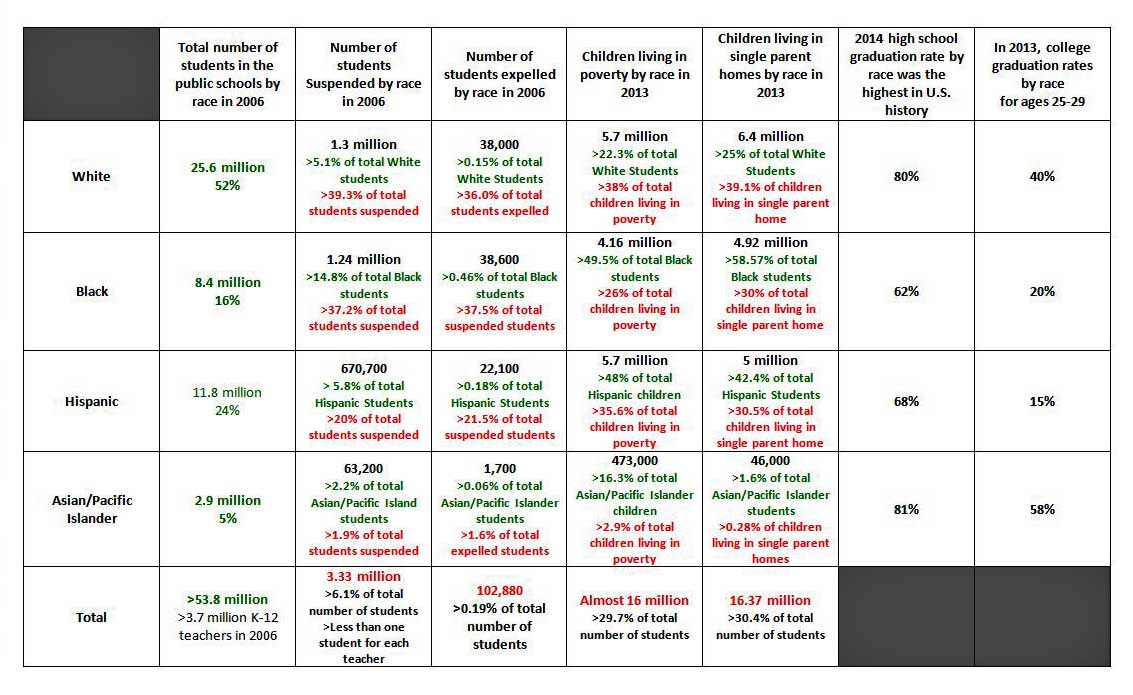
In a previous post Suspensions and Expulsions in the US Public Schools—what does that 3.3 million really mean, it’s obvious that I failed to reach some readers with what I meant to say instead of what they thought I wrote. Some readers of that post became angry and some accused me of having racist tendencies, and then I was locked out and shunned by one group.

I haven’t changed my mind. I still think that poverty and/or single parent homes are the main culprit behind the number of suspensions and expulsions in the public schools, and I pointed this out and provided links to the research in my other post about suspensions and expulsions to support what I wrote.

While racism might be a factor in some of the suspensions and expulsions of Black or African-American children, there was no evidence that this was the case for Asian-Americans and Hispanic/Latinos—both minorities with a long history of being the victims of racism and discrimination—and even if it were true that some suspensions of Black or African Americans was motivated by racism, what could we do to identify individual cases and stop this unacceptable behavior?

CHART UPDATE with two more columns on Jan 10

But we can make an effort to reduce the suffering caused by poverty and illiteracy, and there are proven methods that work. For instance, a transparent, national, early childhood education program that would be managed by the democratic public schools where we’d have a better chance to keep an eye on these programs working with our youngest and neediest children to make sure racism, segregation and discrimination doesn’t rear its evil, horned face behind a wall of secrecy.

The foundation of a strong middle class is access to education for every child beginning in the first few years of life. Sadly, millions of children in this country are cut off from quality early learning. Children in countries as diverse as Mexico, France, and Singapore have a better chance of receiving preschool education than do children in the United States. For children in the U.S. who do attend, quality varies widely and access to high-quality programs is even more limited in low-income communities where it’s needed most.

We already know from decades of evidence that the education reform movement’s opaque and secretive corporate Charter schools are contributing to a resurgence of segregation. This is wrong, and it will lead to more racism and discrimination—instead of less.

If we bicker with each other over how many—difficult to prove and even harder to stop—suspensions of Black or African American children in the public schools is influenced by racism, we are allowing ourselves to get sidetracked from dealing with a challenge we can do something about, and that is to combat poverty and illiteracy.

Like my 80+ year-old friend said but with a revision to his thinking, “I’d rather face racism from a position of strength with an education, a high level of literacy and in the middle class instead of living in poverty, illiterate, feeling angry and powerless.”

UPDATE on 1-11-15

One more thing—looking at that chart, I have to ask this question: With the obvious racism and discrimination that Asian Americans faced and still face, how did they achieve those numbers beating out even the Whites in every column? In addition, the Asian-American unemployment rate is the lowest of all racial groups. The Asian American divorce rate by race is also the lowest at 8% while Whites are the highest at 27%, African Americans are 22% and Hispanics are 20%. There’s more I could add to this list, but that’s in another post I wrote at https://crazynormaltheclassroomexpose.com/2013/05/11/what-parenting-method-works-best/

  • In addition read this post on Marie Corfield’s blog about the segregationist practices of New Jersey’s Charter Schools.

UPDATE on 1-20-15

AARP Bulletin asked, “What can be done to make black youth less vulnerable and fully integrated into mainstream America?” Kareem Abdul-Jabbar replied, “The main problem is the reluctance to educate black Americans. Since the Civil War, people have been indifferent to it—including black Americans.”

_______________________

Lloyd Lofthouse is a former U.S. Marine and Vietnam Veteran,
who taught in the public schools for thirty years (1975 – 2005).

Runner Up in Biography/Autobiography
2015 Florida Book Festival

Crazy-is-Normal-a-classroom-expose-200x300

Honorable Mentions in Biography/Autobiography
2014 Southern California Book Festival
2014 New England Book Festival
2014 London Book Festival

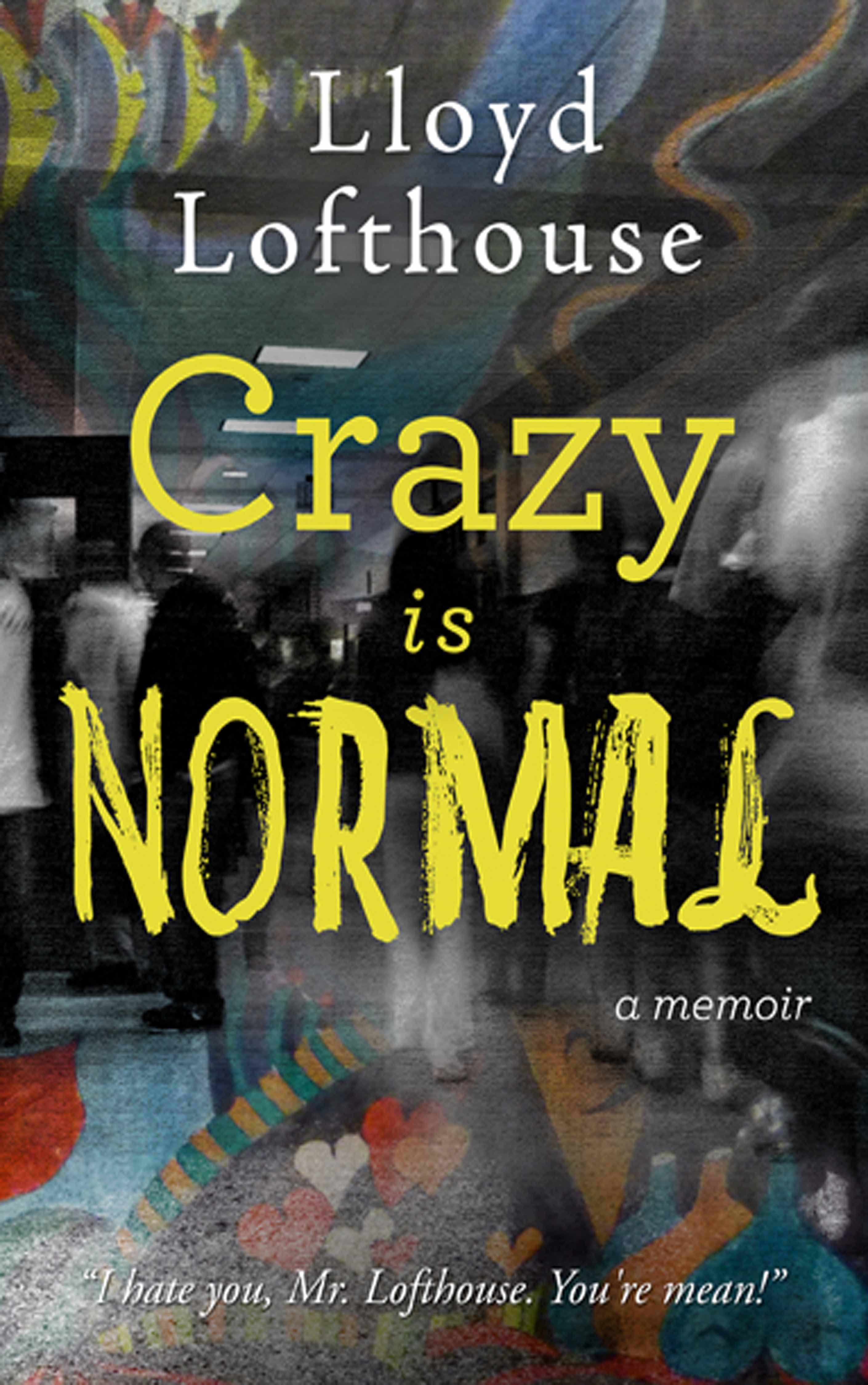
His third book is Crazy is Normal, a classroom exposé, a memoir. “Lofthouse presents us with grungy classrooms, kids who don’t want to be in school, and the consequences of growing up in a hardscrabble world. While some parents support his efforts, many sabotage them—and isolated administrators make the work of Lofthouse and his peers even more difficult.” – Bruce Reeves

Lofthouse’s first novel was the award winning historical fiction My Splendid Concubine [3rd edition]. His second novel was the award winning thriller Running with the Enemy. His short story A Night at the “Well of Purity” was named a finalist of the 2007 Chicago Literary Awards. His wife is Anchee Min, the international, best-selling, award winning author of Red Azalea, a New York Times Notable Book of the Year (1992).

To follow this Blog via E-mail see upper right-hand column and click on “Sign me up!”


Tags: , , , , , , , ,

Measuring the Success or Failure of Public Education in the United States through Literacy: Part 3 of 3

In Conclusion, in case you are wondering why I included Mexico in this comparison, the PEW Research Hispanic Trends Project reports that “The number of Hispanic students in the U.S. public schools nearly doubled from 1990 to 2006, accounting for 60% of the total growth in public school enrollments over that period. There are now approximately 10-million Hispanic students in the nation’s public kindergartens and its elementary and high schools; they make up about one-in-five public school students in the United States. Most if not all of these students come from the poorest population in Mexico, and they bring with them the same attitudes toward education they held before they came to the United States.

Ranking functional literacy in English speaking countries and Mexico

1st Place: In the United Kingdom, 80% read at Level 3 or above.

What explains the UK having such a low functional illiteracy rate? The Guardian.com reports that the “UK publishes more books per capita than any other country.” Does this translate into the UK being a more literate society? If this is one reason, it might be a cultural difference between the other major English speaking countries with similar cultural heritages.

2nd Place:  In the United States, 65% read Intermediate Level or above.

3rd Place: In New Zealand, 55% of adults read at level 3 or above

4th Place: In Australia, 53.6% of adults read at level 3 or above

5th Place: In Mexico, 64% of adults do not have a high school degree or its equivalent, and the The World Bank estimates that in 2012, 52.3-percent of Mexicans lived in poverty in their home country compared to 15% of the U.S. population, who live in poverty— and 25.6%, or about 12 million are Hispanic, and 35% or 6 million of the 16 million children who live in poverty in the U.S. were also Hispanic. In fact, in Mexico, over half of Mexican youth at age 15 are functionally illiterate and cannot solve simple equations or explain basic scientific phenomenon. WorldFund.org

In addition, the New York Times reports that many of these children who come from Latin America are boys between ages 15 and 17 when they arrive in the United States, and they come from some of the poorest regions in those countries. Do you think these children arrived in the U.S. functionally literate in their own language?

Return to Part 2 or Start with Part 1

View as Single Page

_______________________

Lloyd Lofthouse is a former U.S. Marine and Vietnam Veteran,
who taught in the public schools for thirty years (1975 – 2005).

Crazy-is-Normal-a-classroom-expose-200x300

His third book is Crazy is Normal, a classroom exposé, a memoir. “Lofthouse presents us with grungy classrooms, kids who don’t want to be in school, and the consequences of growing up in a hardscrabble world. While some parents support his efforts, many sabotage them—and isolated administrators make the work of Lofthouse and his peers even more difficult.” – Bruce Reeves

Lofthouse’s first novel was the award winning historical fiction My Splendid Concubine [3rd edition]. His second novel was the award winning thriller Running with the Enemy. His short story A Night at the “Well of Purity” was named a finalist of the 2007 Chicago Literary Awards. His wife is Anchee Min, the international, best-selling, award winning author of Red Azalea, a New York Times Notable Book of the Year (1992).

To follow this Blog via E-mail see upper right-hand column and click on “Sign me up!”


Tags: , , , ,

Measuring the Success or Failure of Public Education in the United States through Literacy: Part 2 of 3

Literacy is the ability to read and write. In modern context, the word means reading and writing in a level adequate for written communication and generally a level that enables one to successfully function at certain levels of a society.

The standards of what level constitutes “literacy” vary between societies.

In the United States alone, one in seven persons (i.e., over 40 million people) can barely read a job offer or utility bill, which arguably makes them functionally illiterate in a developed country such as the US.

In 2003 the National Assessment of Adult Literacy (NAAL), conducted by the US Department of Education, found that fourteen percent of American adults scored at this “below basic” level in prose literacy. More than half of these persons did not have a high-school diploma or GED. Thirty-nine percent of persons at this level were Hispanic; twenty percent were Black; and thirty-seven percent were White.

Now, to compare the five countries listed in the post to the United States.

First – Mexico: The OECD reports that 7.2 years is the average years of schooling of adults in Mexico.

Second – Canada: In 2012, Indicators of Well-being in Canada reported that 22% of adult Canadians had less than a high school education in addition to 16.5% reading at Level 1 or Below Level 1. Canada has five literacy levels. Canada’s Below Level 1 and Level 1 are equal to Below Basic in the United States. 83.9% of Canadians read at levels 2, 3, and 4/5. If Canada measures literacy the same as the United Kingdom, then 48.5% are ranked at Level 2 and below and are functionally illiterate.

Third – United Kingdom: The Telegraph reported that one in five Brits is functionally illiterate—that’s 20% that read below level 2, the common definition of functional illiteracy, and the OECD reports that the UK is ranked 22nd for literacy and 21st for numeracy out of 24 countries. BBC.com

Fourth – Australia: Uses the same five level literacy skill level rating system as the UK and Canada, and in 2006, almost 46.4% of adults read at Level 2 or below and were functionally illiterate. abs.gov.au

Fifth – New Zealand: The distribution of literacy skills within the New Zealand population is similar to that of Australia, the United States and the United Kingdom. Analysis of New Zealand Data from the International Adult Literacy Survey reports that 45% of adult New Zealanders were in Levels 1 and 2 for prose literacy. EducationCounts.govt.nz 5731 and EducationCounts.govt.nz 5495

Sixth – United States: 14% or 30 million were ranked below basic on the 2003 National Assessment of Adult Literacy (NAAL), and 49% of adults who ranked below basic had less than/some high school but did not graduate from high school or earn a GED/high school equivalency. The United States has four literacy levels compared to five for the UK, Canada, Australia and New Zealand. 87 percent of American’s read at basic or above.  65 percent read Intermediate and above. As reported by the OECD, one in six adults (16.6%) in the United States scored below level 2, in literacy.  nces.ed.gov

Part 3 Continues on November 19, 2014 or start with Part 1

View as Single Page

 _______________________

Lloyd Lofthouse is a former U.S. Marine and Vietnam Veteran,
who taught in the public schools for thirty years (1975 – 2005).

Crazy-is-Normal-a-classroom-expose-200x300

His third book is Crazy is Normal, a classroom exposé, a memoir. “Lofthouse presents us with grungy classrooms, kids who don’t want to be in school, and the consequences of growing up in a hardscrabble world. While some parents support his efforts, many sabotage them—and isolated administrators make the work of Lofthouse and his peers even more difficult.” – Bruce Reeves

Lofthouse’s first novel was the award winning historical fiction My Splendid Concubine [3rd edition]. His second novel was the award winning thriller Running with the Enemy. His short story A Night at the “Well of Purity” was named a finalist of the 2007 Chicago Literary Awards. His wife is Anchee Min, the international, best-selling, award winning author of Red Azalea, a New York Times Notable Book of the Year (1992).

To follow this Blog via E-mail see upper right-hand column and click on “Sign me up!”


Tags: , , , , ,

Measuring the Success or Failure of Public Education in the United States through Literacy: Part 1 of 3

There are many ways to measure the success or failure of public education in the United States, and one way is to compare functional Illiteracy in the United States to similar English speaking countries and Mexico, because culture plays an important role in children’s attitude toward education and literacy.

It’s arguable that the four MOST similar countries/cultures in the world, when compared to the United States, are Canada, Australia, New Zealand, and the United Kingdom, because they share an Anglo Saxon heritage, culture, and the same language. In addition, almost 80% of the U.S. population is white alone (in 2013, 77.7% were white), and the more than 13% who are African American, who have been in the U.S. for several generations, due to slavery, are no longer linked to an African cultural heritage. If you doubt that, consider that 78% of African Americans are Protestants and 5% are Catholics and—forced—immigration from Africa stopped and/or slowed drastically after the Civil War in 1865. What this means is that African Americans with roots that reach back 150 years or more are culturally American. If interested in this topic, I suggest you read a study out of Yale: African vs. African-American: a shared complexion does not guarantee racial solidarity

The United Nations defines illiteracy as the inability to read and write a simple sentence in any language, and it’s arguable that English is one of the most difficult languages to learn—if not the most difficult—if it is your second language. To understand this, I suggest you read 10 Reasons Why English is a Hard Language

The BBC asked, How many hours does it take to be fluent in English?

Huan Japes, deputy chief executive of English UK, a trade body for language colleges, says a rule of thumb is 360 hours—120 hours for each of three stages—to get to the standard the government expects benefit claimants to reach. …

Dr Elaine Boyd, head of English language at Trinity College London, says, “If someone is really highly motivated, they can learn really quickly. It’s common for children under the age of 11 to be very immersed and be fluent in about six months.” …

Philida Schellekens, a language consultant, says that when she researched English language learning in Australia a decade ago the figure of 1,765 hours was used. That could mean four years of classes. It signifies the standard needed to do a clerical job in an office.

In English Spelling Confuses Everyone, Professor Julius Nyikos, a linguistics expert born and raised in Hungary, learned numerous languages in his elementary school, high school, and university training. He came to the US in 1949 and, after a few years of studying English, was able to continue his profession as a linguist that he began in Europe. He spent many years as a professor at Washington & Jefferson College in Pennsylvania studying the languages of the world. In his scholarly article for the 1987 Linguistics Association of Canada and the United States Forum, titled “A Linguistic Perspective of Functional Illiteracy,” he made the statement, “It would be both ludicrous and tragic if it took lawsuits to jolt us into the realization that neither the teachers, nor the schools should be faulted as much as our orthography [spelling], which is incomparably more intricate than that of any other language (emphasis added). If English is not the absolute worst alphabetic spelling in the world, it is certainly among the most illogical, inconsistent, and confusing. This is due to the developmental history of the present.”

Part 2 Continues on November 18, 2014

View as Single Page

_______________________

Lloyd Lofthouse is a former U.S. Marine and Vietnam Veteran,
who taught in the public schools for thirty years (1975 – 2005).

lloydlofthouse_crazyisnormal_web2_5

His third book is Crazy is Normal, a classroom exposé, a memoir. “Lofthouse presents us with grungy classrooms, kids who don’t want to be in school, and the consequences of growing up in a hardscrabble world. While some parents support his efforts, many sabotage them—and isolated administrators make the work of Lofthouse and his peers even more difficult.” – Bruce Reeves

Lofthouse’s first novel was the award winning historical fiction My Splendid Concubine [3rd edition]. His second novel was the award winning thriller Running with the Enemy. His short story A Night at the “Well of Purity” was named a finalist of the 2007 Chicago Literary Awards. His wife is Anchee Min, the international, best-selling, award winning author of Red Azalea, a New York Times Notable Book of the Year (1992).

To follow this Blog via E-mail see upper right-hand column and click on “Sign me up!”


Tags: , , , , ,