Before I get started, according to the Common Core State Standards Initiative website, formal assessment is expected to take place in the 2014–2015 school year, and seeks to establish consistent educational standards across the states as well as ensure that students graduating from high school are prepared to enter credit-bearing courses at two- or four-year college programs or enter the workforce.
There’s also a Common Core Timeline you might find interesting. If you click the previous link, also visit the Analysis page; then scroll down to #3: How is the federal government involved in the Common Core? The rest of that page is worth reading too. Look close to discover the short timeline to achieve goals that no country on the planet has ever achieved with 100 percent of 17/18 year olds no matter how much time they were given.
Anyway, the impact of poverty on educational outcomes for children is well documented. The US National Library of Medicine reports, “School readiness reflects a child’s ability to succeed both academically and socially in a school environment. It requires physical well-being and appropriate motor development, emotional health and a positive approach to new experiences, age-appropriate social knowledge and competence, age-appropriate language skills, and age-appropriate general knowledge and cognitive skills. It is well documented that poverty decreases a child’s readiness for school through aspects of health, home life, schooling and neighborhoods.”
Poverty Timeline: In 2000, the poverty rate was at its lowest in U.S. history at 11.3 percent. Under Presidents G. W. Bush and Obama, by 2012, the poverty rate had soared to more than 15 percent, the highest rate in decades.
In addition, “The Department of Agriculture’s measure of poverty, every red state (Republican) from Arizona to South Carolina has the highest poverty rates in America; between 17.9% and 22.8%.”aattp.org
By 2012, the share of Hispanics living in poverty had risen to 25.6 percent and for blacks 27 percent lived in poverty—compared to 9.7 percent who were non-Hispanic white. In addition, in 2012, 73.7 million American children represented 23.7 percent of the total U.S. population, but made up a disquieting 34.6% of Americans in poverty and a full 35% of Americans living in deep poverty. National Center for Law and Economic Justice
From this point on, I’m going to focus on what air pollution does to children, and the challenges that their teachers face to achieve the goals set by the rank and yank assessments of the Common Core Standards.
Thefindings of the Yale University research add to evidence of a widening racial and economic gap when it comes to air pollution. Communities of color and those with low education and high poverty and unemployment face greater health risks even if their air quality meets federal health standards. … Also, children and teenagers were more likely than adults to breathe most of the substances.
“The results suggest a sizable effect of pollution on academic performance, which provides evidence of another avenue by which pollution is harmful. Not only is it bad for children’s health, but it also impacts negatively on students’ performance in school and their ability in general, which we would expect to reduce future labor earnings. Since lower socioeconomic households tend to reside in more highly polluted areas, our results suggest that a decrease in pollution will result in a decrease in inequality, everything else held equal.”
Conclusion: Thanks to President Obama and his partner Bill Gates, children who live in poverty can’t win in the fake corporate-reform movement that is at war with public education and classroom teachers. The war on public education seriously started with President G. W. Bush’s NCLB and became more Machiavellian—think of Darth Vader and the dark side of the force in the Star Wars films—with President Obama’s Race to the Top and the rank and yank assessments of the Common Core standards.
The Obama-Gates driven rank and yank method of judging teachers and children—then firing and/or failing the losers besides closing schools and turning those children over to corporations to teach—will hit the poorest schools with Thor’s Hammer.
If you have trouble accepting this conclusion, then I suggest reading Why Poor Schools Can’t Win at Standardized Testing by Meredith Broussard published in The Atlantic Magazine on July 15, 2014, to discover the real agenda behind the reform movement in education—a reform movement that is focused on profit and to hell with children, teachers and parents.
Anyone who really wants to help the public schools improve would start with two programs: First, a national early childhood education program.
Second, teacher training resulting in a paid, full-time, year-long residency program with a master teacher and follow up support from the teacher-training program for the following two years. There would be no rank and yank assessment agenda linked to the Common Core Standards, and no public schools would be closed. Instead, they would be fully funded.
Lloyd Lofthouse is a former U.S. Marine and Vietnam Veteran,
who taught in the public schools for thirty years (1975 – 2005).
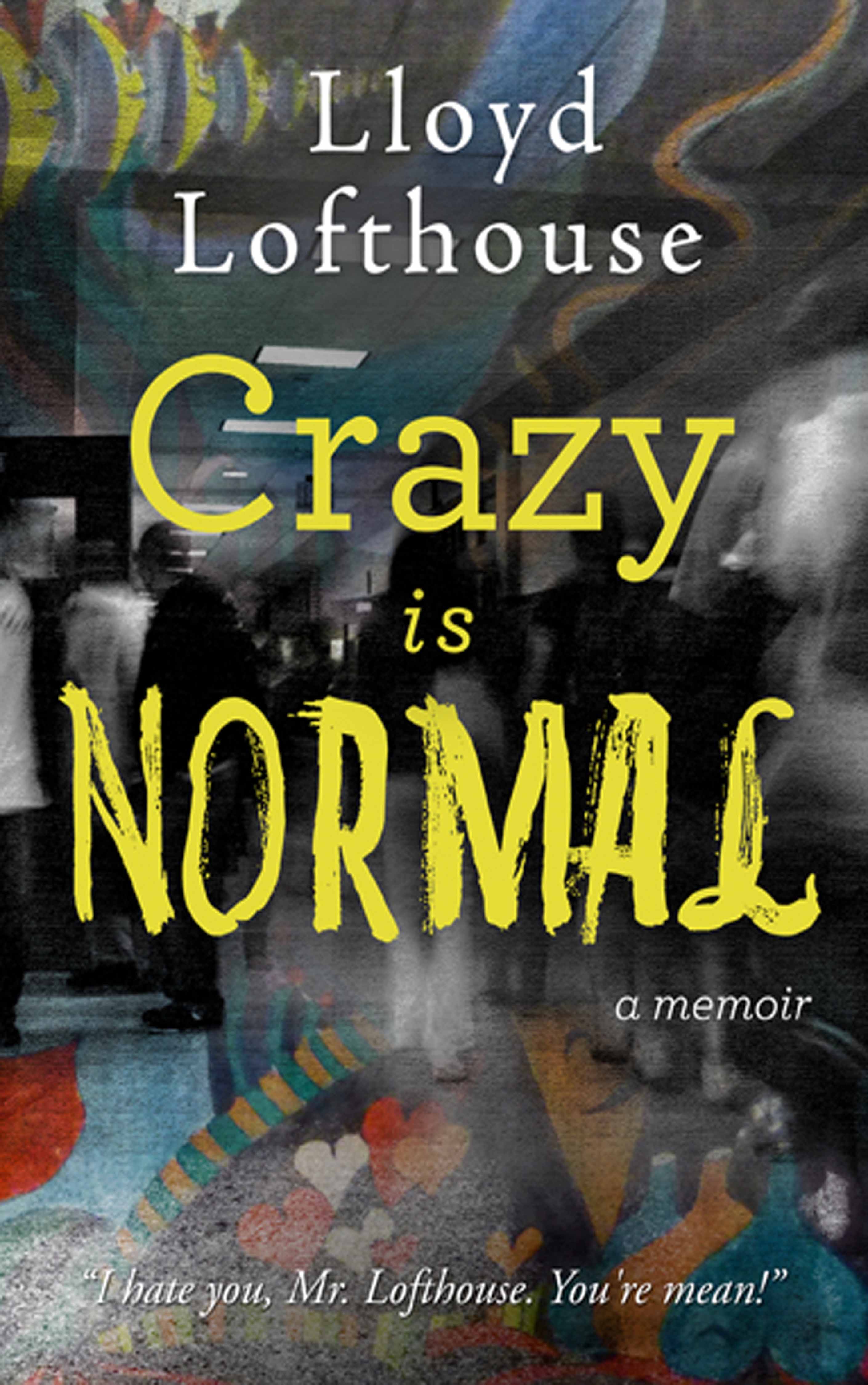
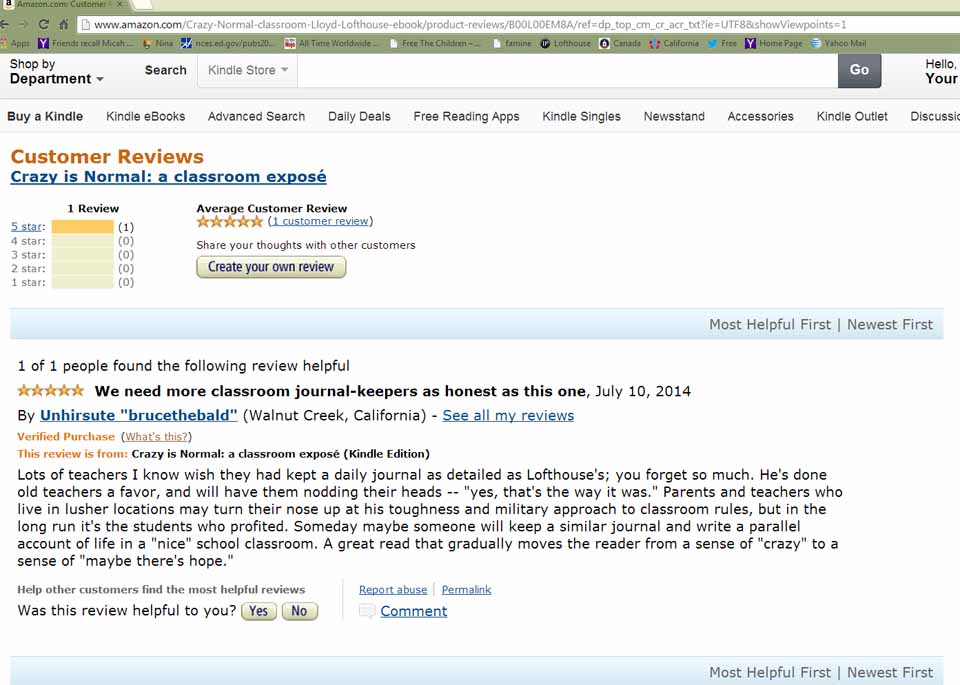
His third book is Crazy is Normal, a classroom exposé, a memoir. “Lofthouse presents us with grungy classrooms, kids who don’t want to be in school, and the consequences of growing up in a hardscrabble world. While some parents support his efforts, many sabotage them—and isolated administrators make the work of Lofthouse and his peers even more difficult.” – Bruce Reeves
Lofthouse’s first novel was the award winning historical fiction My Splendid Concubine [3rd edition]. His second novel was the award winning thriller Running with the Enemy. His short story A Night at the “Well of Purity” was named a finalist of the 2007 Chicago Literary Awards. His wife is Anchee Min, the international, best-selling, award winning author of Red Azalea, a New York Times Notable Book of the Year (1992).
To follow this Blog via E-mail see upper right-hand column and click on “Sign me up!”
The two Fs I’m talking about are Finland and France.
In another forum, this comment was made about Finland’s public schools: “Comparisons with Finland are foolish – virtually no childhood poverty, income equality instead of inequality and few immigrants … and high suicide rates.”
Here’s my revised reply:
What you say about Finland is true, but the U.S. can still learn from Finland combined with what France is doing to deal with similar challenges that the United States faces. While Finland offers the best model for how to run public schools successfully, France offers methods to deal with a large immigrant population and poverty.
The French national institute of statistics INSEE estimates that foreign-born immigrants and the direct descendants of immigrants (born in France with at least one immigrant parent) represent 19 percent of the total population.
Compared to France’s immigrant population of 19 percent, less than 13 percent of the U.S population is labeled as immigrants. Therefore, France is a country to pay attention to, because we can learn from France’s successes and failures.
It’s almost impossible to find another country that compares to the U.S. among developed nations, because none of them have the rate of childhood poverty the U.S. has. To find a match, we have to look, for instance, at Turkey or Mexico. But in Turkey and Mexico only about a third of the population has earned a high school degree or its equivalent compared to more than 90 percent in the United States, while the on-time H.S. graduation rate in France is 85 percent—much closer to the U.S.
In addition, France offers a successful lesson when it comes to early childhood education programs—a national program that’s missing in the United States.
It’s arguable that France’s reduced rate of poverty from 20 percent in the 1960s to less than 7 percent today is due, in part, to its national early childhood education program that is available to all children starting as young as two.
Poverty in France has fallen by 60% over thirty years. Although it affected 15 percent of the population in 1970, in 2001 only 6.1 percent were below the poverty line.
As for using the suicide rate in Finland as an excuse to ignore the country’s public schools, it’s arguable that latitude has more to do with the suicide rate than Finland’s culture, socialist economy and/or public education.
To discover what I’m talking about, you may want to read studies that suggest a connection between suicide rates and higher latitudes.
For instance, a recent study of suicide in Alaska (21.8 per 100,000 people and 35.1 among Alaska Natives) suggests that the rate of intentional, self-inflicted death gets higher the farther north a community is located. The suicide rate in Finland is close to Alaska’s.
For every 5 degree increase in latitude—about 345 miles—the suicide rate jumps 18 percent, according to the model. Finland’s latitude is between 60 to 65 degrees North compared to Alaska’s 58 to 71 degrees North. Alaska spans almost 20 degrees of latitude.
Conclusion: Why isn’t the White House and Congress doing the right thing and learning from the two Fs to improve public education and reduce poverty in the United States? Why do they listen to frauds like Michelle Rhee instead?
I think you’ll find the answer to the previous questions in the following video.
What can we learn from Finland and France?
That teacher residency programs have the best teacher retention, because these programs require a year-long residency in a mentor’s classroom, a requirement that matches the teacher training methods used in high archiving nations like Finland.
In France, teachers are recruited via two competitive examinations: the examination for school teachers and the examination for secondary and high school teachers. Those who pass the examination successfully will then enter one year of professional training. During their in-class training with students, the teachers are monitored and assisted by the qualified inspectors and the training centers.
In fact, the most successful teacher training in the United States is a one year, urban teacher residency program where student teachers are placed in a mentor teacher’s classroom. Teachers from this program have an 87-percent retention rate compared to 50-percent for teachers who go through a traditional college of education or, even worse, 33 percent for Teach For America (TFA) recruits.
Note that TFA’s methods to train teachers are not used in Finland, France or Shanghai, China.
What teacher training program do you think the Obama White House and Arne Duncan’s Department of Education favors and promotes?
If your answer was Michelle Rhee’s TFA, you were correct. Michelle Rhee and TFA are flawed frauds designed to destroy the public schools by flooding classrooms with incompetent teachers who are not properly and adequately trained. TFA recruits receive five weeks of summer training compared to the proven method of one year of in-class mentored training with follow up support.
Compare this teacher residency program with the 5 weeks of summer training for TFA recruits that doesn’t include any classroom experience.
_______________________
Lloyd Lofthouse is a former U.S. Marine and Vietnam Veteran,
who taught in the public schools for thirty years (1975 – 2005).
His third book is Crazy is Normal, a classroom exposé, a memoir. “Lofthouse presents us with grungy classrooms, kids who don’t want to be in school, and the consequences of growing up in a hardscrabble world. While some parents support his efforts, many sabotage them—and isolated administrators make the work of Lofthouse and his peers even more difficult.” – Bruce Reeves
Lofthouse’s first novel was the award winning historical fiction My Splendid Concubine [3rd edition]. His second novel was the award winning thriller Running with the Enemy. His short story A Night at the “Well of Purity” was named a finalist of the 2007 Chicago Literary Awards. His wife is Anchee Min, the international, best-selling, award winning author of Red Azalea, a New York Times Notable Book of the Year (1992).
To follow this Blog via E-mail see upper right-hand column and click on “Sign me up!”
Sunday, I walked downtown to see The Purge: Anarchy, and while watching the film and walking home afterwards, I couldn’t stop thinking about the unnamed New Founding Fathers mentioned at the beginning of the film—who were in their ninth year as the leaders of the United States. In case you forgot or never knew, the U.S. Constitution limits a U.S. president to two, four-year terms. Therefore, with the current U.S. Constitution, there’s no way one president can stay in office nine years. But in this film that’s set about a decade in the future, the United States is led by a cabal that calls itself the New Founding Fathers that’s more like the Politburo of the old Soviet Union. There is no mentioned that the United States still has a Congress or Supreme Court.
Let’s get the synopsis of this film out of the way first with no spoilers. In the film, a vengeful father comes to the aid of a mother, her teenage daughter, and a defenseless young couple on the one night of the year that all crime, including murder, is legal.
We never learn who the New Founding Fathers are, but who else could they be but Bill Gates, the infamous Koch brothers, the Walton family, Eli Broad, Rupert Murdoch and a few other ruthless billionaire oligarchs who either inherited their fortunes or earned the money through crooked trickery and the corruption of elected officials.
These billionaires are the same people who are currently spending hundreds of millions of dollars to mislead America as they reinvent the United States into something that will obviously resemble the country in this film—where the agenda of the New Founding Fathers is to get rid of the so-called vermin at the bottom who were probably born into poverty through no fault of their own.
Who are the working poor? According to a January 2014 Pew Research report most poor Americans are in their prime working years. In 2012, 57 percent of poor Americans were ages 18 to 64, and only 9.1 percent were age 65 and over, while poverty among children younger than 18 was 21.8% in 2012, and is worse today.
In addition, research from the Brookings Institution says, “If you’re born into a middle-class family, there’s a 76 percent chance you’ll end up middle class or even wealthier. Born into a poor family? Only a 35 percent chance.
Brookings offers three simple rules to end up middle class, no matter how low you start out.
One: graduate from high school
Two: work full time
Three: marry before you have children
It’s easy to tell a kid who lives in poverty that they have to graduate from high school to have a chance to move up to the middle class, but to insure that this happens, all children must start kindergarten with a love of reading from day one—reaching high school with a high level of literacy is the key to being a lifelong learner.
To make this happen, we must start with a national early childhood education program for all children as young as three, and this is something that Obama plans to ask Congress to vote for during his last year in office.
What do you think the odds are that Congress will approve anything Obama asks for in 2015? Why didn’t President Obama start with a national early childhood education program when he had the votes in Congress instead of first starting with the flawed and brutal Bill Gates funded Common Core agenda?
Bill Gates—who I’m sure would be one of the New Founding Fathers if this film were to become reality—seems to be doing all he can to make sure children who are born to poverty stay in poverty.
I’m almost done reading “The Teacher Wars, A History of America’s Most Embattled Profession” by Dana Goldstein, and it was Bill Gates who derailed any meaningful improvement in the public schools by spending hundreds of millions of dollars to implement a Machiavellian “rank and yank” system called Common Core designed to punish children and teachers.
The tragedy is that there are proven, positive methods to improve public education, but President Obama and Bill Gates are all but ignoring those solutions for something malignant.
The programs I’m talking about are already being used in most developed countries with dramatic success. They’re known as Continuous Quality Improvement programs where teachers are mentored to become the best they can be instead of being ranked by annual student standardized tests and then yanked out of the classroom based on the results.
In fact, high-achieving nations like Finland and Shanghai, China already require that every teacher must go through a year-long residency in a mentor teacher’s classroom. Teacher programs that do this already exist in the United States but they are only turning out a few hundred teachers annually and aren’t getting the funding they should have.
Research from Urban Teacher Residency United, a national network of nineteen programs, reveals that principals consistently rate urban teacher residency graduates as more effective than other first-year teachers and nationwide, urban teacher residencies have an 87 percent retention rate at four years, compared to the loss of nearly half of all new urban teachers over a similar period of time, and two thirds (66 percent) of Teach for America (TFA) recruits, who only have five weeks of summer training before being tossed in urban classrooms to sink or swim. (The Teacher Wars, A History of America’s Most Embattled Profession by Dana Goldstein)
By the way, in 1975-76, I was fortunate enough to go through a paid, year-long residency in a mentor teacher’s fifth-grade classroom, and I went from there to teach until August 2005 in public schools with a childhood poverty rate higher than 70 percent along with violent street gangs that dominated the streets around those schools, including the elementary school where I was an intern.
In conclusion, I think we should purge from all political power those who would most likely become the New Founding Fathers of the United States, before they get a chance to create the nightmare world we see in this film. After all, the billionaire oligarchs mentioned earlier in this post already seem to be working hard toward that goal.
If we don’t invest in early childhood education, we pay the price as a nation. Sesame Street can’t do it alone.
_______________________
Lloyd Lofthouse is a former U.S. Marine and Vietnam Veteran,
who taught in the public schools for thirty years (1975 – 2005).
His third book is Crazy is Normal, a classroom exposé, a memoir. “Lofthouse presents us with grungy classrooms, kids who don’t want to be in school, and the consequences of growing up in a hardscrabble world. While some parents support his efforts, many sabotage them—and isolated administrators make the work of Lofthouse and his peers even more difficult.” – Bruce Reeves
Lofthouse’s first novel was the award winning historical fiction My Splendid Concubine [3rd edition]. His second novel was the award winning thriller Running with the Enemy. His short story A Night at the “Well of Purity” was named a finalist of the 2007 Chicago Literary Awards. His wife is Anchee Min, the international, best-selling, award winning author of Red Azalea, a New York Times Notable Book of the Year (1992).
Scot Lehigh is a Boston Globe Op-Ed columnist and from a recent rant, he’s also an angry, fake education reformer and cheer leader of Charter schools, who claims that Charter schools have enemies and the Massachusetts State legislature caved to pressure from these critics, but Scot leaves out a lot of the facts behind the reasons for keeping the CAP.
For instance, “The demographics of charter schools differ in almost all cases from the demographics of their sending districts. … Charters serve fewer Hispanic students, English language learners, special education students and low-income students than their sending districts. (The Rennie Center for Education Research and Policy, a nonpartisan, evidence-based organization.)
In addition, The Center for Education Policy and Practice reported that Boston’s (so-called) “high-performing” Commonwealth charter schools appear to be contributing to a two-track educational system that is segregating students based on language proficiency, special education status and poverty.
The result is that Commonwealth charter schools appear to be operating largely as publicly funded private schools.
While students may be selected through a lottery system, actual application and acceptance appears to be predicated on such practices as participating in parent or student school visits and pre-lottery interviews, parental behavior contracts and acceptance of rigid discipline codes … the claims of high performance appear to result from significant student attrition resulting from the use of “pushout” strategies based on student academic and/or behavioral performance. The promoting power of these schools puts them in the category of “dropout factories.”
The study concludes with: It appears that those who are part of this “selective out-migration of low achievers” are those who find the work too difficult or the rules too strict.
“Even the vaunted KIPP (Charter) schools are not immune to pushing out under performing students (to make it look like they are doing a better job than public schools). A study by SRI International in 2008 of five KIPP schools in the San Francisco Bay area found that 60 percent of their students left in middle school. Predictably, those who were counseled out tended to be the weaker students.”(Education Week.org)
In conclusion, any school that hand picks students will have a higher success rate compared to public schools—as long as those weaker students who were given the boot are not included in any press release or Op-ed piece written by a fake education reformer and cheer leader of elitist Charter schools. Therefore, if you are a fan of Charter schools, look in a mirror and ask yourself if you are a fool, an elitist or a racist who doesn’t want your kids sharing classrooms with the at-risk students that cause the lower average test scores that make public schools look like losers when they aren’t.
Eighty-six percent of Blacks have completed high school by age 25+ compared to 89 percent for Asians, 65 percent for Hispanic, and 92 percent of Whites. – Pew Research Center.
_______________________
Lloyd Lofthouse is a former U.S. Marine and Vietnam Veteran,
who taught in the public schools for thirty years (1975 – 2005).
His third book is Crazy is Normal, a classroom exposé, a memoir. “Lofthouse presents us with grungy classrooms, kids who don’t want to be in school, and the consequences of growing up in a hardscrabble world. While some parents support his efforts, many sabotage them—and isolated administrators make the work of Lofthouse and his peers even more difficult.” – Bruce Reeves
Lofthouse’s first novel was the award winning historical fiction My Splendid Concubine [3rd edition]. His second novel was the award winning thriller Running with the Enemy. His short story A Night at the “Well of Purity” was named a finalist of the 2007 Chicago Literary Awards. His wife is Anchee Min, the international, best-selling, award winning author of Red Azalea, a New York Times Notable Book of the Year (1992).
The reason for this Blog that I launched in January of 2010 was to support this memoir. Crazy is Normal, a classroom exposeis based on a daily classroom journal that I kept as a teacher in 1994-95. I have friends who are still teaching, and I know that the work climate for public school teachers is worse today than it was back then thanks to two presidents: George W. Bush and even worse, Obama, who, like a fool, I voted for twice, because I had no idea of his agenda to destroy the public schools and replace them with corporate, for profit schools that would not be answerable to the public while the public supported them with the taxes they pay.
Why do you think President Obama partnered will the richest man on the planet to make this happen. Yes, Bill Gates is Obama’s partner in the destruction of the democratic public schools that have a 175 years of history behind them and nothing but a record of improvement that continues to this day regardless of the lies you might hear or read from the media.
Lofthouse’s first novel was the award winning historical fiction My Splendid Concubine [3rd edition]. His second novel was the award winning thriller Running with the Enemy. His short story A Night at the “Well of Purity” was named a finalist of the 2007 Chicago Literary Awards. His wife is Anchee Min, the international, best-selling, award winning author of Red Azalea, a New York Times Notable Book of the Year (1992).
To follow this Blog via E-mail see upper right-hand column and click on “Sign me up!”
To discover the answer, I turned to the top eight ranked countries on the 2012 International PISA Test. To come up with the top eight, I dropped China from the list because Shanghai, Hong Kong and Macao do not represent all of China’s 15 or 16 year old children. I’ve also dropped Liechtenstein and Estonia, because it’s ridiculous to compare the United States—with more than 316 million people and almost 50 million children in its public schools—to Liechtenstein with a total population that’s less than 37 thousand and Estonia with about 1.3 million.
To repeat, the United States has almost 50 million children attending K–12, 4 million teachers, and 1 in 4 children live in poverty—the United States is much more diverse and has challenges the top ranked countries don’t have to deal with. Liechtenstein, for instance, has one of the highest standards of living in the world with one of Europe’s most affluent communities. Estonia has 589 schools and compulsory education only goes to 9th grade.
Fair Test.org reports “The U.S. is the only economically advanced nation to rely heavily on multiple-choice tests (But Pearson is working hard to change that and add more countries. To learn more, I suggest you read No profit left behind). Other nations use performance-based assessment to evaluate students on the basis of real work such as essays, projects and activities. Ironically, because these nations do not focus on teaching to multiple-choice and short-answer tests, they score higher on international exams.”
Truth Out.org reports, “Among the most prominent members of the testocracy are some of the wealthiest people the world has ever known. Its tsars include billionaires Bill Gates, Eli Broad, and members of the Walton family (the owners of Walmart), who have used their wealth to circumvent democratic processes and impose test-and-punish policies in public education. They fund a myriad of organizations—such as Michelle Rhee’s StudentsFirst, Teach for America, and Stand for Children—that serve as shock troops to enforce the implantation of high-stakes testing and corporate education reform in states and cities across the nation.”
I also think it’s important to compare the racial diversity and total population of the United States with the eight top ranked PISA countries. It is also worth noting that children represent more than one-third of the 46.5 million Americans who live in poverty. In addition, blacks and Hispanics are more likely than whites to be poor and to be in poverty and deep poverty (For instance, only 10% of Whites live in poverty compared to 27% of Blacks and 24% of Hispanic/Latino – The Henry J. Kaiser Family Foundation). The poverty rate (the percentage of all people in the United States who were poor) also remained at high levels: 15.1% for all Americans and 21.8% for children under age 18.
77.7% of Americans are White – 248 million
17.1% Hispanic or Latino – 54.5 million
13.2% or Black – 42 million
5.3% are Asian – 16.8 million
1.2% are American Indian and Alaska Native – 3.8 million
Singapore – 5.4 million and 26% or 1.4 million live below poverty line compared to 46.5 million in the United States or 861% of the total population of Singapore. BBC.com reports, that in Singapore everyone is provided an education, health care and public housing if they can’t afford their own. What they pay for housing is based on what they earn. If one compares the poor in Singapore to those in countries such as India and China, or even the homeless in the US, it is indeed true that the situation here is not as dire. ”Singapore has an extensive social safety net,” said a ministry spokesman. ”Singaporeans enjoy subsidized housing, healthcare and education.”
77% Chinese
14.8% Malays
7% Indians
1.2% Other
Taiwan – 23.34 million and 1.16% or 27 thousand live below the poverty line compared to 46.5 million in the United States or 199.2% of the total population of Taiwan.
84% Taiwanese (including Hakka)
14% mainland Chinese
2% indigenous
South Korea – 50.22 million and 15% or 7.53 million live below the poverty line compared to 46.5 million in the United States or 92% of the population of South Korea.
Koreans except for 20,000 Chinese
Japan – 127.3 million and 16% or 20.3 million live below the poverty line compared to 46.5 million in the United State or 36.5% of the total population of Japan.
95% Japanese
5% foreign citizens
Switzerland – 8 million, but only 1.93 million are permanent residents (23.8% of the total population), and 6.9% (not sure if this is based on permanent or total) live below the poverty line compared to 46.5 million in the United States or 581.25% of the total population of Switzerland.
Netherlands – 16.8 million and 10.5% or 1.764 million live below the poverty line compared to 46.5 million in the United States or 277.78% of the total population of the Netherlands.
78.5% Dutch
5% EU
2.2% Indonesian
2.3% Turkish
2% Surinamese
2% Moroccan
6% other
Finland – 5.4 million. Finland has one of the lowest poverty rates in the world compared to 46.5 million in the United States or 861% the total population of Finland.
89.33% Finish
5.34% Swedish
5.33% Other Ethnic groups
Canada – 35.1 million and 9.4% or 3.3 million live below the poverty line compared to 46.5 million in the United States or 132.5% the total population of Canada.
86% White (European Canadian)
8% Aboriginal
5% East Asian
4% South Asian
2% Black
4% Southeast Asian
9% Other
After eliminating China, Liechtenstein and Estonia, from the 2012 International PISA Test ranking, Singapore became #1, Chinese Taipei #2, South Korea #3, Japan #4, Switzerland #5, the Netherlands #6, Finland #7, and Canada #8
There are about 25,000 teachers in its primary and secondary schools.
Edutopia.org reports “Teaching is a highly respected and well-compensated profession in Singapore. All teachers are trained at the country’s National Institute of Education (NIE) (one training program). All new teachers are paired with experienced teachers for mentoring, and peer feedback is built into the schedule. Teachers are entitled to 100 low or no-cost hours of professional development each year. There are approximately 522,000 students attending about 350 schools in Singapore’s education system.
There are more than 300 thousand teachers who teach in preschool, primary school, junior high school, and senior high school (teaching about 4 million students). The teachers are trained in universities of education with teacher training programs or centers. These institutions are also responsible for providing in-service training and guidance forlocal education practitioners.
Teaching is a highly respected profession in South Korea, and among the most popular career choices for young South Koreans. This is largely due to competitive pay, job stability, and good working conditions – for example, there is a high degree of collaboration among teachers. Elementary teachers must attend one of 13 institutions to become qualified whereas secondary school teachers have multiple pathways into teaching and often attend comprehensive universities. Teachers are paid well in South Korea. Lower secondary teachers can expect a mid-career salary of $52,699, much higher than the OECD average of $41,701. There are about 7 million K-12 students in South Korea.
In Japan, teaching is a respected profession, and teachers have traditionally been paid better than other civil servants. Japan’s average teacher salary for a lower secondary school teacher after 15 years of service (the number that the OECD typically uses for international comparison) is $49,408, as compared to the OECD average of $41,701. The teaching profession in Japan is also highly selective, at both the program admission and the hiring phase. About 14% of applicants are admitted into schools of education, and of those who graduate, only 30-40% find work in public schools.Eric Digests.org reports, “Many Japanese believe that the examination system is too stressful, that the schools are too rigid and don’t meet the needs of individual students, that contemporary students show little interest in studying, and that the educational system needs to produce more creative and flexible citizens for the twenty-first century.”
Stanford.edu says, “In 2002 the Ministry of Education began to implement educational reforms that officials labeled the most significant since the end of World War II. In an attempt to stimulate students to be independent and self-directed learners, one third of the content of the national curriculum was eliminated. Japanese students in grades 3-9 are now required to take Integrated Studies classes in which they and their teachers jointly plan projects, field trips, and other ‘hands-on’ activities. Students in Integrated Studies learn about their local environment, history, and economy. … and teachers are not allowed to give tests on what students have learned.”
The goal is to impart adequate knowledge and competence for educating and teaching pupils and students at the various educational levels, as well as children and adolescents with special needs. Teacher education and training is realized within a two-tier model with Bachelor’s and Master’s degree programs.
During the 2008/09 school year there were 1.266 million students in the K-12 Swiss educational system, who were taught by more than 100,000 teachers.
ButSusan Ohanian.org reports teachers in Germany, Austria and Switzerland are seeing their school ranked by the Bertelsmann Foundation (using achievement tests) comparing the school of all districts with each other—the teachers are protesting and fighting back. Because compulsory achievement tests are planned in all three countries, they are wary of school rankings that lead to a “senseless competition” among schools.
In 1917, private and public schools were given equivalent financial status under the Constitution. As a result, the Netherlands is in the unique situation, compared with the rest of the world, of having 70 percent of its schools administered and governed by private school boards. The Constitution thus guarantees “freedom of education”, which embrace the freedom to set up schools, freedom to determine the principles on which they are based (freedom of conviction) and freedom of organization of teaching.
State University.com reports,There is an extensive amount of parental involvement in Dutch schools. … In addition, many schools also have a separate parents’ council or committee.
Teacher training in the Netherlands continues to undergo an overhaul. In 2008, the government, following the recommendations of an advisory council, formulated an action plan to tackle the teacher shortage and improve the position and quality of teachers. Given the high performance of its students and its teacher salaries, which, at $60,174 for a mid-career lower secondary school teacher far outpace the OECD average of $41,701, there is still a teacher shortage in the Netherlands due primarily to the aging teacher workforce.
The 2008 TALIS survey of Dutch teachers revealed thatthe majority of teachers participate in informal, rather than formal, professional development. This generally takes the form of informal mentorships and conversations, courses and workshops and reading professional literature. … Part of the government’s action plan is the creation of a stronger professional organization for teachers that will be able to evaluate teachers and provide teacher training grants.
There are 596,000 children in the k-12 compulsory education system.There are only 24 private comprehensive schools in Finland (0.5%). – ncee.org
Education has always been an integral part of Finnish culture and society, and teachers currently enjoy great respect and trust in Finland. Finns regard teaching as a noble, prestigious profession—akin to medicine, law, or economics— and one driven by moral purpose rather than material interests. Teachers also are the main reason Finland now leads the international pack in literacy, science, and math.
Over 5.11 million students were enrolled in public schools in 2007/08. The full-time teaching force at primary and secondary level is around 310,000. About 5.6% of students are in private schools. Private schools have historically been less common on the Canadian Prairies and were often forbidden under municipal and provincial statutes enacted to provide equality of education to students regardless of family income.
Teacher training programs are housed in Canadian universities, although separate standards for teacher qualification exist across the provinces. There are only about 50 teacher education programs in Canada, so it is easy for provincial governments to regulate quality.
For professional development, all Canadian provincial Ministries of Education support and require ongoing teacher training efforts though, like nearly everything else in the Canadian education system, this is decentralized and subject to different requirements depending on location.
The United States
First, the U.S. has 1,206 schools, colleges and departments of education that trains teachers, and they exist in 78% of all universities and colleges. There is no standard method of how teachers are trained as there are in most of the top 8 countries.
It’s also worth mentioning again that Fair Test.orgreports “The U.S. is the only economically advanced nation to rely heavily on multiple-choice tests. Other nations use performance-based assessment to evaluate students on the basis of real work such as essays, projects and activities. Ironically, because these nations do not focus on teaching to multiple-choice and short-answer tests, they score higher on international exams.”
Unlike most countries that rank high on the International PISA test, teacher training in the United States is all over the place from TFA (Teach for America)—that’s probably the worst teacher training program in the country if not the world— with a few weeks of lecture/study and little or no actual experience working with children in addition to little/no follow up support.
Let’s compare TFA to the highest rated teacher training program in the United States: a yearlong residency where teachers work full time in a master teacher’s classroom for one full school year that includes follow up support after they start teaching their own students, and this seems more in line with what most of the eight highest ranked countries train and support teachers.
The AUSL Chicago Teacher Residency is a year-long urban teacher training program in Chicago’s Public Schools. This intensive 12-month, full-time, paid training program combines teacher preparation, certification, and a Master’s degree to give Residents the tools they need to dramatically improve student achievement in Chicago’s Public Schools.
In the United States, about nine out of ten (91 percent) of teachers agree that “successful completion of a teacher preparation program” and that “evaluation by an administrator that includes direct classroom observation” would be good measurements to use in determining teacher qualification.”
If you haven’t figured it yet what’s missing in the United States, I’ll tell you. The main ingredients that are missing are respect and support. In the United States, teachers have been scapegoated and blamed for just about everything for decades, and teachers get little to no support unless it is from other teachers.
In addition, based on survey responses, 53 percent of (U.S.) public schools need to spend money on repairs, renovations, and modernizations to put the school’s onsite buildings in good overall condition. The total amount needed was estimated to be approximately $197 billion, and the average dollar amount for schools needing to spend money was about $4.5 million per school. – nces.ed.gov
A few last thoughts: The top eight highest ranked countries on the 2012 PISA test have almost 36.5 million people living below the poverty line compared to 46.5 million in the United States. In addition, a January 15, 2013 Stanford Report revealed, “There is an achievement gap between more and less disadvantaged students in every country; surprisingly, that gap is smaller in the United States than in similar post-industrial countries, and not much larger than in the very highest scoring countries.
“Achievement of U.S. disadvantaged students has been rising rapidly over time, while achievement of disadvantaged students in countries to which the United States is frequently unfavorably compared – Canada, Finland and Korea, for example – has been falling rapidly.”
_______________________
Lloyd Lofthouse is a former U.S. Marine and Vietnam Veteran,
who taught in the public schools for thirty years (1975 – 2005).
Lofthouse’s first novel was the award winning historical fiction My Splendid Concubine [3rd edition]. His second novel was the award winning thriller Running with the Enemy. His short story A Night at the “Well of Purity” was named a finalist of the 2007 Chicago Literary Awards. His wife is Anchee Min, the international, best-selling, award winning author of Red Azalea, a New York Times Notable Book of the Year (1992).
To follow this Blog via E-mail see upper right-hand column and click on “Sign me up!”


 Crazy Normal - the Classroom Exposé