Category Archives: Parenting
James Harvey: How We Cooked the Books to Produce a Deeply Flawed “A Nation at Risk”
James Harvey, a member of the staff that wrote what ended up being called “A Nation at Risk”, reveals why/how our government in 1983, declared war on OUR public schools, our teachers, our family values, and our children.
A war that has made some wealthy while letting our schools rot, and turned our public schools into a Ukrainian battle field, under endless attack.
“The bumbling began immediately,” Harvey writes, when “Reagan startled the commission members by hailing their call for prayer in the schools, school vouchers, and the abolition of the Department of Education.”
Cherry Picking the Facts — Cooking the Books
“There were at least three problems with what the commission finally produced. First, it settled on its conclusions and then selected evidence to support them. Second, its argument was based on shockingly shoddy logic. And third, it proposed a curricular response that ignored the complexity of American life and the economic and racial divisions within the United States.” …

James Harvey, a member of the staff that wrote what ended up being called “A Nation at Risk”, reveals why/how our government in 1983, declared war on OUR public schools, our teachers, our family values, and our children.
A war that has made some wealthy while letting our schools rot, and turned our public schools into a Ukrainian battle field, under endless attack.
“The bumbling began immediately,” Harvey writes, when “Reagan startled the commission members by hailing their call for prayer in the schools, school vouchers, and the abolition of the Department of Education.”
Cherry Picking the Facts
Cooking the Books
“There were at least three problems with what the commission finally produced. First, it settled on its conclusions and then selected evidence to support them. Second, its argument was based on shockingly shoddy logic. And third, it proposed a curricular response that ignored the complexity of American…
View original post 12 more words
When looking for a good public school, ignore the Standardized Test Scores.
In this post, I’m going to tell you what to look for when searching for a good public school. FIRST: Charter Schools are not real public schools. Do not forget that.
Charter Schools are not REAL public schools.
Public schools have what’s known as school report cards that can be found on-line. Those reports are supposed to report a lot of info.
Always ignore the standardized test score rankings.
Low standardized test scores basically reveal how many children at a public school live in poverty. A high child poverty rate at a public school is what brings those stupid, useless tests scores down, not the teachers.
Higher test scores for a public school usually reveals it is located in a more expensive area where many of the parents are college educated and/or earn more money.
If the public school report card has the following information, use it to determine if it is a good public school.Look for the average level of education for the teachers at the school and the turnover rate. If most of the teachers have a higher level graduate degree, in the subject area they teach, then they probably know what they’re doing and are good at it.
If the public or charter school has a high turnover rate for its teachers, those schools are in trouble and probably are being mismanaged by its district administrators and maybe the site administrators, too. Those not a public Charter Schools have a reputation for high teacher turnover and harsh disclpline for both teachers and students.
Many administrators have never taught, and many of them couldn’t teach their way out of a paper bag if their lives depended on it.
Still, you can ask how many of the administrators at a public school and the ones in the district office were teachers for at least six years before moving to administration. If the top admin never taught, they probably do not know what they are doing because they do not know the challenges teachers face in public school classrooms.
If the public school has a low teacher turnover rate and hangs on to its teachers for long periods of time, those are the public schools you want to focus on. The teachers that stay are more dedicated and work harder. It’s a demanding, challenging job that drives out the undedicated teachers really fast.
A lower teacher turnover rate also usually means the administrators probably know how tough teaching really is. Good public schools do not focus on teaching to raise those damn standardized test scores. They focus on supporting their teachers so they can teach the children instead.
Teachers that don’t learn how to manage their classes and/or can’t stand the pressure burn out faster and leave sooner.
Incompetent administrators, in public schools and those private sector Charter Schools speed up teacher burnout when they focus more on those useless and often misleading standardized test results instead of supporting teachers so they can teach, not to the test, but what their students should be learning.
A good teacher often works more than 50 hours a week while only teaching about 25 of those hours. Teaching is like an iceberg. Most of the work teachers do takes place out of sight, before and after school and on the weekends. When I was still teaching (1975 – 2005), my work weeks often ran 60 to 100 hours when I added all the time I put in: correcting student work at home, doing grades at home, calling parents from school and at home, planning lessons at school and at home, et al.
It’s not easy to manage your classes, teach. and do all that stuff during regular school hours.
I’m a former US Marine and combat vet. Teaching was tougher and more demanding than any other job I’ve had in my life (I worked in the private sector for about 15 years, too), including being a combat Marine.
By the time I went into teaching, I was 30 and I stayed for 30 years until I was 60. If I had to go back to work for some reason, I’d rather be a Marine again instead of a teacher. Marine Corps boot camp and being shot at in combat, as long as whoever was shooting at me kept missing, was less stressful and demanding than teaching. I think the Marines did more to prepare me for teaching than earning my teaching credential through a full-time, year-long urban residency did. Still those urban residency teacher training programs are considered the best ways to learn how to become a teacher.
What Factors determine Quality Public Schools
There are several factors that determine the quality of public school districts, and the results of standardized test score are NOT one of them.
What to look for:
How old are the public school buildings? It isn’t easy to teach or learn in buildings with roofs that leak, old moldy carpets, overcrowded classrooms, et al.
Funding is another important factor. Too many public school districts are not getting the funding they need to update and maintain infrastructure, keep class sizes low (12 to 20 in a class. It’s okay to have less than 12 but no more than 20) and hire the best teachers. In crowded, aging classrooms, teachers often become overwhelmed and face burnout, one of the major factors for high teacher turnover.
“Funding is always an issue for schools and is, in fact, one of the biggest issues facing the American public education system today. For more than 90% of K-12 schools, funding comes from state and local governments, largely generated by sales and income taxes.”
A high rate of child poverty in a school district is also a challenge. Children living in poverty, in every country, have problems learning because… well, they live in poverty.
“Students living in poverty often have fewer resources at home to complete homework, study, or engage in activities that helps equip them for success during the school day.”
Teacher quality is also an important factor. There is no uniform method in the United States to train teachers. In some states, a high school dropout with a GED is allowed to teach. In others, to teach, you need a four year, or more, college degree.
The worst teacher training in the United States is probably from Teach for America. The best are urban residency programs.
TFA trains their future teachers in a few weeks with little or no time practicing, under supervision, in a classroom with real students.
Urban residency teacher training programs often run for an entire school year, full time in a classroom with a master teacher and college classes required to earn a credential through this program are held after regular school hours and during summers.
In The Teacher Wars, by Dana Goldstein, in one chapter, the author goes into detail comparing the different teacher training programs.
https://www.amazon.com/Teacher-Wars-Americas-Embattled-Profession/dp/0345803620
Back to a few of the major flaws of Standardized Tests.
The only tests that are useful are teacher made tests that are not used to determine a students grade or rank teachers or schools. Teacher made tests should be used a s a tool to help teachers discover what their students are learning so the teacher can focus on what they are not learning.
“Some of the cons of standardized testing include the fact that standardized tests are unable to assess a student’s higher-level thinking skills, teachers may alter their curriculum in order to ‘teach to the test,’ and standardized tests have been shown to result in inequitable outcomes for students.”
The human brain also doesn’t work well to remember what a Standardized Test asks. Even if a teacher taught what the Standardized Tests asks, and this isn’t always the case, there is no guarantee students will remember what they were taught by the time they take these useless tests.
“There are numerous reasons to believe that high stakes standardized tests are actually quite damaging to education and have received forceful criticism over the past dozen years as a result. Examples include their propensity to drive out teachers, encouraging teaching “to the test” as well as increasing grade retention and school dropout rates, all of which question the imposition of high quantities of standardized tests throughout a student’s school career.”
https://www.learningandthebrain.com/blog/neuroscience-standardized-test-taking/
Still, what can parents do?
Well, parents may learn how long the average teacher stays in their job in a school district, what the annual teacher turnover rate is, and with a bit more digging, find out if a public school district’s admisntration is obsessed with standardized tests OR supports teachers to teach over the damn tests.
Hint: Parents aren’t going to learn this from the administrators. You have to ask involved parents and teachers, when no administrators are around.
Will the Tech Industry’s Obsession for Disruption End my Blogging
Disruption: disturbance or problems which interrupt an event, activity, or process
Last Saturday, July 18, 2020, my blogging was disrupted by WordPress, and my temper, calm for months, exploded. Before the COVID-19 pandemic, I had lunch with friends every week and joined others in group meetups. Thanks to the virus, I have lived alone since March 13. No one has visited me, and I have visited no one. Zoom, e-mails, phone calls, and WebEx help but cannot replace face-to-face visits.
Back to July 18 when I logged onto my iLookChina.net blog to schedule three new posts for August, my first thought when I saw the new editing page for WordPress was, “What the FUCK!”
I complained to WordPress and the little help they offered did nothing to end the stress from the disruption they caused.
I learned that WordPress was changing the Classic Editor I had been using for a decade to a Block Editor (whatever that is). From what I saw, I did not like the Block Editor and that feeling has not changed.
I was comfortable using the Classic Editor. I have better things to do than being forced to learn something new that stresses me out.
On Sunday, July 19, I wrote an angry letter expressing my frustration to Matthew Charles Mullenweg, the Founder, and CEO of WordPress. When I write an angry letter, I never mail the rough draft. I wait a few days and then revise to filter out the worst of my anger. But that rough draft will never be revised and mailed to Mr. Mullenweg. Instead, that letter has been added to this post.
Matthew Charles Mullenweg, Founder, and CEO of WordPress
WordPress Corporate Office Headquarters Automatic, Inc.
60 29th Street #343
San Francisco, California 94110-4929
Dear Mr. Mullenweg:
This morning I attempted to start scheduling the August 2020 posts for my https://ilookchina.com/ blog [806,254 hits/visits], and ran into an “alleged” improvement to the page where bloggers like me create their posts and schedule them. The changes to the WordPress editing page were so drastic that I couldn’t complete that task. I did not know what to do. I was lost. All the old menus were gone. I did see how I would upload a photo from one of the files on my desktop. I am not in the mood to learn how to use the new and disruptive Block Editor that is replacing the Classic Editor.
I always write my blog posts offline and copy and paste them into the Classic Editor that I have been using for a decade for all four of my WordPress Blogs.
Here are my other three blogs:
https://lloydlofthouse.org/ [92,621 hits/visits]
https://crazynormaltheclassroomexpose.com/ [121,597 hits/visits]
https://thesoulfulveteran.com/ [238,261 hits/visits]
Why do I want the Classic Editor back?
WordPress just became the flaming straw that set off the fuse to my explosive anger. Somehow I managed to stay calm since March while billions of people around the world (including you) are struggling to avoid dying of COVID-19. Last month, when the electrical circuits in my garage blew out, I still managed to stay calm. Then last week, my HVAC system stopped cooling my house in the middle of a heatwave. That HVAC was a new system installed in 2017 for $18k, but I still did not flip my lid.
Then along came WordPress with its NEW Block Editor.
Why change something that was working? Why not set up an easy to find a button where we are allowed to keep the old design over the new one? What is wrong with you guys? Keep it simple. Do not change the old so drastically that it becomes stressful to deal with.
In the short term, stress can leave us anxious, tearful and struggling to sleep. But over time, continuously feeling frazzled could trigger heart attacks, strokes, and even suicidal thoughts. “In short, yes, stress can kill you,” – The American Institute of Stress
In case you don’t know it, change is not always good.
Sincerely (not really, I’m too angry to feel sincere),
Lloyd Lofthouse
High levels of cortisol caused by stress over a long period of time wreak havoc on your brain.
A few days after writing the letter to Matthew Charles Mullenweg, I read a piece from The San Francisco Chronicle. There’s a name for tech’s attitude problem: toxic positivity, Silicon Valley’s obsession with disruption and destruction of the existing order and evangelical embrace of the new. It’s better on the other side of the river, we promise … in recent years, that’s become its own kind of orthodoxy, where the only appropriate response to new technology, according to the insiders of Silicon Valley, is cheerleading. Criticism of technology isn’t viewed as rational skepticism by those for whom innovation has become a religion; it’s heresy.”
Forbes also published a piece on this topic. “The Myths of Disruption: How Should You Really Respond to Emerging Technologies? Disruption may be the most overused term in the business lexicon today. Every startup wants to disrupt the established order. Every incumbent is scared of being disrupted. Disruption is a rallying cry or a bogeyman, depending on where you sit. And no one is immune: if an executive dares to suggest that their industry is free from the threat of disruption, they are accused of being short-sighted or in denial, and heading the way of the Titanic or the T-Rex. I find this obsession with disruption a little disturbing. “
Years ago, I started rebelling against technology’s forced disruption.
I bought two Kindle e-readers. Then a couple of years later, I returned to reading books printed on paper and my kindles have been gathering dust ever since. Old fashioned books do not have batteries that need to be recharged and do not have software to update. This is ironic since the novels I have published have sold more than 60,000 e-books through Amazon, Barnes & Noble, and other bookselling sites.
The new should always be easier to use than the old.
I had a smartphone once, and after a couple of years I turned it in for a dumb phone. I do not text. I do not run around taking smartphone videos and photographs of myself. My dumb phone gets used about five-minutes a month. That smartphone was a fucking pain in the ass, always demanding attention to keep working.
Fuck that shit! If you want to replace something old with something new, keep it simple!
When I bought my first tablet computer, it lasted a day before I returned it, because it wasn’t easy to set up and use.
I have an HP laptop locked in a safe. I update the laptop once a month. If my desktop gets hijacked again by ransomware, that laptop will be my backup while the desktop is in the shop being unhacked.
The last two times I bought new cars, I refused to sign the contract unless the dealers replaced the satellite-linked, streaming radio with the fancy touch screen with a CD player that was easier to use. The only new shit I liked was the backup camera and the chirping thing that warns me when another car is in one of my blind spots.
I plan to do the same thing with the next car I buy. If the dealer wants my money, they have to replace the irritating new crap with a CD player, or I will start looking for an older, used car that predates the annoying disruptive tech. If I can afford to buy a new car every few years, I can afford to rebuild an old one when it wears out and even have someone add batteries and turn it into a plugin hybrid. I’ve read about people that have done that on their own.
I have news for disrupters like WordPress, Microsoft, Apple, and all the other tech geniuses. I do not want anyone else disrupting my life. I do that just fine by myself, and when it comes to learning new things, I want to make that decision and not have it forced on me.
This might be my last post for all of four of my blogs if I cannot get the Classical WordPress Editor back. There is enough stress in this world without Donald Trump and Silicon Valley companies like WordPress generating disruption.
Will this be my last blog post? I do not know. I have been blogging for a decade. I have written and published 2,455 posts for iLookChina, 614 for LloydLofthouse.com, 1.444 for Crazy Normal, the classroom exposé, and 269 for The Soulful Veteran. That is a lot of writing, research, and reading. Those posts have generated more than a million reads or visits.
Ω
Lloyd Lofthouse is a former U.S. Marine and Vietnam combat vet living with PTSD. He went to college on the GI Bill and earned a BA in journalism followed by an MFA in writing.
Discover his award-winning books:
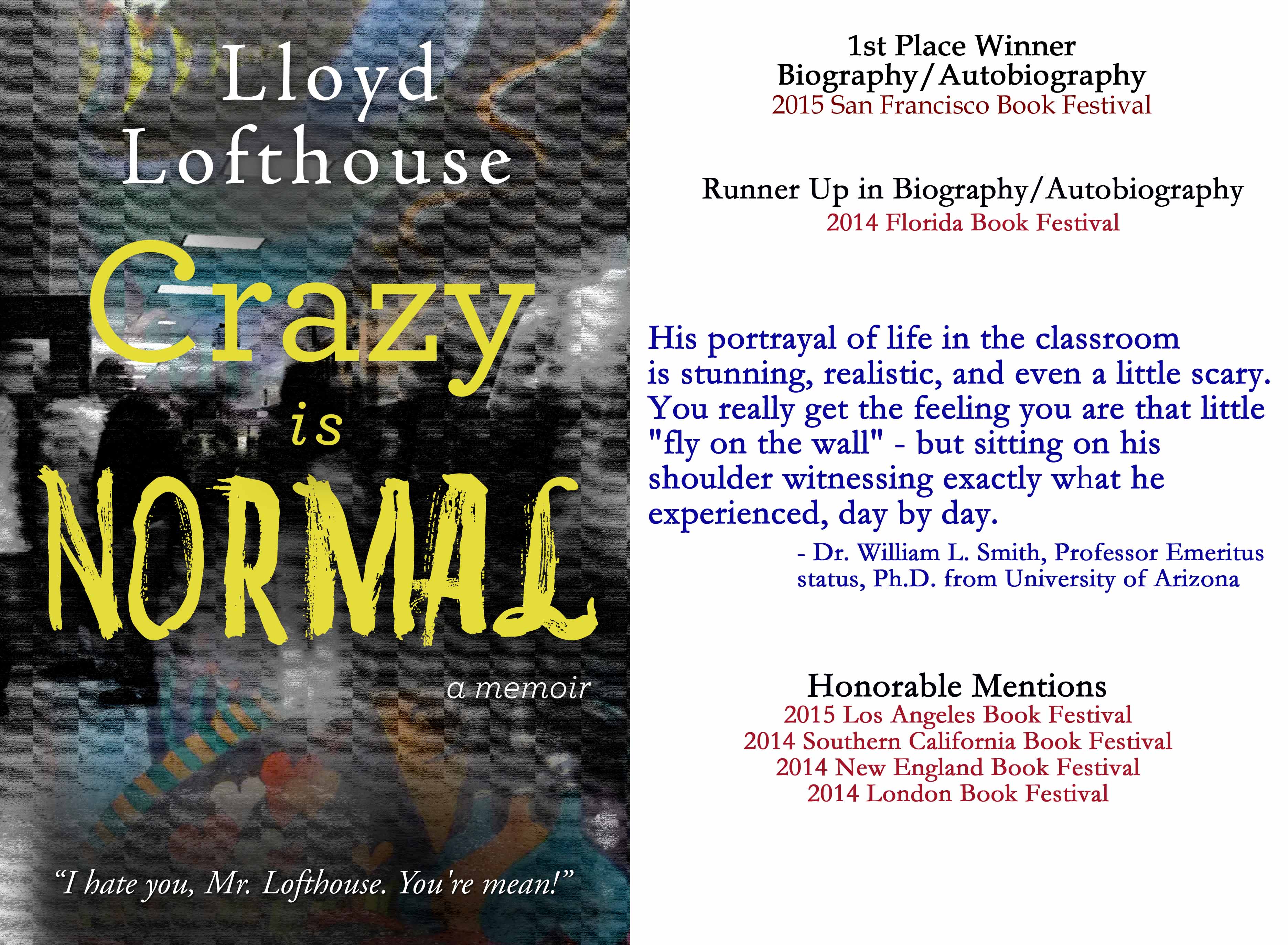
Crazy is Normal: a classroom exposé
The Redemption of Don Juan Casanova
The Dangerous Technology Revolution to Improve Education
The promise was that technology was going to revolutionize education and teachers would become a thing of the past, but after decades of results and many studies, the evidence says technology will not revolutionize education and removing human interaction between human teachers and students is already a disaster for learning.
The Verge.com reports, “Evidence mounts that laptops are terrible for students at lectures. Time to reconsider the notebook and pen. …Writing things by hand is becoming less common as gadgets and speech recognition software continue to replace pen and paper, but it’s long proven that handwriting improves motor skills, memory, and creativity. So even though note taking with a laptop might be faster, you might want to think about how much information you’re retaining.”
Studies at Princeton University, the University of California, York University and McMaster University and the United States Military Academy all confirmed that students who do not have access to a [technology] device performed significantly better than those who did.
In fact, Psychology Today reports, “Too Much Screen Time Damages the Brain. But what about kids who aren’t ‘addicted’ per se? Addiction aside, a much broader concern that begs awareness is the risk that screen time is creating subtle damage even in children with ‘regular’ exposure, considering that the average child clocks in more than seven hours a day (Rideout 2010). As a practitioner, I observe that many of the children I see suffer from sensory overload, lack of restorative sleep, and a hyperaroused nervous system, regardless of diagnosis—what I call electronic screen syndrome. These children are impulsive, moody, and can’t pay attention—much like the description in the quote above describing damage seen in scans.”
In addition, Dr Aric Sigman, Health Education Lecturer, Fellow of the Society of Biology, Associate Fellow of the British Psychological Society, writes, “Screen time has now become a medical issue. Research published in the world’s most reputable medical and scientific journals shows that the sheer amount of time children spend watching TV, DVDs, computers and the internet is linked with significant measurable biological changes in their bodies and brains that may have significant medical consequences. … Conclusion: What can be done? One may ask why the studies above are not reaching decision makers such as the European Parliament. An editorial in the American Medical Association’s Archives of Pediatric and Adolescent Medicine asked a similar question: ‘Why is it that something that is widely recognized as being so influential and potentially dangerous has resulted in so little effective action?’”
The answer is simple: it’s all about money from the many becoming profits for the few and who has control of what our children learn by teaching our children that the Earth was created in six days a little over 6,000 years ago and that the science of evolution is a lie; that climate change and global warming is also a lie.
__________________________________
Lloyd Lofthouse is a former U.S. Marine and disabled Vietnam Veteran, with a BA in journalism and an MFA in writing, who taught in the public schools for thirty years (1975 – 2005).
To follow this Blog via E-mail see upper right-hand column and click on “Sign me up!”
What Tests and Teachers Cannot Fix in any Schools
We live in an era where traditional American, community based, democratic, transparent, nonprofit, publicly funded, public schools are starved of funds and even closed while professional, dedicated, hardworking teachers are punished or fired based on student test results; tests that profit the private sector corporations that produce them.
The result is that more of our children end up in autocratic, CEO controlled, opaque (secretive), often child abusing, fraudulent-and-inferior, no excuses, test centered, publicly funded, private sector corporate charter schools where management gets paid a lot more, and teachers are paid less but work longer hours. WNYC.org reports, “Charters spend $774 more per pupil on administration, and $1,140 less on instruction, than do traditional publics.”
What’s ignored is the fact that tests and teachers cannot fix the effects of: 1. Childhood poverty, 2. Depression, 3. Blood-sugar imbalances, 4. Childhood PTSD, 5.Substance abuse, and 6. Lack of sleep.
- Effects of Poverty, Hunger and Homelessness on Children and Youth
The American Psychological Association reports, “The nation’s economic crisis has deeply affected the lives of millions of Americans. Skyrocketing foreclosures and job layoffs have pulled the rug out from under many families, particularly those living in low-income communities. Deepening poverty is inextricably linked with rising levels of homelessness and food insecurity/hunger for many Americans and children are particularly affected by these conditions.”
- Childhood Depression
WebMD.com says, “Children who are depressed may not do well in school, may become socially isolated, and may have difficult relationships with family and friends, Fassler says. Depression in children is also associated with an increased risk for suicide. The rate of suicide among young people has nearly tripled since 1960 and is the sixth leading cause of death among children between the ages of 5 and 14, the third leading cause of death among 15- to 24-year-olds, and the second leading cause of death among college students.”
- Blood-sugar imbalances
The CDC’s National Center for Health Statistics found, “Kids consume too much sugar, mostly from processed foods.”
Learning Liftoff.com says, “It’s shocking to note that according to the U.S. Department of Agriculture, the average child under 12 consumes 49 pounds of sugar annually. That’s only three pounds less than the average adult despite children being much smaller. All that sugar consumption isn’t helping their overall health, but is it impacting their academic performance? You might be surprised at the answer.”
- Sugar Decreases Attention Span and memory
- Chronic Sugar Consumption Might Permanently Impair Memory Function
- Sugar Foods Crowd Out Brain Food
- Childhood PTSD
The U.S. Department of Veterans Affairs reports, “Studies show that about 15% to 43% of girls and 14% to 43% of boys go through at least one trauma. Of those children and teens who have had a trauma, 3% to 15% of girls and 1% to 6% of boys develop PTSD. Rates of PTSD are higher for certain types of trauma survivors. … Besides PTSD, children and teens that have gone through trauma often have other types of problems. Much of what we know about the effects of trauma on children comes from the research on child sexual abuse. This research shows that sexually abused children often have problems with: fear, worry, sadness, anger, feeling alone and apart from others, feeling as if people are looking down on them, low self-worth, and not being able to trust others; behaviors such as aggression, out-of-place sexual behavior, self-harm, and abuse of drugs or alcohol.”
- Substance abuse
Alcohol Rehab.com says, “Children of parents who suffer from substance abuse problems can have problems at school as a result of the upheaval, unpredictability and violence they face at home. Some children have immense strength and can cope with their problems and still manage to maintain good school grades and relationships, but more often than not this is not the case. Bullying, fighting, bad grades, problems with attention span, fear of authority and emotional problems are all signs that a child is facing significant home problems.”
- Lack of sleep
The Douglas Institute in Quebec reports, “Reducing sleep may disrupt the ability of students to concentrate for long periods of time, and remember what they learn in class. According to a study, children with reduced sleep are more likely to struggle with verbal creativity, problem solving, inhibiting their behaviour, and generally score lower on IQ tests according to current leading research.”
Sleep Foundation.org recommends that school age children 6-13 sleep 9 to 11 hours and adolescents 14-17 should sleep 8 to 10 hours daily, but according to Sleep For Kids.org “It is clear from the poll results that we need to focus as much on the sleeping half of children’s lives as we do on the waking half. Children are clearly not getting enough sleep,” says Jodi A. Mindell, PhD, who served as Chair of NSF’s 2004 Poll Task Force: “And a remarkable number of children have some kind of sleep problem.”
Why are billionaire oligarchs like Bill Gates, the Koch brothers, Eli Broad, and the Walton family ignoring what tests and teachers cannot fix and spending so much money to subvert democracy and destroy the publicly funded, community based, democratic, transparent, non-profit, public schools and replace them with autocratic, opaque, child abusing, often fraudulent and inferior, publicly funded, private sector corporate charter schools? If you don’t know the answers, start here: Behind Closed Doors of the Billionaire Foundations, The Plot Against Public Education, and The Billionaires’ War Against Public Education.
Discover more about why Corporate driven public education reform is destroying OUR children’s health and future
__________________________________
Lloyd Lofthouse is a former U.S. Marine and disabled Vietnam Veteran, with a BA in journalism and an MFA in writing, who taught in the public schools for thirty years (1975 – 2005).

To follow this Blog via E-mail see upper right-hand column and click on “Sign me up!”
Stop writing your name in Cursive. You have had Several Warnings.
Megan Zander at She Knows wrote a post with this headline: Teacher’s aggressive note on 7-year-old’s homework goes viral, and many of the comments are critical of teachers and schools for what the alleged teacher wrote in red ink – the title of this post.
First, I was a public school teacher for thirty years, and I required my students to write their first and last name on every written assignment in addition to the period they were in and the date. When they didn’t write all that information, I wrote in aggressive red ink explaining to them why they lost some points from what the assignment was worth.
How can I justify being so aggressive? Well, I worked with almost 200 students in five or six classes often working 60 to 100 hours a week—25 hours teaching and the rest correcting work and planning lessons (not counting all the usually useless meetings teachers have to attend). All the work had to also be done in blue or black ink. Why would I have an aggressive rule like that? Well, the English department voted on it, and it was unanimous, because it made our jobs easier. Work written in pencil was more difficult to read and correct and teachers are correcting papers every night for several hours a night and on the weekends. To make sure my students knew this aggressive rule, there were large posters on the walls in my classroom reminding them that the work had to be done in blue or black ink, and I reminded them daily at the start of every written assignment.
For those reasons, when my students turned in work written in pencil, I wrote in aggressive red ink that if they wanted to earn credit for that assignment, they’d have to do it over in blue or black ink and turn it in the next school day.
Oh, and there were always kids who didn’t even bother to write their name on an assignment. Guess what happened to that work.
Without knowing all the details I will NOT condemn the ONE teacher who wrote that note in aggressive red ink or—for that matter—the entire education system in the United States.
Why am I refusing to rush in where so many fools have already gone?
The answer is simple—in the United States there are more than 3.5 million public school teachers, more than 15,000 public school districts in 50 states (the states are supposed to be responsible for public education—not the US Congress, the White House, a corporation or a CEO) teaching 50+ million children (not counting the territories), and to use this one incident to condemn everyone else in the public school systems that are not a monopoly is wrong on so many counts.
In fact, corporations build monopolies. Public schools with community based democratic school boards that are state controlled by 50 states are not monopolies. The public school system is made up of more than 15,000 individual school districts that are controlled by the local communities through elected democratic school boards that answer to the voters/parents.
- What kind of school did this teacher work for?
- What kind of teacher training did this teacher have—TFA, traditional or a full-time, yearlong urban residency?
- Was this teacher under contract or a substitute teacher with no teacher training?
- How many years has this teacher been in the classroom?
- Was the school an underfunded, transparent, community-based, democratic, non-profit public school, a private school, or an autocratic, opaque, boot-camp like (see Success Academy), for profit (no matter what you call the school) corporate Charter school paid for by taxpayers but allowed to do whatever the CEO/manager of the school wants behind closed doors, and if a parent complains, the child is often kicked out of the school?
- What state was it in—was it in Florida, Ohio or one of the other states where the public schools are under threat of a hostile takeover by corporate America?
If this teacher worked in a community based, democratic school, then there should be an elected school board and if those elected representatives, who are mostly parents from the same community, want to do something about the eleven words this teacher wrote in aggressive red ink, then they will, because that is the democratic process when it comes to public schools.
But if this child was in a corporate Charter school there is very little that can be done, because parents have no rights in those schools, teachers live in fear because they have no job protection, and these schools have no elected school boards to complain to. In corporate Charters if a parent doesn’t like the school, their child will often quickly find themselves out on the streets or back in an underfunded public school if there are any left.
A Brenda Hatcher seems to have spread this note on Facebook, and she alleges that the mother is a military veteran. I am also a military veteran. I served in the U.S. Marines and fought in Vietnam before I went to college on the GI Bill and eventually became a public school teacher for 30 years. I’d like to talk to this alleged military mother.
Megan Zander’s conclusion said, “After all, a child who’s willing to bend the rules in school could grow up to be the one who makes the rules.”
I shuddered at the thought that children who bend the rules will end up being our leaders.
I hope Megan might want to know why I shuddered at that thought. Megan, did you know that the professions with the most psychopaths in them are the ones who make the rules?
Which Professions Have the Most Psychopaths? The Fewest? – Time.com
- CEOs and lawyers belong to the profession with the most psychopaths alongside journalists and police officers.
- Teachers are on the list for the professions with the least number of psychopaths alongside nurses, doctors and charity workers.
Megan Zander is a former divorce attorney—a lawyer—turned SAHM to twin boys. She’s written for The Stir, Scary Mommy, Rare.us, Mommyish and Bustle.
______________________________
BLAME IT ON THE TEACHER AS USUAL
Lloyd Lofthouse is a former U.S. Marine and Vietnam Veteran, with a BA in journalism and an MFA in writing,
who taught in the public schools for thirty years (1975 – 2005).

To follow this Blog via E-mail see upper right-hand column and click on “Sign me up!”
 Crazy Normal - the Classroom Exposé