Category Archives: family values
James Harvey: How We Cooked the Books to Produce a Deeply Flawed “A Nation at Risk”
James Harvey, a member of the staff that wrote what ended up being called “A Nation at Risk”, reveals why/how our government in 1983, declared war on OUR public schools, our teachers, our family values, and our children.
A war that has made some wealthy while letting our schools rot, and turned our public schools into a Ukrainian battle field, under endless attack.
“The bumbling began immediately,” Harvey writes, when “Reagan startled the commission members by hailing their call for prayer in the schools, school vouchers, and the abolition of the Department of Education.”
Cherry Picking the Facts — Cooking the Books
“There were at least three problems with what the commission finally produced. First, it settled on its conclusions and then selected evidence to support them. Second, its argument was based on shockingly shoddy logic. And third, it proposed a curricular response that ignored the complexity of American life and the economic and racial divisions within the United States.” …

James Harvey, a member of the staff that wrote what ended up being called “A Nation at Risk”, reveals why/how our government in 1983, declared war on OUR public schools, our teachers, our family values, and our children.
A war that has made some wealthy while letting our schools rot, and turned our public schools into a Ukrainian battle field, under endless attack.
“The bumbling began immediately,” Harvey writes, when “Reagan startled the commission members by hailing their call for prayer in the schools, school vouchers, and the abolition of the Department of Education.”
Cherry Picking the Facts
Cooking the Books
“There were at least three problems with what the commission finally produced. First, it settled on its conclusions and then selected evidence to support them. Second, its argument was based on shockingly shoddy logic. And third, it proposed a curricular response that ignored the complexity of American…
View original post 12 more words
When looking for a good public school, ignore the Standardized Test Scores.
In this post, I’m going to tell you what to look for when searching for a good public school. FIRST: Charter Schools are not real public schools. Do not forget that.
Charter Schools are not REAL public schools.
Public schools have what’s known as school report cards that can be found on-line. Those reports are supposed to report a lot of info.
Always ignore the standardized test score rankings.
Low standardized test scores basically reveal how many children at a public school live in poverty. A high child poverty rate at a public school is what brings those stupid, useless tests scores down, not the teachers.
Higher test scores for a public school usually reveals it is located in a more expensive area where many of the parents are college educated and/or earn more money.
If the public school report card has the following information, use it to determine if it is a good public school.Look for the average level of education for the teachers at the school and the turnover rate. If most of the teachers have a higher level graduate degree, in the subject area they teach, then they probably know what they’re doing and are good at it.
If the public or charter school has a high turnover rate for its teachers, those schools are in trouble and probably are being mismanaged by its district administrators and maybe the site administrators, too. Those not a public Charter Schools have a reputation for high teacher turnover and harsh disclpline for both teachers and students.
Many administrators have never taught, and many of them couldn’t teach their way out of a paper bag if their lives depended on it.
Still, you can ask how many of the administrators at a public school and the ones in the district office were teachers for at least six years before moving to administration. If the top admin never taught, they probably do not know what they are doing because they do not know the challenges teachers face in public school classrooms.
If the public school has a low teacher turnover rate and hangs on to its teachers for long periods of time, those are the public schools you want to focus on. The teachers that stay are more dedicated and work harder. It’s a demanding, challenging job that drives out the undedicated teachers really fast.
A lower teacher turnover rate also usually means the administrators probably know how tough teaching really is. Good public schools do not focus on teaching to raise those damn standardized test scores. They focus on supporting their teachers so they can teach the children instead.
Teachers that don’t learn how to manage their classes and/or can’t stand the pressure burn out faster and leave sooner.
Incompetent administrators, in public schools and those private sector Charter Schools speed up teacher burnout when they focus more on those useless and often misleading standardized test results instead of supporting teachers so they can teach, not to the test, but what their students should be learning.
A good teacher often works more than 50 hours a week while only teaching about 25 of those hours. Teaching is like an iceberg. Most of the work teachers do takes place out of sight, before and after school and on the weekends. When I was still teaching (1975 – 2005), my work weeks often ran 60 to 100 hours when I added all the time I put in: correcting student work at home, doing grades at home, calling parents from school and at home, planning lessons at school and at home, et al.
It’s not easy to manage your classes, teach. and do all that stuff during regular school hours.
I’m a former US Marine and combat vet. Teaching was tougher and more demanding than any other job I’ve had in my life (I worked in the private sector for about 15 years, too), including being a combat Marine.
By the time I went into teaching, I was 30 and I stayed for 30 years until I was 60. If I had to go back to work for some reason, I’d rather be a Marine again instead of a teacher. Marine Corps boot camp and being shot at in combat, as long as whoever was shooting at me kept missing, was less stressful and demanding than teaching. I think the Marines did more to prepare me for teaching than earning my teaching credential through a full-time, year-long urban residency did. Still those urban residency teacher training programs are considered the best ways to learn how to become a teacher.
What Factors determine Quality Public Schools
There are several factors that determine the quality of public school districts, and the results of standardized test score are NOT one of them.
What to look for:
How old are the public school buildings? It isn’t easy to teach or learn in buildings with roofs that leak, old moldy carpets, overcrowded classrooms, et al.
Funding is another important factor. Too many public school districts are not getting the funding they need to update and maintain infrastructure, keep class sizes low (12 to 20 in a class. It’s okay to have less than 12 but no more than 20) and hire the best teachers. In crowded, aging classrooms, teachers often become overwhelmed and face burnout, one of the major factors for high teacher turnover.
“Funding is always an issue for schools and is, in fact, one of the biggest issues facing the American public education system today. For more than 90% of K-12 schools, funding comes from state and local governments, largely generated by sales and income taxes.”
A high rate of child poverty in a school district is also a challenge. Children living in poverty, in every country, have problems learning because… well, they live in poverty.
“Students living in poverty often have fewer resources at home to complete homework, study, or engage in activities that helps equip them for success during the school day.”
Teacher quality is also an important factor. There is no uniform method in the United States to train teachers. In some states, a high school dropout with a GED is allowed to teach. In others, to teach, you need a four year, or more, college degree.
The worst teacher training in the United States is probably from Teach for America. The best are urban residency programs.
TFA trains their future teachers in a few weeks with little or no time practicing, under supervision, in a classroom with real students.
Urban residency teacher training programs often run for an entire school year, full time in a classroom with a master teacher and college classes required to earn a credential through this program are held after regular school hours and during summers.
In The Teacher Wars, by Dana Goldstein, in one chapter, the author goes into detail comparing the different teacher training programs.
https://www.amazon.com/Teacher-Wars-Americas-Embattled-Profession/dp/0345803620
Back to a few of the major flaws of Standardized Tests.
The only tests that are useful are teacher made tests that are not used to determine a students grade or rank teachers or schools. Teacher made tests should be used a s a tool to help teachers discover what their students are learning so the teacher can focus on what they are not learning.
“Some of the cons of standardized testing include the fact that standardized tests are unable to assess a student’s higher-level thinking skills, teachers may alter their curriculum in order to ‘teach to the test,’ and standardized tests have been shown to result in inequitable outcomes for students.”
The human brain also doesn’t work well to remember what a Standardized Test asks. Even if a teacher taught what the Standardized Tests asks, and this isn’t always the case, there is no guarantee students will remember what they were taught by the time they take these useless tests.
“There are numerous reasons to believe that high stakes standardized tests are actually quite damaging to education and have received forceful criticism over the past dozen years as a result. Examples include their propensity to drive out teachers, encouraging teaching “to the test” as well as increasing grade retention and school dropout rates, all of which question the imposition of high quantities of standardized tests throughout a student’s school career.”
https://www.learningandthebrain.com/blog/neuroscience-standardized-test-taking/
Still, what can parents do?
Well, parents may learn how long the average teacher stays in their job in a school district, what the annual teacher turnover rate is, and with a bit more digging, find out if a public school district’s admisntration is obsessed with standardized tests OR supports teachers to teach over the damn tests.
Hint: Parents aren’t going to learn this from the administrators. You have to ask involved parents and teachers, when no administrators are around.
A Conspiracy Theory that turned out to be Real
On July 4, 1776, The Declaration of Independence said, “We hold these truths to be self-evident, that all men are created equal, that they are endowed by their Creator with certain unalienable Rights, that among these are Life, Liberty and the pursuit of Happiness.”
Read Slaying Goliath, and learn that some of the wealthiest and most powerful Americans are trying to take away our rights to life, liberty, and the pursuit of happiness.
I was a public school teacher in California from 1975 – 2005. During those thirty years, I worked 60 to 100 hours a week during the school year. I took work home seven days a week and couldn’t wait for the winter and spring breaks, not because of the time off from teaching, but because I’d have time to catch up correcting student work. After all, teachers have to sleep, too.
In 1983, President Ronald Reagan released a report that was a lie. That report was called “A Nation at Risk,” and it painted the nation’s public schools as failures. After that misleading report, teachers were called lazy and incompetent. The public schools were blamed for the prison population in the United States that was really caused by Presidents Nixon and Reagan’s war on recreational drugs like marijuana.
The critics of the public schools even came up with a misleading term that was also a lie. It was called “The school to prison pipeline.” There has never been a school to prison pipeline in the United States.
After “A Nation at Risk,” came the Self Esteem Movement that got its start in Catholic K-12 schools and from the pulpit of evangelical Christian churches. When that failed, teachers were blamed again. However, the majority of teachers, including me, did not agree with the Self Esteem Movement that put pressure on us to stop failing students that refused to learn and inflate grades so children would feel good about themselves, even if they didn’t deserve it.
That top-down failure was followed by The Whole Language Approach to teaching. English Lit Teachers like me were told to stop teaching mechanics, grammar, and spelling because it was boring. We were told that the kids could learn that boring stuff just by reading on their own, except most kids do not read on their own.
A decade later, when that Whole Language Approach that was forced on teachers also failed, teachers were blamed again.
That is why, back in the 1980s, I started to think there was a conspiracy theory to destroy the public schools. Over the years, as one top-down movement after another to improve the public schools failed, I convinced myself that it could not be right that someone was trying to destroy our public schools.
Who could be that cruel, that greedy, that monstrous, to deliberately demonize teachers and blame them for almost every problem in the United States? The critics said teachers were lazy. The critics said we were incompetent. The critics said our labor unions were corrupt and were getting in the way of improving the public schools.
I retired from teaching in 2005 and swore that if I was forced to teach again, I’d instead rejoin the U.S. Marines and fight in Afghanistan against Islamic terrorists. Since I had already served in the Marines and fought in Vietnam before I was a teacher, I knew that being a teacher was way worse because of the way teachers are treated in this country.
When I retired, I took a 40-percent pay cut and left without medical insurance, but the critics said teachers were greedy, and our retirement systems would cause the states to go bankrupt. I live in California, and about 6% of the state’s annual budget goes to support the teacher retirement system.
If you believe that retired teachers are greedy, let me sell you a vacation home on a moon orbiting Saturn. I understand the view of Saturn’s rings are incredible.
Read Slaying Goliath, and you will learn that what I suspected back in the 1980s was real. There has been a movement in the United States for decades to replace the nation’s democratic, transparent, public schools and destroy the teaching profession. That disruptive movement wants to replace the people’s public school with a profit-driven, often corrupt, secretive, autocratic, private school system that operates without rules and oversight.
Read Slaying Goliath, and you will learn that the leaders of the publicly funded, private-sector charter school industry are mostly deceivers and liars.
Read Slaying Goliath, and you will learn that the leaders of the publicly-funded private/religious voucher school industry are also mostly deceivers and liars.
When you read Slaying Goliath, you will learn who those liars are. You will learn who is behind the disruption of our public schools and how they are subverting our Constitutional Republic to strip us of our rights. Then maybe you will be angry enough to support and even join the passionate resistance of parents, grandparents, teachers, and children that are already fighting to save America’s public schools.
__________________________________
Lloyd Lofthouse is a former U.S. Marine and disabled Vietnam Veteran, with a BA in journalism and an MFA in writing, who taught in the public schools for thirty years (1975 – 2005).

The Shocking 50 State Report Card on Support for Public Education in the U.S.
- To read the detailed 31 page report go to: The Network for Public Education’s A 50 State Report Card
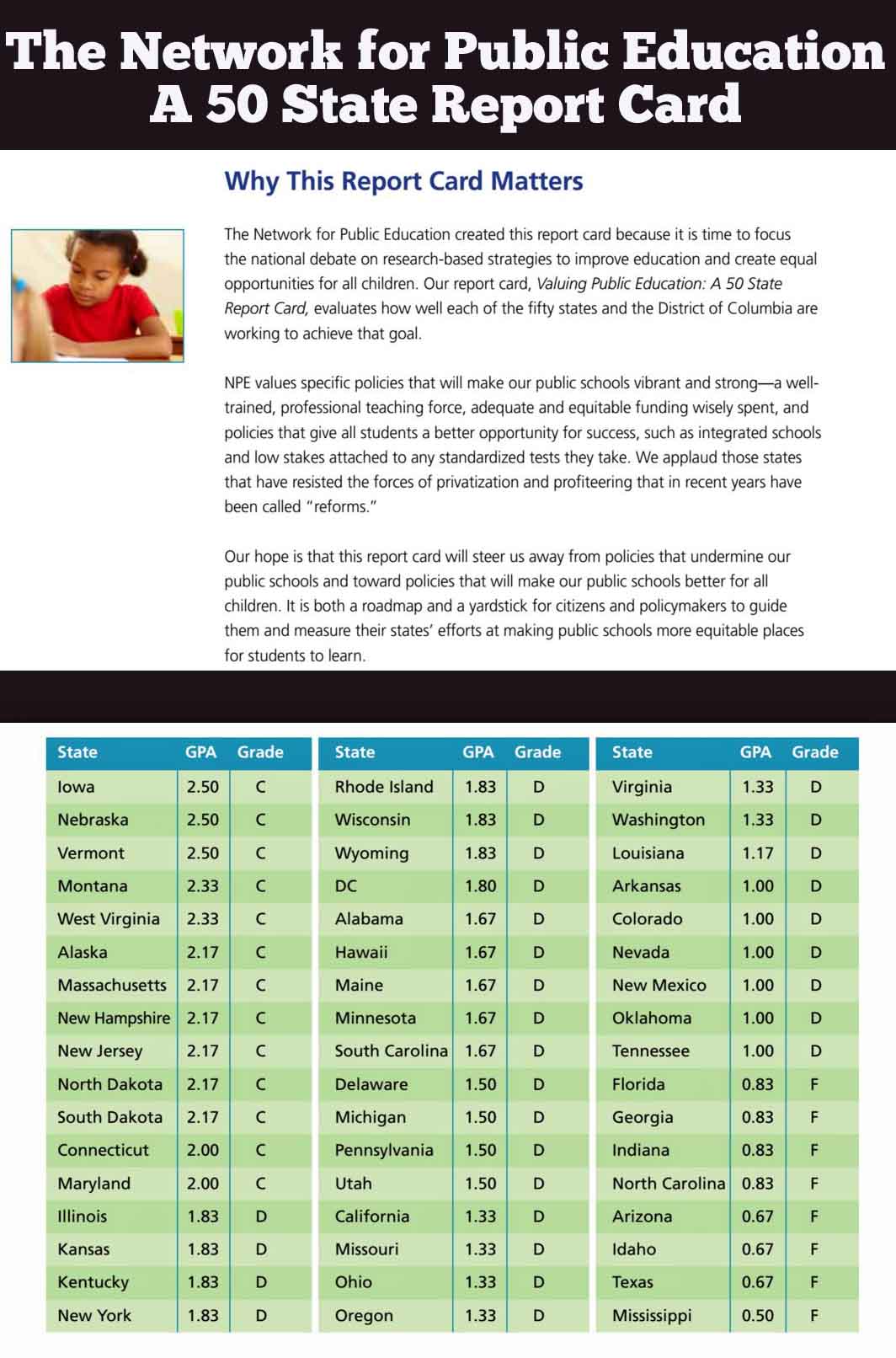
- To read the detailed 31 page report go to: The Network for Public Education’s A 50 State Report Card
Who do you think should pick the elected leaders of the United States?
My old friend did it again. He’s a good bellwether for far-right conservative thinking, because he is a born-again fundamentalist Christian, far-right libertarian who thinks abortion is murder and that women should be ruled by men because, well, women are women, and the Bible supports what he thinks. He reads far-right writers, and he watches and listens to far-right media. If he thinks something, you can easily guess where he is getting his ideas.
Anyway, he recently wrote in an e-mail: “You’ve probably heard Churchill’s comment on democracy – ‘It’s the worse form of government except for all the others.’ This can be said about money and elections also – ‘The rich are the worse ones to choose our leaders except for all others.’ Society can be looked at as composed of various groups – rich, poor, artists, criminals, theologians, those living on welfare, students, men, and woman – a…
View original post 1,227 more words
Stop writing your name in Cursive. You have had Several Warnings.
Megan Zander at She Knows wrote a post with this headline: Teacher’s aggressive note on 7-year-old’s homework goes viral, and many of the comments are critical of teachers and schools for what the alleged teacher wrote in red ink – the title of this post.
First, I was a public school teacher for thirty years, and I required my students to write their first and last name on every written assignment in addition to the period they were in and the date. When they didn’t write all that information, I wrote in aggressive red ink explaining to them why they lost some points from what the assignment was worth.
How can I justify being so aggressive? Well, I worked with almost 200 students in five or six classes often working 60 to 100 hours a week—25 hours teaching and the rest correcting work and planning lessons (not counting all the usually useless meetings teachers have to attend). All the work had to also be done in blue or black ink. Why would I have an aggressive rule like that? Well, the English department voted on it, and it was unanimous, because it made our jobs easier. Work written in pencil was more difficult to read and correct and teachers are correcting papers every night for several hours a night and on the weekends. To make sure my students knew this aggressive rule, there were large posters on the walls in my classroom reminding them that the work had to be done in blue or black ink, and I reminded them daily at the start of every written assignment.
For those reasons, when my students turned in work written in pencil, I wrote in aggressive red ink that if they wanted to earn credit for that assignment, they’d have to do it over in blue or black ink and turn it in the next school day.
Oh, and there were always kids who didn’t even bother to write their name on an assignment. Guess what happened to that work.
Without knowing all the details I will NOT condemn the ONE teacher who wrote that note in aggressive red ink or—for that matter—the entire education system in the United States.
Why am I refusing to rush in where so many fools have already gone?
The answer is simple—in the United States there are more than 3.5 million public school teachers, more than 15,000 public school districts in 50 states (the states are supposed to be responsible for public education—not the US Congress, the White House, a corporation or a CEO) teaching 50+ million children (not counting the territories), and to use this one incident to condemn everyone else in the public school systems that are not a monopoly is wrong on so many counts.
In fact, corporations build monopolies. Public schools with community based democratic school boards that are state controlled by 50 states are not monopolies. The public school system is made up of more than 15,000 individual school districts that are controlled by the local communities through elected democratic school boards that answer to the voters/parents.
- What kind of school did this teacher work for?
- What kind of teacher training did this teacher have—TFA, traditional or a full-time, yearlong urban residency?
- Was this teacher under contract or a substitute teacher with no teacher training?
- How many years has this teacher been in the classroom?
- Was the school an underfunded, transparent, community-based, democratic, non-profit public school, a private school, or an autocratic, opaque, boot-camp like (see Success Academy), for profit (no matter what you call the school) corporate Charter school paid for by taxpayers but allowed to do whatever the CEO/manager of the school wants behind closed doors, and if a parent complains, the child is often kicked out of the school?
- What state was it in—was it in Florida, Ohio or one of the other states where the public schools are under threat of a hostile takeover by corporate America?
If this teacher worked in a community based, democratic school, then there should be an elected school board and if those elected representatives, who are mostly parents from the same community, want to do something about the eleven words this teacher wrote in aggressive red ink, then they will, because that is the democratic process when it comes to public schools.
But if this child was in a corporate Charter school there is very little that can be done, because parents have no rights in those schools, teachers live in fear because they have no job protection, and these schools have no elected school boards to complain to. In corporate Charters if a parent doesn’t like the school, their child will often quickly find themselves out on the streets or back in an underfunded public school if there are any left.
A Brenda Hatcher seems to have spread this note on Facebook, and she alleges that the mother is a military veteran. I am also a military veteran. I served in the U.S. Marines and fought in Vietnam before I went to college on the GI Bill and eventually became a public school teacher for 30 years. I’d like to talk to this alleged military mother.
Megan Zander’s conclusion said, “After all, a child who’s willing to bend the rules in school could grow up to be the one who makes the rules.”
I shuddered at the thought that children who bend the rules will end up being our leaders.
I hope Megan might want to know why I shuddered at that thought. Megan, did you know that the professions with the most psychopaths in them are the ones who make the rules?
Which Professions Have the Most Psychopaths? The Fewest? – Time.com
- CEOs and lawyers belong to the profession with the most psychopaths alongside journalists and police officers.
- Teachers are on the list for the professions with the least number of psychopaths alongside nurses, doctors and charity workers.
Megan Zander is a former divorce attorney—a lawyer—turned SAHM to twin boys. She’s written for The Stir, Scary Mommy, Rare.us, Mommyish and Bustle.
______________________________
BLAME IT ON THE TEACHER AS USUAL
Lloyd Lofthouse is a former U.S. Marine and Vietnam Veteran, with a BA in journalism and an MFA in writing,
who taught in the public schools for thirty years (1975 – 2005).

To follow this Blog via E-mail see upper right-hand column and click on “Sign me up!”
Where should literacy start—at home or in school?
According to Zero to Three.org, “Literacy often begins early, long before children encounter formal school instruction in writing and reading. … Many young children begin to learn about writing and reading well before they start elementary school. ”
In addition, Parents.com says, “Reading is an addiction that parents should encourage well before their baby’s first birthday. … When you read to children, they’re getting your full attention, and that’s what they just love. Nothing—no TV show or toy—is better than that. Reading to babies is also a great way to immerse them in the sounds and rhythms of speech, which is crucial for language development.”
We also hear a lot in the media about Finland’s PISA ranking, and how great their public schools are, but where does literacy start in Finland for most children? Stuff4Educators.com says, “Finland has a completely transparent alphabet code and most parents teach their children to read pre-school, as it’s easy to do.”
In addition, Stanford University psychologist Brian Wandell said, “Historically, people have assumed that all children’s brains come adequately equipped and ready to learn to read,” just as with learning to speak, which occurs naturally without much training. But, he said, “Sometimes, there is a natural distribution of capabilities. Reading is probably the hardest thing we teach people to do in the education system. There are some kids who are just going to have a hard time.” – The DANA Foundation.org – Your gateway to responsible information about the brain.
But, surprise, surprise: “People who read ‘lots’ and fiction ‘lots’ outscore those who read ‘lots’ but fiction only ‘somewhat’ or ‘not much’. This is because a wider range of vocabulary is typically used in fiction than in non-fiction writing.” – Economist.com
However, the mandated Common Core language arts and literacy standards puts more emphasis on reading nonfiction even though we know that fiction uses a wider range of vocabulary and leads to a higher level of literacy and a higher level of literacy equal college and career readiness.
And that is why I have a problem with the term “school to prison pipeline”, and the corporate education reform movement that blames only teachers for children who are not college and career ready starting as early as kindergarten and the impossible NCLB mandate that 100% of 17-18 year olds be college and career ready before high school graduation—no country in the world has achieved this at any time, even Finland.
If there is a prison pipeline, it starts in the home and not in the schools and it is linked to literacy, because “75% of prison inmates are illiterate.” – Invisible Children.org
The BBC reports, “that falling behind at the very beginning of school can be the starting point for permanent disadvantage.”
Therefore, parents and/or guardians, if you want to help your child to be college and career ready and have a better chance to stay out of prison, start reading to your children early and don’t wait until kindergarten for teachers to do your job for you. Parenting is more than just giving birth, feeding the child and providing a TV to entertain the kids in addition to a place to sleep. Instead of letting your children become addicted to TV and texting, get them hooked on books before they start kindergarten. In fact, reading is a healthy addiction that every child should have starting at an early age.
_______________________
Lloyd Lofthouse is a former U.S. Marine and Vietnam Veteran,
who taught in the public schools for thirty years (1975 – 2005).

Lofthouse’s first novel was the award winning historical fiction My Splendid Concubine [3rd edition]. His second novel was the award winning thriller Running with the Enemy. His short story A Night at the “Well of Purity” was named a finalist of the 2007 Chicago Literary Awards. His wife is Anchee Min, the international, best-selling, award winning author of Red Azalea, a New York Times Notable Book of the Year (1992).
To follow this Blog via E-mail see upper right-hand column and click on “Sign me up!”
What would happen to the Corporate RheeForm War against Public Education in the U.S. if every American knew the few facts in this post?
Value Added Measurement (VAM) uses the results of student tests linked to the flawed Common Core Standards that are being forced on the nation’s public schools to punish teachers for students who–-for a variety of reasons that seldom if ever have anything to do with the actual teaching—are not learning.
In fact, VAM totally ignores the student learning factor and places ALL the blame on teachers when reputable studies have repeatedly proven that time spent in the classroom and teaching represents less than 30% of the factors that lead to a child’s learning. The other factors that make up two-thirds of what causes a child to learn takes place outside of school in the home/family environment, and poverty DOES play a vital role when it comes to a child learning what is taught by a teacher in the classroom.
Even the results of the International PISA tests prove that poverty is a major factor, and to make my point, I’m using several different reputable sources.
FIRST: A Stanford study found:
“There is an achievement gap between more and less disadvantaged students in every country; surprisingly, that gap is smaller in the United States than in similar post-industrial countries, and not much larger than in the very highest scoring countries.
“Achievement of U.S. disadvantaged students has been rising rapidly over time, while achievement of disadvantaged students in countries to which the United States is frequently unfavorably compared – Canada, Finland and Korea, for example – has been falling rapidly.
“U.S. PISA scores are depressed partly because of a sampling flaw resulting in a disproportionate number of students from high-poverty schools among the test-takers. About 40 percent of the PISA sample in the United States was drawn from schools where half or more of the students are eligible for the free lunch program, though only 32 percent of students nationwide attend such schools.”
SECOND: The Economic Policy Institute validated that the Stanford report was correct.
THIRD: Mel Riddle, the Associate Director for High School Services at NASSP (National Association of Secondary School Principals), compared the results of the PISA and focused on children who lived in poverty to discover that children living in poverty in the United States are improving and doing better than their socioeconomic peers in the other OECD countries.
Mel reported: “PISA results have provided ample fodder for public school bashers and doomsayers who further their own philosophies and agendas by painting all public schools as failing. For whatever reason, the pundits, many of whom have had little or no actual exposure to public schools, refuse to paint an accurate picture of the state of education.
“A closer look at the data tells a different story. Most notable is the relationship between PISA scores in terms of individual American schools and poverty. While the overall PISA rankings ignore such differences in the tested schools, when groupings based on the rate of free and reduced lunch are created, a direct relationship is established.”
FOURTH: The Center for Public Education looked closely at the time American children spent in school compared to other countries and asked and answered several questions.
For instance: Are students in India and China required to go to school longer than U.S. students?
According to data from the OECD and the World Data on Education, students in China and India are not required to spend more time in school than most U.S. students.
Do other countries require more instructional hours for students than the U.S.?
According to the OECD, the hours of compulsory instruction per year in these countries range from 608 hours in Finland (a top performer) to 926 hours in France (an average performer) at the elementary level, compared to the over 900 hours required in California, New York, Texas, and Massachusetts.
Are U.S. students receiving less instruction?
The data clearly shows that most U.S. schools require at least as much or more instructional time as other countries, even high-performing countries like Finland, Japan, and Korea.
In conclusion, I ask again: What would happen to the Corporate RheeForm War against Public Education in the U.S. if every American knew the few facts in this post?
_______________________
Lloyd Lofthouse is a former U.S. Marine and Vietnam Veteran,
who taught in the public schools for thirty years (1975 – 2005).
Lofthouse’s first novel was the award winning historical fiction My Splendid Concubine [3rd edition]. His second novel was the award winning thriller Running with the Enemy. His short story A Night at the “Well of Purity” was named a finalist of the 2007 Chicago Literary Awards. His wife is Anchee Min, the international, best-selling, award winning author of Red Azalea, a New York Times Notable Book of the Year (1992).
To follow this Blog via E-mail see upper right-hand column and click on “Sign me up!”
 Crazy Normal - the Classroom Exposé